
Ride Hailing Market: The App That Changed Movement
How ride hailing platforms are reshaping urban transport, convenience, and daily mobility
Hook Intro
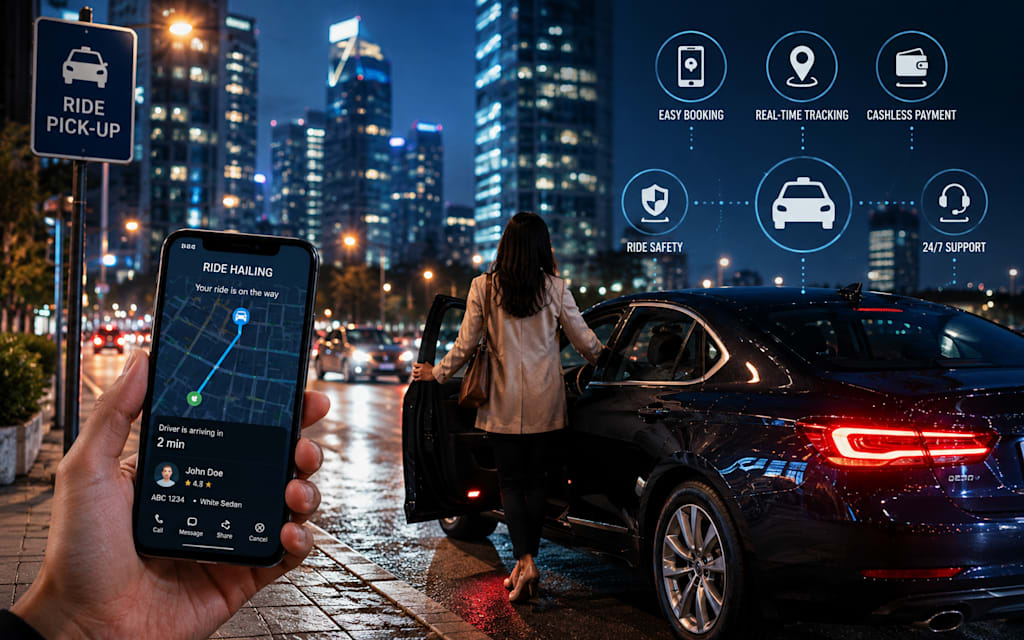
A woman leaves the office late at night. Instead of waiting on a crowded sidewalk searching for transport, she taps a button on her phone. Within minutes, headlights approach. Her ride has arrived before she even finishes checking the route.
That small moment has become part of daily life for millions of people worldwide. Ride hailing transformed transportation from a street side uncertainty into an on demand digital experience. Today, the Ride Hailing Market sits at the center of urban mobility, changing how people commute, travel, and think about vehicle ownership itself.
Why Ride Hailing Became Essential
Modern cities move fast. People expect transportation to be immediate, trackable, and flexible. Ride hailing platforms meet those expectations by connecting passengers and drivers through real time digital systems.
The appeal goes beyond convenience. Ride hailing reduces the stress of parking, lowers dependence on personal vehicles, and provides mobility access in areas underserved by traditional public transport.
According to Mordor Intelligence, the Ride Hailing Market size is expected to grow from USD 184.49 billion in 2026 to USD 392.27 billion by 2031, advancing at a compound annual growth rate of 16.29 percent. This growth reflects how deeply app based mobility has integrated into everyday transportation behavior.
Understanding Ride Hailing Market Share and Structure
The Ride Hailing Market share reflects diverse transportation needs across regions and demographics.
Passenger cars accounted for the majority of market share in 2025, supported by everyday commuting and airport transportation demand. At the same time, two wheelers are emerging as one of the fastest growing categories, particularly in densely populated cities where speed and affordability matter
App based bookings dominate the market because they combine route optimization, digital payments, and live tracking into a single experience. Personal users continue to account for most revenue, while corporate mobility programs are expanding rapidly as businesses replace traditional transport reimbursements with ride credits and app integrated travel systems.
Asia Pacific holds the largest Ride Hailing Market share due to high urban density, smartphone penetration, and large commuter populations. South America is emerging as one of the fastest growing regions as digital mobility platforms expand across urban centers.
Ride Hailing Market Trends Transforming Mobility
Several Ride Hailing Market trends are shaping the next phase of transportation.
• Electric vehicle integration: More ride hailing fleets are adopting electric vehicles to reduce operating costs and emissions.
• Autonomous driving development: Companies are exploring robo taxi services and self driving integrations.
• Corporate mobility programs: Businesses increasingly provide ride hailing credits instead of maintaining company fleets.
• Super app ecosystems: Ride hailing platforms are expanding into food delivery, payments, and multimodal transportation services.
These trends highlight how ride hailing is evolving from a simple transport service into a broader mobility platform.
This transition also strengthens the overall Ride Hailing Market analysis, where technology and transportation are becoming inseparable.
Challenges the Industry Still Faces
Despite rapid expansion, ride hailing companies face significant operational and regulatory challenges. Driver compensation models, data privacy concerns, cybersecurity risks, and local transportation regulations continue to shape market dynamics.
Profitability also remains a major focus. Companies must balance user affordability, driver earnings, and platform sustainability in increasingly competitive environments.
Traffic congestion presents another paradox. While ride hailing improves convenience, it can also increase vehicle density in urban centers if not integrated effectively with public transportation systems.
Ride Hailing Market Forecast and the Road Ahead
The Ride Hailing Market forecast points toward continued global growth as smartphone adoption rises and urban populations expand. Shared mobility is expected to become increasingly connected with public transit, electric mobility, and autonomous driving technologies.
Future ride hailing experiences may involve autonomous fleets, AI driven route optimization, and subscription based transportation packages that combine multiple mobility services into a single platform.
Ownership itself may gradually become less central in cities where mobility access is faster, cheaper, and more flexible through digital platforms.
About the Creator
Enjoyed the story? Support the Creator.
Subscribe for free to receive all their stories in your feed.
Comments
There are no comments for this story
Be the first to respond and start the conversation.