
Reimagining the Mouse Pointer for the AI Era: When the Cursor Stops Clicking and Starts Thinking
When the Cursor Stops Clicking and Starts Thinking

There was a time when the mouse pointer was revolutionary.
A blinking arrow that said: “You are in control.”
But let’s be honest with each other.
That arrow hasn’t changed much in over 50 years… while everything around it has gone full sci-fi.
We moved from desktop computing to cloud ecosystems. From static software to generative intelligence. From typing commands to talking to machines that now think back.
Yet the cursor—the very symbol of human-computer interaction—still behaves like it’s waiting for instructions in 1984.
That’s the problem.
And that’s exactly what the next wave of AI is coming to disrupt.
Not your apps.
Not your workflows.
But the way you point at reality itself on a screen.
The Real Bottleneck Was Never Intelligence. It Was Context.
Here’s the uncomfortable truth most tech builders avoided for decades:
AI wasn’t hard because machines couldn’t understand.
AI was hard because machines couldn’t see what you meant.
Every time you opened an AI tool, you had to perform a strange ritual:
Copy this
Paste that
Explain everything
Over-describe context
Translate your intention into machine language
In short: you had to leave your world and enter the AI’s world.
That’s backwards.
Because in real life, intelligence doesn’t work like that.
You don’t explain everything to a colleague before they understand what “this” means.
You point.
You gesture.
You say:
“Fix this.”
“Move that.”
“Explain this part.”
And somehow… they get it.
Because humans don’t rely on perfect instructions.
We rely on shared context.
The Cursor Is About to Stop Being Dumb
Now imagine this:
You hover over a building in a photo and say:
“Show me directions.”
No copying. No switching tabs. No opening maps.
Just intention → action.
That is the shift we are stepping into.
A new generation of AI-powered interfaces—like experimental work being explored with models such as Google’s Gemini—is transforming the cursor from a passive selector into an intelligent interpreter.
The cursor is no longer just pointing.
It is understanding.
The End of the AI Window Era
Let’s call out another inefficiency nobody likes to admit:
AI today still behaves like a destination.
You leave your document, your browser, your design tool… and you go to AI.
That creates friction.
And friction kills flow.
The new philosophy flips that entirely.
Instead of dragging your world into AI…
AI comes into your world.
Inside your browser. Inside your document. Inside your workflow.
This is exactly the direction being explored through AI-native browsing experiences like Chrome and experimental environments such as Google Labs.
The goal is not to make AI another tool.
The goal is to make it the ambient intelligence layer of everything you already do.
Four Principles That Change Everything
Behind this shift are four deceptively simple ideas.
But don’t be fooled.
Simple ideas are usually the ones that rewrite industries.
1. Maintain the Flow
Flow is sacred.
It is that psychological state where you stop switching tasks and start creating momentum.
Traditional AI breaks flow.
It forces detours, tabs, prompts, and context switching.
The next-generation pointer eliminates that.
Imagine:
Highlight a PDF → “Summarize this into bullet points”
Hover over a table → “Turn this into a chart”
Select a recipe → “Double the ingredients instantly”
No switching apps.
No rewriting context.
Just continuous motion.
Work becomes fluid again.
2. Show and Tell
Most AI systems today demand something unnatural:
Precision before understanding.
But humans don’t think like that.
We don’t describe everything in detail before acting.
We show.
We point.
We assume shared context fills the gap.
An intelligent cursor changes the game by absorbing:
What you’re pointing at
What surrounds it
What matters in that moment
So instead of writing:
“Summarize paragraph 3 of section 2 of page 14”
You simply point.
And the system already knows.
Because it sees what you see.
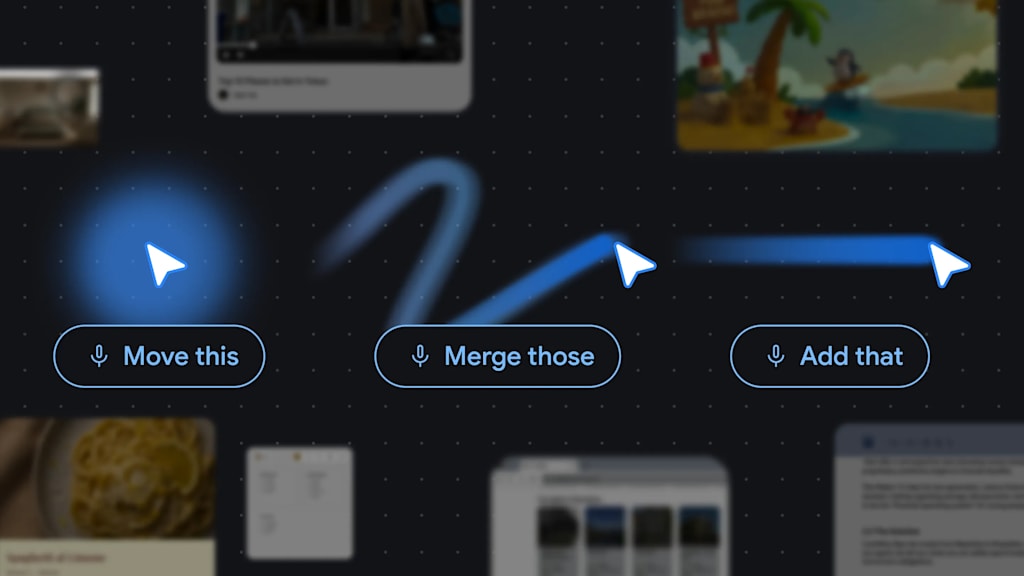
3. The Power of “This” and “That”
Language is already efficient when humans use it.
We say:
“Fix this.”
“Move that here.”
“What does this mean?”
We rely on gesture, tone, and shared attention.
Now imagine AI that understands that exact ambiguity.
No rigid prompting.
No technical instruction manuals.
Just natural shorthand conversation with context-aware intelligence.
That is the real breakthrough—not smarter machines, but more human interaction.
4. Turning Pixels Into Real-World Meaning
This is where things get truly disruptive.
Because until now, computers saw pixels.
AI sees entities.
Objects. Places. Actions. Meaning.
A scribbled note becomes a to-do list.
A paused travel video becomes a booking opportunity.
A photo of a building becomes a navigation target.
Screens stop being static surfaces.
They become interactive realities.
And once that shift happens, the cursor is no longer a pointer.
It becomes a bridge between imagination and action.
The Cursor Becomes a Co-Pilot
We are entering an era where computing stops asking:
“What do you want me to do?”
And starts asking:
“What do you mean by this?”
That difference is everything.
Because one forces you to translate.
The other understands you directly.
This is what experimental systems powered by Gemini inside Chrome are beginning to demonstrate.
You don’t search anymore.
You indicate.
You don’t type prompts.
You gesture intent.
You don’t explain context.
You exist within it.
The End of Software as We Know It
If this trajectory continues, software stops being something you open.
It becomes something that is already there.
Waiting.
Observing.
Assisting.
Your cursor becomes less like a tool and more like a conversational partner embedded in every digital surface.
And suddenly:
Spreadsheets explain themselves
Images become interactive
Documents become responsive environments
Websites become intelligent spaces
The interface disappears.
And intelligence becomes the interface.
Final Thought: We Are Teaching Computers to Understand “This”
Every technological revolution begins with a simple question:
What if we didn’t have to adapt to the machine anymore?
The AI-enabled cursor is one of those inflection points.
Because for the first time, we are not teaching humans to be more precise.
We are teaching machines to understand less precision, more meaning.
To understand:
“This.”
“That.”
Here.
Now.
In context.
And when that happens, the mouse pointer finally stops being a relic of the past…
…and becomes the first true citizen of the AI era.
About the Creator
Omasanjuwa Ogharandukun
I'm a passionate writer & blogger crafting inspiring stories from everyday life. Through vivid words and thoughtful insights, I spark conversations and ignite change—one post at a time.
Enjoyed the story? Support the Creator.
Subscribe for free to receive all their stories in your feed.
Comments
There are no comments for this story
Be the first to respond and start the conversation.