
Real-Time Ecommerce Data Extraction: Challenges & Solutions
Discover the biggest challenges in real-time ecommerce data extraction and explore practical solutions businesses use for accurate pricing, inventory, and competitor insights.

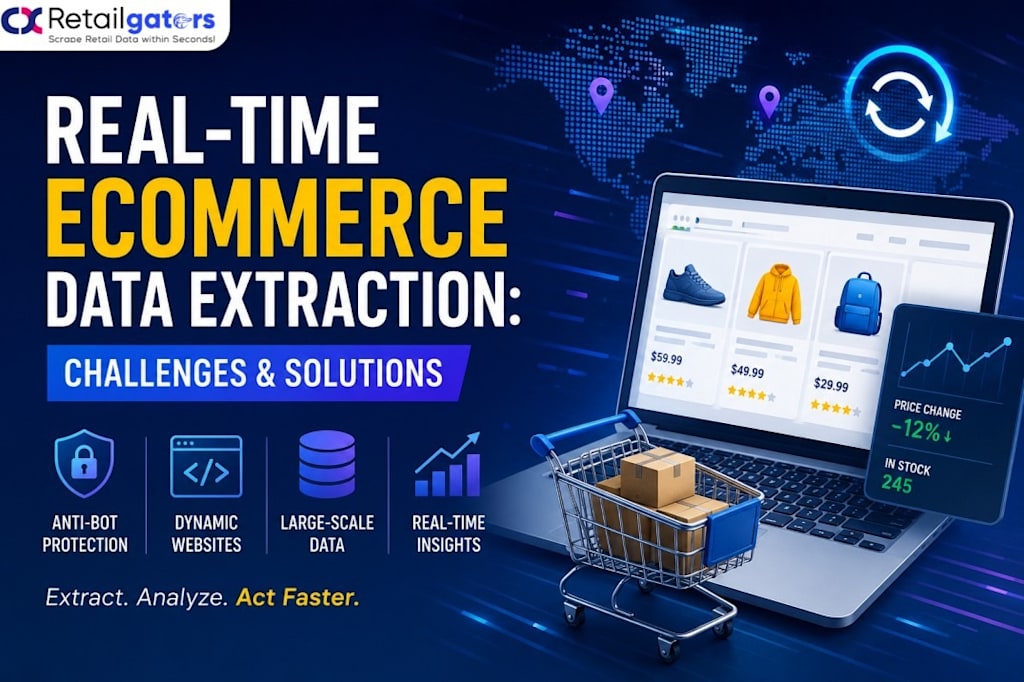
Ecommerce moves fast. Prices change within minutes, stock availability shifts constantly, and customer behavior evolves every second. For modern businesses, relying on outdated information is no longer an option. Companies now depend on real-time ecommerce data extraction to monitor competitors, track product availability, optimize pricing, and improve decision-making.
However, extracting ecommerce data in real time is not as simple as copying product details from a website. Ecommerce platforms have become more advanced, dynamic, and protected against automated data collection. Businesses often face technical barriers, data inconsistencies, IP blocking, and scalability issues during the extraction process.
Despite these challenges, companies that successfully collect and analyze ecommerce data gain a major competitive advantage. They can react faster to market trends, identify pricing opportunities, and improve customer experiences.
In this article, we will explore the key challenges businesses face in real-time ecommerce data extraction and the practical solutions used to overcome them.
Why Real-Time Ecommerce Data Matters
Online shoppers compare products across multiple platforms before making a purchase. Because of this behavior, ecommerce brands constantly adjust pricing, promotions, and inventory levels.
Real-time ecommerce data extraction helps businesses monitor these changes instantly. Instead of relying on manual research, companies can automate data collection from marketplaces, retail stores, and competitor websites.
This information supports several important business functions, including:
- Competitive price monitoring
- Inventory tracking
- Product trend analysis
- Customer sentiment monitoring
- Market research
- Dynamic pricing strategies
- Product catalog optimization
For example, if a competitor reduces product pricing during a flash sale, brands using real-time monitoring can quickly respond and stay competitive.
Major Challenges in Ecommerce Data Extraction
Although the benefits are clear, extracting ecommerce data in real time comes with several technical and operational challenges.
1. Anti-Bot Protection Systems
Most ecommerce platforms actively prevent automated scraping activities. Their systems are designed to detect unusual browsing behavior and block suspicious traffic.
- Common protection methods include:
- CAPTCHA verification
- IP blocking
- Rate limiting
- Browser fingerprinting
- JavaScript challenges
- Behavioral analysis
Websites like Amazon, Walmart, and Shopify-powered stores use advanced anti-bot systems to protect their data.
When scrapers send too many requests or behave unnaturally, websites can immediately restrict access.
Solution
Businesses use rotating proxies, browser automation tools, and human-like browsing techniques to avoid detection. Advanced scraping systems also simulate real user behavior, including mouse movement, random delays, and session management.
Using residential proxies instead of datacenter IPs also improves extraction success rates.
2. Dynamic Website Structures
Modern ecommerce websites constantly update their layouts, HTML structures, and APIs. A scraper that works today may fail tomorrow after a website redesign.
Many ecommerce platforms also load product information dynamically using JavaScript frameworks like React or Angular. Traditional scraping methods often fail to capture this content correctly.
Solution
Businesses now rely on headless browsers and rendering technologies like:
- Puppeteer
- Playwright
- Selenium
These tools render JavaScript content before extracting data, making it easier to collect dynamic product details accurately.
In addition, AI-powered scraping systems can automatically detect structural changes and adapt extraction rules without manual intervention.
3. Large-Scale Data Volume
Real-time ecommerce monitoring often involves millions of products across multiple marketplaces. Managing such large datasets becomes difficult without scalable infrastructure.
Data extraction systems must process:
- Product titles
- Prices
- Ratings
- Reviews
- Inventory levels
- Seller information
- Product variations
Collecting this data continuously can create performance bottlenecks.
Solution
Cloud-based scraping infrastructure helps businesses scale operations efficiently. Distributed scraping systems divide workloads across multiple servers, reducing downtime and improving speed.
Many companies also use queue management systems and parallel processing to handle large-scale extraction smoothly.
Data pipelines built on cloud platforms help organize, clean, and store massive ecommerce datasets in real time.
4. Inconsistent Data Quality
Ecommerce data is often messy and unstructured. Product names may vary across websites, categories can differ, and duplicate listings are common.
For example, the same smartphone model might appear with slightly different titles on different marketplaces.
This inconsistency makes analysis difficult.
Solution
Data normalization and enrichment processes help standardize extracted information. Businesses use machine learning algorithms to clean, classify, and organize product data.
Common data-cleaning practices include:
- Removing duplicates
- Standardizing units and formats
- Category mapping
- Product matching
- Seller validation
Accurate data processing improves reporting quality and business intelligence outcomes.
5. Real-Time Monitoring Complexity
Collecting data once per day is relatively simple. However, real-time monitoring requires continuous extraction without interruptions.
Ecommerce prices can change several times within a few hours. Flash sales and limited-time offers increase the need for instant updates.
Continuous monitoring creates additional challenges such as:
- Increased server costs
- Faster IP blocking
- Higher processing requirements
- Data synchronization issues
Solution
Businesses use event-driven architectures and smart scheduling systems to optimize extraction frequency.
Instead of scraping every page repeatedly, intelligent systems prioritize high-value products and monitor only relevant changes.
Incremental scraping techniques also reduce bandwidth usage and improve efficiency.
6. Legal and Compliance Concerns
Data extraction must follow legal and ethical guidelines. Some websites restrict automated access through terms of service policies.
Improper scraping practices may create legal risks or violate compliance regulations.
Solution
Businesses should implement responsible extraction practices and follow publicly accessible data policies. Many companies also work with professional ecommerce data providers that maintain compliance standards and ethical collection methods.
Legal consultation is recommended for enterprise-scale extraction projects.
Technologies Powering Modern Ecommerce Data Extraction
Modern ecommerce extraction systems combine multiple technologies to improve reliability and scalability.
Some commonly used technologies include:
AI and Machine Learning
AI helps identify website changes, improve product matching, and optimize extraction logic automatically.
Proxy Networks
Rotating residential proxies help avoid detection and distribute requests safely.
Cloud Infrastructure
Cloud platforms provide scalable processing power for large-scale data collection.
Browser Automation
Automation tools simulate real-user browsing behavior for accurate data extraction.
API Integration
Whenever available, APIs provide structured and reliable access to ecommerce data.
Business Benefits of Real-Time Ecommerce Data Extraction
Businesses investing in real-time ecommerce intelligence gain several long-term advantages.
Faster Pricing Decisions
Brands can react immediately to competitor pricing changes and market trends.
Better Inventory Planning
Real-time stock monitoring helps reduce overstocking and stockout situations.
Improved Market Intelligence
Businesses gain deeper visibility into customer demand, product trends, and seller performance.
Enhanced Customer Experience
Accurate product availability and pricing improve buyer satisfaction.
Stronger Competitive Positioning
Companies using live ecommerce data can adapt faster than competitors relying on manual analysis.
Final Thoughts
Real-time ecommerce data extraction has become essential for modern online businesses. From price monitoring to market intelligence, accurate and timely data helps companies stay competitive in a rapidly changing digital marketplace.
However, the process involves several technical challenges, including anti-bot protection, dynamic websites, scalability issues, and data inconsistency. Businesses that implement the right technologies and extraction strategies can overcome these obstacles successfully.
As ecommerce competition continues to grow, companies that leverage real-time data will make smarter decisions, respond faster to market shifts, and create stronger customer experiences.
In today’s data-driven ecommerce environment, speed and accuracy are no longer optional. They are the foundation of sustainable business growth.
About the Creator
Enjoyed the story? Support the Creator.
Subscribe for free to receive all their stories in your feed.
Comments
There are no comments for this story
Be the first to respond and start the conversation.