
Putin’s Great Victory Day Parade Was Cancelled by the War He Started
Russia scaled back its most powerful annual military display because it feared Ukrainian drone attacks over Moscow. That one detail tells you everything about how this war is really going.
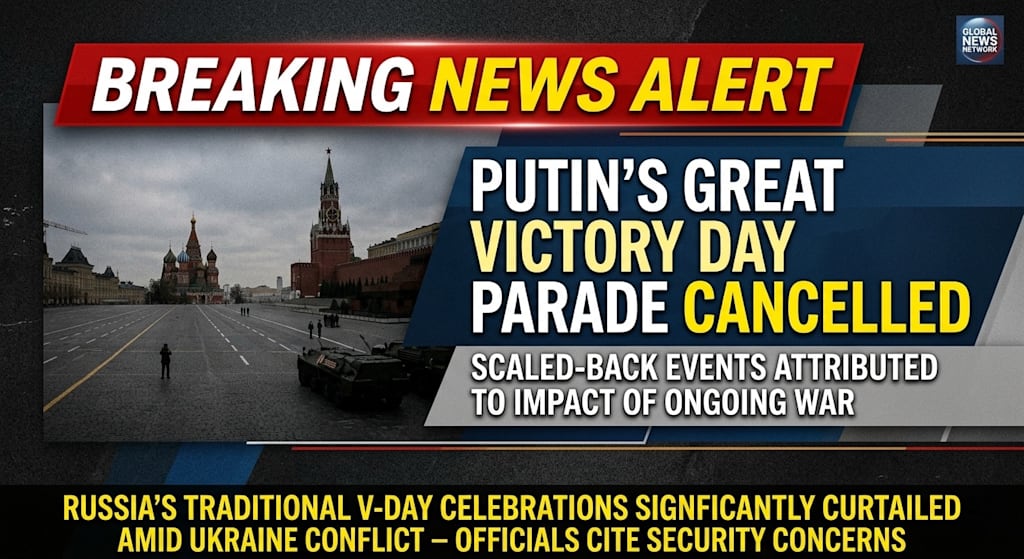
Every year on May 9, Vladimir Putin turns Moscow into a stage.
Victory Day is not merely a military parade. It is political theater, historical mythology, and national identity fused into one carefully choreographed spectacle. Tanks thunder across Red Square. Missile launchers glide past the Kremlin. Thousands of soldiers march in perfect formation beneath giant banners celebrating Soviet sacrifice and triumph. Fighter jets streak through the sky in patriotic colors while cameras broadcast the imagery across Russia and around the world.
For the Kremlin, the message has always been simple:
Russia is powerful. Russia endures. Russia wins.
But this year, the performance felt strikingly different.
The 2026 Victory Day parade was noticeably reduced in scale, stripped of much of the overwhelming military imagery that has defined the event for decades. Gone were many of the iconic displays of heavy armor and advanced missile systems that traditionally symbolize Russian military dominance. The spectacle was smaller, quieter, more cautious.
And that caution revealed something important.
Victory Day Is Russia’s Sacred Civic Religion
To understand why this matters, you have to understand what Victory Day means inside Russia.
Victory Day marks the Soviet Union’s defeat of Nazi Germany on May 9, 1945 — a victory achieved at horrifying human cost. Approximately 27 million Soviet citizens died during what Russians call the Great Patriotic War. Entire cities were destroyed. Families were erased. Generations were traumatized.
Unlike many national holidays rooted in abstract ideals, Victory Day is built on genuine historical suffering and sacrifice. It occupies a near-sacred place in Russian memory.
For decades, successive Russian governments have used the holiday not only to honor the dead but also to reinforce patriotism and national unity. Under Vladimir Putin, however, the symbolism became even more politically significant.
Putin increasingly framed modern Russia as the direct heir of Soviet wartime heroism. He portrayed contemporary geopolitical struggles — especially the war in Ukraine — as continuations of the historical fight against fascism and external threats.
In this narrative, Russia is never the aggressor.
Russia is always defending civilization.
That is why the parade matters so deeply. It is designed not only to celebrate history but to legitimize present-day policy.
The Fear Behind the Missing Tanks
This year’s scaled-back ceremony exposed an uncomfortable reality: even the Kremlin no longer feels entirely secure in the heart of Moscow.
Russian authorities reportedly reduced the display of major military hardware due to fears of Ukrainian drone attacks. The same weapons systems Russia once dismissed as minor irritations have now become capable of threatening symbolic events at the very center of Russian power.
That fact alone represents a remarkable shift in the war.
When Russia launched its invasion of Ukraine in February 2022, many analysts — including officials within Moscow itself — believed Kyiv could fall within days or weeks. Russian planners expected rapid regime collapse, swift territorial gains, and minimal long-term resistance.
Instead, the conflict evolved into a grinding, attritional war lasting more than four years.
Ukraine adapted quickly, turning drones, decentralized warfare, and Western military support into tools capable of imposing costs far beyond the battlefield. The war gradually exposed weaknesses in Russian logistics, intelligence coordination, troop morale, and industrial capacity.
Now, even symbolic ceremonies inside Moscow are shaped by those vulnerabilities.
The absence of tanks from Red Square was not merely a logistical adjustment. It was a visual acknowledgment that the war has fundamentally altered Russia’s sense of security.
Symbolism Matters in Authoritarian Systems
In democratic societies, political legitimacy often depends on elections, institutions, and public debate.
In highly centralized systems, legitimacy depends heavily on perception.
Strongman leaders cultivate images of control, inevitability, and strength. Public spectacles become essential political tools. Military parades, mass rallies, and carefully staged ceremonies communicate authority not just to foreign rivals but to domestic audiences as well.
That is why diminished symbolism can become politically dangerous.
A parade intended to project invincibility instead projected caution. An event designed to demonstrate overwhelming military confidence instead raised questions about vulnerability. Even ordinary Russians reportedly noticed the contrast between previous years and this year’s restrained display.
And once public perception shifts, it becomes difficult to fully reverse.
The Trump Factor and the Diplomatic Irony
Perhaps the deepest irony of this year’s Victory Day is who dominated the global conversation surrounding it.
Instead of Vladimir Putin using May 9 to command international attention, it was Donald Trump who seized the narrative by announcing a Ukraine ceasefire initiative timed precisely to the holiday.
The symbolism was impossible to miss.
Victory Day is supposed to be Putin’s moment — the annual reaffirmation of Russian strength and historical destiny. Yet this year, global headlines focused less on Moscow’s military spectacle and more on diplomatic maneuvering originating outside Russia.
The ceasefire itself remains fragile. Negotiations over territories like Donetsk remain deeply contested. Neither side appears ready for a comprehensive settlement, and many analysts believe the pause in fighting could collapse at any moment.
But symbolism often outlasts policy details.
The image of a reduced parade, stripped of some of its traditional grandeur, will likely linger longer in public memory than official speeches or diplomatic statements.
What Leaders Choose Not to Show
Authoritarian governments are often extremely careful about what they display publicly.
That is why omissions matter.
When missile launchers disappear from Red Square, when military hardware is minimized, when ceremonies become visibly constrained by security fears, observers begin asking deeper questions about the true condition of the state behind the spectacle.
Power is not only measured by what a country can project.
Sometimes it is measured by what it no longer feels safe enough to display.
And on Russia’s most important national holiday, that silence may have spoken louder than the parade itself.
About the Creator
Enjoyed the story? Support the Creator.
Subscribe for free to receive all their stories in your feed.
Comments
There are no comments for this story
Be the first to respond and start the conversation.