
Powder Coating vs Traditional Finishes: Which Is More Sustainable for Melbourne Projects?
Powder Coating vs Traditional Finishes
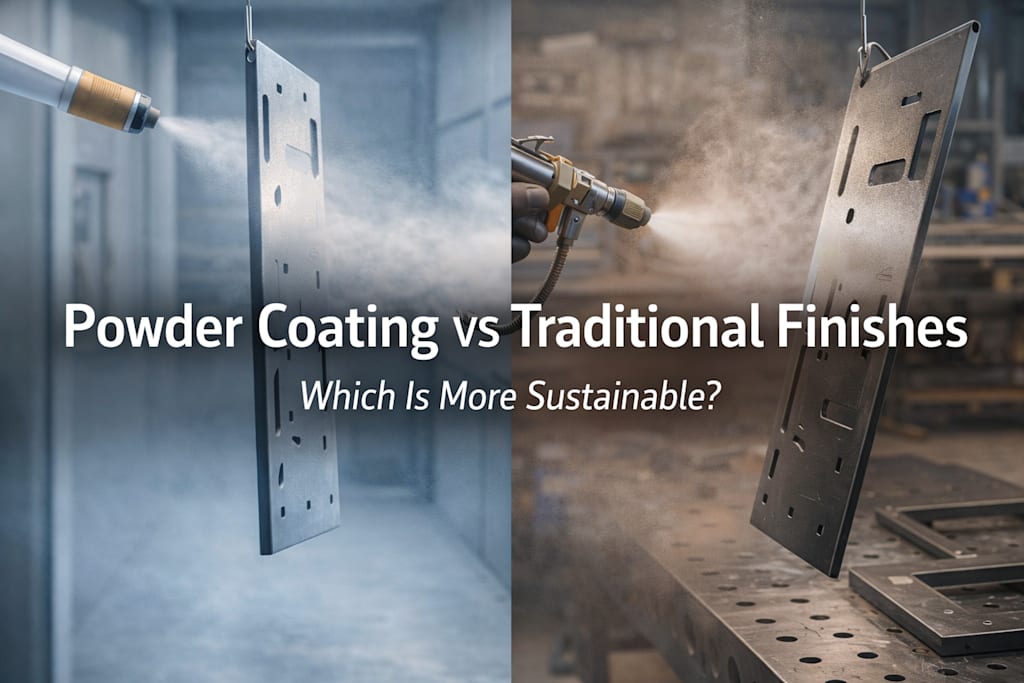
Choosing the right metal finish is one of those decisions that seems straightforward until you start asking the right questions. Cost, appearance, and durability are the obvious factors. But sustainability? That one often gets pushed to the back of the queue. If you're a Melbourne business owner, builder, or project manager weighing up powder coating vs traditional finishes, this article breaks down what actually matters for the environment, your budget, and the long-term life of your metalwork.
And no, it's not as simple as "powder coating always wins."
What Are We Actually Comparing?
Before picking a side, it helps to understand what each method involves.
Powder coating is a dry finishing process. An electrostatically charged powder is applied to a metal surface, which is then cured in an oven at high heat. No liquid, no solvent carrier. The result is a hard, seamless finish that bonds directly to the metal.
Traditional finishes cover a broader family: liquid paint, solvent-based coatings, oil-based enamel, epoxy primers, and HVLP (high-volume, low-pressure) sprayed finishes. These have been the industry standard for decades, and for good reason — they're versatile, widely available, and effective in the right conditions.
Both methods have their place in Melbourne's steel fabrication, structural metalwork, and architectural fit-out sectors. The question is which one carries a lighter environmental footprint over the life of a project.
The Sustainability Breakdown: Where Each Method Stands
VOC Emissions: A Clear Gap
This is where the difference becomes difficult to ignore.
Traditional liquid finishes release Volatile Organic Compounds (VOCs) during application and drying. VOCs contribute to air pollution and are regulated under Australian EPA guidelines. On a large commercial project, the cumulative VOC output from solvent-based coatings can be substantial enough to require specific ventilation controls and environmental compliance reporting.
Powder coating, by contrast, releases near-zero VOCs. There's no solvent evaporation because there's no solvent involved. For Melbourne businesses operating in industrial zones or near residential areas, this distinction matters — both for regulatory compliance and community relations.
Material Waste: The Numbers Tell the Story
Here's something most people don't realise about liquid paint: up to 30–40% of the material can be lost as overspray during application. That overspray either lands on surrounding surfaces or gets extracted as hazardous waste.
Powder coating works differently. Overspray is captured electrostatically and can be recycled back into the process. Transfer efficiency in professional powder coating setups regularly exceeds 95%. That's a meaningful reduction in both material consumption and waste disposal costs.
Water and Solvent Use
Traditional wet finishing often involves solvent-based cleanup — thinners, degreasers, and rinse water that becomes contaminated and requires proper disposal. This generates ongoing waste streams that need careful management.
Powder coating requires no solvents during cleanup. This simplifies waste handling and reduces the environmental risk associated with solvent storage and disposal on-site.
Energy: A More Nuanced Picture
This is where powder coating's sustainability story gets more complex. Curing an oven load of powder-coated steel requires significant energy. On a small batch, the energy cost per item can be higher than a single coat of liquid paint applied at ambient temperature.
That said, powder coating typically achieves a consistent finish in a single pass. Many traditional coating systems require multiple coats with drying time between each layer — primer, undercoat, topcoat — which adds up in both time and energy consumption across the full process.
Durability Is Sustainability in Disguise
This is a perspective worth sitting with.
A metal finish that lasts 15 to 20 years generates far less environmental impact over time than one that needs recoating every four or five years. Each recoat cycle means more materials consumed, more waste produced, and more labour and transport involved.
Powder coating's hard, seamless surface resists chipping, UV degradation, and corrosion exceptionally well. Melbourne's climate — coastal salt air in bayside suburbs, intense summer UV, cold and damp winters inland — puts outdoor metalwork under real pressure. A well-applied powder coat handles those conditions with minimal maintenance.
Traditional finishes can perform well in controlled or interior environments, but outdoor applications often require topcoat maintenance cycles that add up over a decade of service life.
When you calculate the total environmental cost as application footprint plus maintenance footprint over the product's lifetime, powder coating's advantage becomes considerably stronger.
When Traditional Finishes Still Make Sense
Honest advice means acknowledging where traditional finishes remain the right call. A good fabricator will tell you this without hesitation.
There are situations where powder coating simply isn't the most practical option:
- Structural steel is too large for a curing oven. Site-welded assemblies and long-span beams often can't be moved into a powder coating facility after fabrication.
- Field touch-ups and repairs. If a powder-coated surface is damaged on-site, liquid paint is the only realistic way to address it.
- Specialty coatings. Intumescent fire-resistant finishes, anti-graffiti coatings, and certain marine-grade systems require traditional chemistry that powder coating cannot replicate.
- Complex colour-matching or decorative effects. Some architectural applications demand finishes that liquid paint handles more flexibly.
The takeaway here is that the most sustainable choice is the one that's right for the job. Defaulting to powder coating on every project without considering the application context isn't expertise — it's just a habit.
5 Questions to Ask Your Fabricator Before Choosing a Finish
If you're planning a steel fabrication or metalwork project in Melbourne, these questions will help you make a smarter decision:
- What are the VOC and EPA compliance implications of this finish for my specific project scope?
- Will the finished components be used indoors or outdoors, and what are the UV and corrosion demands of that environment?
- What is the realistic service life of this finish, and what does recoating involve?
- Are my fabricated components suitable for powder coating based on their size, geometry, and alloy?
- Does your team have documented, hands-on experience with the finish type you're recommending?
Swift Metal Fabrication, with 55 years of combined experience across Melbourne's steel and metal industry, work through these process with clients before any coating decision is made. Getting the finish right the first time isn't just good workmanship — it reduces waste, lowers lifecycle costs, and reflects a genuinely responsible approach to the built environment.
The Sustainable Choice Requires Asking Better Questions
Powder coating leads in most sustainability metrics. Lower VOC output, minimal material waste, no solvent use, and superior long-term durability make a compelling case, especially for Melbourne's demanding outdoor conditions.
But traditional finishes retain a legitimate role in specific applications, and the most experienced fabricators know when each method is appropriate.
The real shift in thinking is moving from "which finish looks good now?" to "which finish causes the least harm over the full life of this project?" That's a question worth asking before the first coat is ever applied.
About the Creator
Swift Metal Fabrication
Swift Metal Fabrication is a Melbourne-based metal fabrication company delivering precision-driven solutions. With over 55 years of combined industry experience, we specialise in sheet metal work, laser cutting, and light engineering.
Enjoyed the story? Support the Creator.
Subscribe for free to receive all their stories in your feed.
Comments
There are no comments for this story
Be the first to respond and start the conversation.