
Planning Bridge Production With Vacuum Casting Before Investing in Injection Molds
The period between a successful prototype and a stable production design can be awkward.

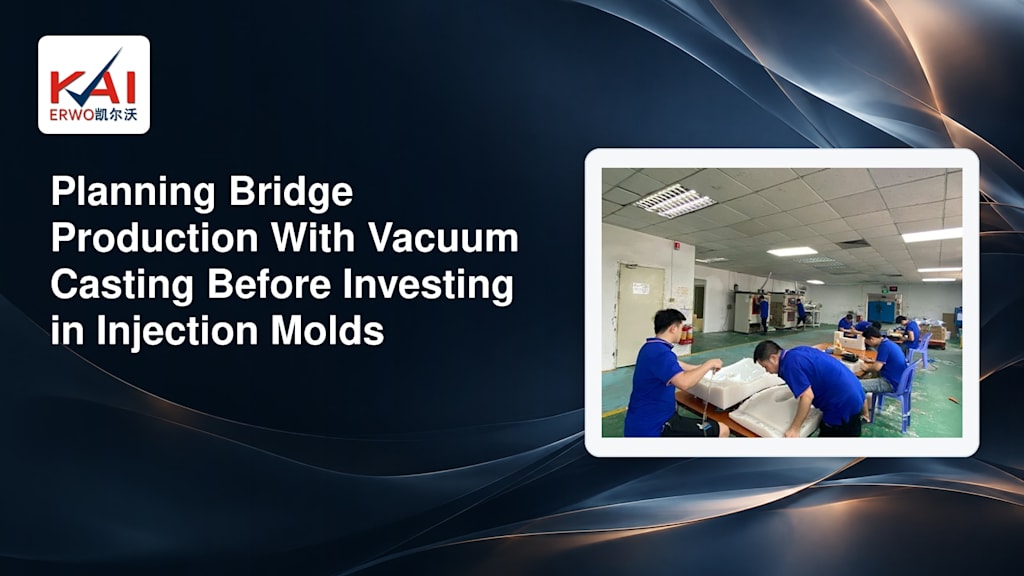
A team may need parts for pilot assemblies or demonstrations while important details are still changing. Ordering permanent tooling too early can turn those changes into expensive commercial decisions.
Bridge production is best treated as a defined development stage, not an informal extension of prototyping. Vacuum casting may suit some short-run plastic part needs, but the order should have a purpose, an endpoint, and a clear relationship to the intended production process.
Define What the Interim Batch Is Allowed to Prove
Write down the questions that must be answered before production tooling is approved. These might concern assembly sequence, component access, packaging fit, or the way users handle an enclosure. Separate those questions from properties that depend on the final material or manufacturing method.
Formlabs describes vacuum casting as a route for making copies using a master and silicone molds. That helps explain its relevance to an interim batch, but it does not establish equivalence with injection-molded production parts.
A cast housing can provide useful assembly feedback while leaving long-term material performance unresolved. State that boundary in the review plan. Otherwise, a convenient interim process can quietly become the basis for conclusions it was never intended to support.
Establish a Release Gate Instead of a Calendar Promise
The end of bridge production should depend on evidence, not just the date on a project schedule. Identify the information required to approve the next manufacturing stage and assign responsibility for reviewing it.
NASA's technology readiness framework links maturity to demonstrated evidence. The useful purchasing lesson is modest: a completed prototype batch does not, by itself, show that every production risk has been resolved.
Keep changes visible throughout the bridge run. Classify them as design corrections, cosmetic refinements, or production-process requirements. A change affecting an assembly interface may require another fit review; a change intended for injection molding may require different manufacturing feedback altogether.
Keep Interim and Production Requirements Side by Side
A transition record makes it easier to avoid carrying an assumption from one process into another.
Transition Item
Interim Batch and Production Question
Material
What is used now and what must be confirmed later
Geometry
Which interfaces are frozen and which remain provisional
Appearance
Which reference applies to each manufacturing stage
Evidence
Which reviews this batch supports and which it cannot support
Change control
Who approves revisions during the interim run
Exit gate
Conditions for moving to production tooling
For a project using a vacuum casting service, a low volume vacuum casting manufacturer can be asked to quote the interim scope independently of the future production forecast. This gives the buyer a clearer view of what is being purchased now and which later requirements still need a separate review.
Avoid presenting the bridge quantity as an open-ended commitment. Decide whether a repeat order would require another sample approval, a new master, or a review of the existing manufacturing instructions.
Protect the Handoff to the Next Process
The transition package should include findings, not merely the latest geometry files.
• Name the decision owner for the production release gate.
• Record which properties remain unverified by the interim parts.
• Maintain a revision log during the bridge batch.
• Preserve assembly findings that affect future tooling.
• Confirm repeat-order assumptions before requesting more parts.
When reviewing Kaierwo as a possible development partner, discuss the manufacturing stages separately. A supplier offering several processes can be useful, but each stage still needs an agreed brief and acceptance criteria.
Frequently Asked Questions
Does bridge production always reduce total project cost?
No. Its value depends on the decisions it supports and the work it prevents or enables. Compare the interim scope with realistic alternatives rather than assuming a saving.
Can the bridge design be transferred directly to injection molding?
Not without review. The intended material, tooling approach, and manufacturing requirements may call for changes to the design or specification.
What if the final production quantity is still uncertain?
Keep the bridge order tied to a defined review need. Document the forecast separately and revisit it when planning the production route.
Before commissioning an interim batch, create a one-page exit plan. List the evidence needed, the limitations that remain, and the person responsible for approving the next manufacturing stage.
About the Creator
Enjoyed the story? Support the Creator.
Subscribe for free to receive all their stories in your feed.
Comments
There are no comments for this story
Be the first to respond and start the conversation.