
Pagoda Lost 700 Million Yuan in Two Years. The High Prices Stayed. The Trust Didn't.
The fruit chain that promised refunds for bad taste is now losing customers to group chats, Sam's Club, and the shop 150 meters away.
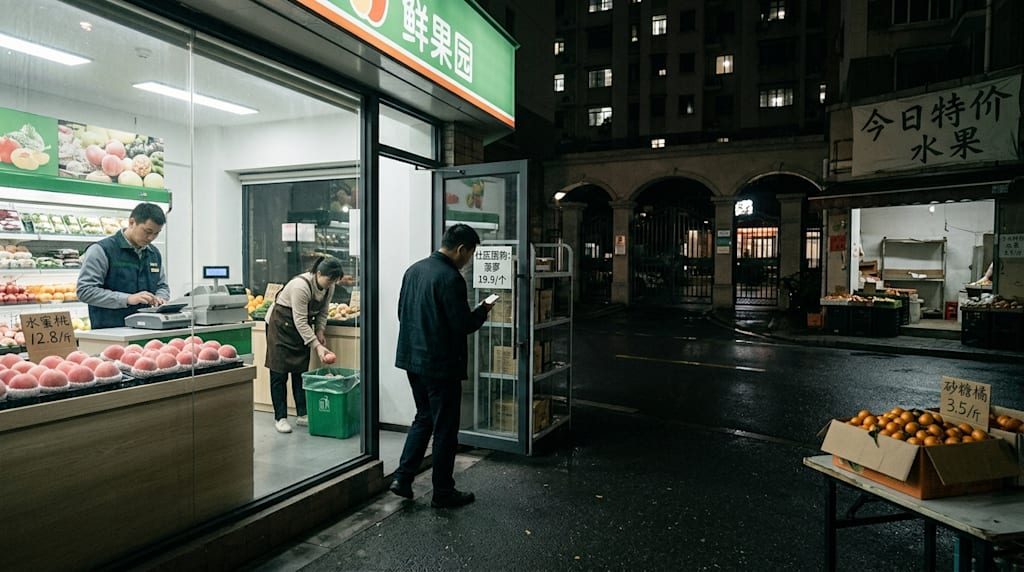
At seven in the evening, outside a residential compound in Hangzhou. The Pagoda light box was on. A clerk lined up peaches. One peach weighed in at 12.8 yuan. In a community group-buying chat, a message popped up: Hainan Golden Diamond pineapple, 19.9 yuan each, arriving tomorrow. A customer stood at the entrance, glanced at the price board, turned, and walked toward the package rack in the compound.
That moment explains Pagoda's 700 million yuan loss over two years.
How it grew
In 2001, Pagoda started in Shenzhen. In 2009, it introduced "Three No Returns for Bad Taste": no receipt, no physical product, no reason required. If the fruit was not sweet, even if it had been cut and eaten, you could get a refund.
Fruit retail back then was roadside stalls, independent shops, and large supermarkets. The same fruit could be sweet at one place and sour at another. If you bought bad fruit, you blamed yourself. Pagoda used its brand to remove the blind-box anxiety. It was the Pang Dong Lai of fruit, trading trust for a premium.
In 2012, its tenth anniversary, it had 300 stores nationwide. In 2015, it passed 1,000 stores and raised a 400 million yuan Series A. In 2021, its twentieth anniversary, it passed 5,000 stores. In 2023, it listed in Hong Kong. Store count peaked at 6,093.
A reporter in a downtown Hangzhou Pagoda heard a clerk pitch it: "Our head office has fruit bases. We don't worry about ordering. We just sell." The tone had the confidence of someone inside the system.
That confidence came from price. Pagoda priced fruit 10% to 30% above nearby shops. Quality fruit was not common then. Consumers paid the premium.
When price became the complaint
In August 2025, founder Yu Huiyong responded to "fruit is too expensive" by saying: "We will not cater to consumers. We are educating consumers to mature."
The remark ignited public opinion. Netizens mocked: "Eating fruit requires being educated now? The last one this arrogant was Zhong Xue Gao."
This afternoon, at a Pagoda in downtown Hangzhou. The clerk pitched peaches. The sample tasted good. The price made people hesitate. One peach cost 12.8 yuan. A box of blueberries cost more than 24 yuan. The clerk explained: "Although our prices are high, our quality is good. Outside may be cheaper, but our fruit is big and sweet. You have to compare to know."
A hundred and fifty meters away, an independent fruit shop had promotion signs across its entrance. The reporter bought five tangerines for 3 yuan. The owner said: "We don't have brand rules. Discount times and amounts are up to us. Most categories sell cheaper than Pagoda."
Ms. Xu used to go to Pagoda often. Now her compound has a group-buying group. Fruit is left at the gate. Sometimes the family goes to Sam's Club and buys by the box. The price is okay, and the quality is good.
Pagoda's 2025 financial report showed membership fee revenue fell 53% year-on-year. Sam's Club, Hema, and roadside fruit shops were taking its customers.
The franchise model
Pagoda made money in the past. Its franchise model was a big reason.
The brand sends goods to franchisees and books revenue. Whether the franchisee sells them is not the brand's direct burden. During the consumption upgrade, franchisees made money, and everyone was happy. In a downturn, franchisees cannot make money, so they cut costs.
The cuts are direct: keep selling poor-quality products, or tamper with the scale. In 2024, media exposed Pagoda stores passing rotten fruit off as good. The Three No Returns service was adjusted. The company bears 60%, the franchisee 40%.
The brand wants to protect its quality image. The franchisee wants to survive. Their demands collided in the downturn. Consumers trust the word "Pagoda," but the person handing over the fruit is the franchisee. When the franchisee sacrifices quality, the brand promise is hollowed out.
In 2025, Pagoda's revenue was 8.174 billion yuan, down 20.4% year-on-year. Gross margin was 7.3%. Sell 10 yuan of fruit, and gross profit is just over 0.7 yuan, before rent, labor, and loss. Franchise store sales were 5.912 billion yuan, down from 7.396 billion yuan in 2024, a drop of 20.1%.
Wanting both
Facing decline, Pagoda repositioned as a "high-quality and high-value-for-money fruit expert and leader."
Consumers read high quality as expensive. They read high value for money as cheap and practical. Emphasize both, and the message fights itself. Buyers of high-end fruit think you are not high-end enough. Bargain hunters think you are still too expensive.
In 2025, the "Good Fruit Repayment" promotion ran 22 times. Cumulative sales exceeded 500 million yuan. It drew more than 29 million store visits. WeChat community groups reached 32,200. Total members across channels reached 95.3 million. In the second half of 2025, net profit attributable to shareholders turned positive at 25 million yuan. In the first half of 2026, revenue was 5.008 billion yuan, up 14.5% year-on-year. Net profit attributable to shareholders was 33.564 million yuan. Gross margin recovered to 12.2%.
Average daily sales per store fell from 5,168 yuan to 3,824 yuan. The turnaround relied on closing stores, not on improving per-store efficiency. That recovery is fragile.
A brand can stand for one core value. Trying to own both "high quality" and "high value for money" often pleases neither side.
Acquiring Wangpi Matou
Pagoda invested to control the hard-discount supermarket Wangpi Matou.
The logic: the main brand cannot cut prices sharply because of its high-end positioning. A discount store can use lower prices to capture price-sensitive shoppers.
A discount store solves a channel problem, not a perception problem. Pagoda's real problem is that consumers no longer believe in its high prices. The quality promise behind the word "Pagoda" no longer supports prices above the market. Opening a discount store and selling cheap fruit under another name does not repair the main brand.
Discount stores are already crowded. Wangpi Matou has more than 300 stores. Dai Yonghong has more than 1,000. Ai Snacks has more than 2,000. Mingming Busy Group has more than 26,000. Pagoda's gross margin is 7.3%. There is little room to cut further.
In the first half of 2026, Pagoda worked with retail brands and provided supply chain services. The turnaround mainly came from partner distribution. Acquiring a store for distribution is not a strong reason. Another possibility is that Pagoda wanted to invest early in a company that might list. Snack volume retail and hard discount were hot for a while. After snack volume retail listed, prices were no longer cheap either. Hard discount is a price war.
Fruit retail rarely produces giants
The three fruit giants: Xianfeng Fruit, Pagoda, and Hongjiu Fruit.
Xianfeng Fruit failed to list in recent years and faces an equity freeze. Hongjiu Fruit, the "first fruit stock" focused on B2B distribution, was delisted from the Hong Kong Stock Exchange at the end of 2025 after financial report problems. Pagoda lost 700 million yuan in two years.
Fruit is fresh produce. It has a short shelf life and spoils easily. From picking, transport, storage, to shelf, every link can create loss. Industry data shows fruit retail loss rates run from 35% to 45%. Buy a batch, and 30% to 40% may be thrown away. Those losses go into the price. Even Dole, the global fruit distribution leader, has a gross margin under 10%.
Independent fruit shops survive not because their quality is better. They have no brand profit share, no franchise fee, and no headquarters control costs. They can set prices flexibly and react fast.
Pagoda's problem is that its model is failing in a new era.
The way out
Pagoda should drop "high value for money" and return to "high-quality fruit expert."
High quality does not equal high price. High quality should be verifiable, perceptible, and stable. Consumers are not unwilling to pay for quality. They are unwilling to pay for uncertain quality.
First, align the interests of the brand and franchisees. The franchise model itself is not the problem. The problem is that the brand only supplies goods. It does not manage sell-through. Stricter quality checks. A fairer return cost-sharing system. A supply plan based on each store's profitability. Franchisees must make money before the quality promise can hold.
Second, make quality visible and testable. "Tasty" is vague. Label sugar content, origin, and harvest time. Then consumers can understand why a peach costs 12.8 yuan.
Third, accept a smaller footprint. Focus on store quality. Shrinking from 6,093 stores and closing more than 1,600 was painful but right. The next step is to improve the store model, not rush back into expansion.
In fruit, "good" and "cheap" are hard to do at the same time. Choose "good": accept a smaller scale and rebuild the quality promise. Choose "cheap": rebuild the supply chain and store model, and accept a different competitive logic. Swinging between the two will burn the trust that is left.
At nine in the evening, at a Pagoda store. The clerk takes a softened peach from the shelf and throws it into the trash. Behind the register, the franchisee presses a calculator. In the phone, the group-buying chat pops up again: "Arriving tomorrow, Golden Diamond pineapple, 19.9 each." A customer passes by, glances at the price board, and keeps walking. The light box is still on.
About the Creator
Jin
Writer of reamstories
https://reamstories.com/jin
Enjoyed the story? Support the Creator.
Subscribe for free to receive all their stories in your feed. You could also become a paid subscriber, letting them know you appreciate their work.
Comments
There are no comments for this story
Be the first to respond and start the conversation.