
Optimizing Revenue Performance Through Strategic AR Resolution in Healthcare
The Role of AR Recovery in Modern Revenue Cycle Management
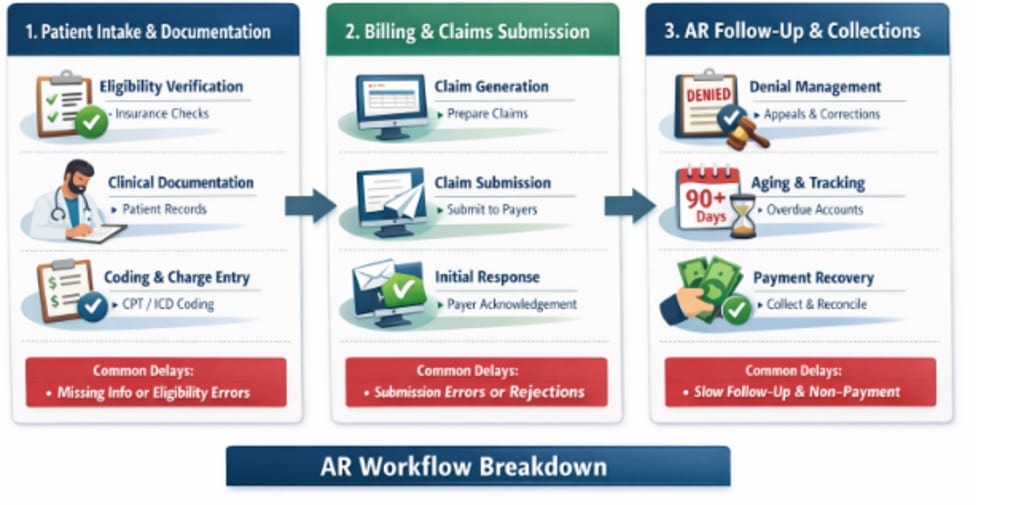
Navigating healthcare reimbursements is feeling like trying to hit a moving target—it gets more complicated every year, and honestly it dont seem to slow down. When rules are always changing, even a small hiccup in your billing process can quickly turns into a major financial headache.
From my own experiance working with billing teams, I have seen how one missed claim or delayed follow-up can creates a chain reaction of losses. It’s not always obvious at first, but over time the impact becomes huge.
While there are many moving parts to Revenue Cycle Management, Accounts Receivable (AR) Recovery is often being treated like a back-end task. But it shouldn’t be. It is more like a strategic lever that helps you get paid what you are actually owed—on time.
A smart AR strategy will:
- Helps identify where process is breaking
- Finds repeated denials that keeps happening
- Stops revenue leaks before it’s too late
- Improves cashflow (or cash-flow, depends how you write it)
For any hospital or clinic, a strong AR framework is making the difference between unstable finances and steady income.
Why AR Recovery is a Strategic Priority
With margins getting thinner and admin work piling up, the “wait and see” approach just doesn’t works anymore. Being reactive in Accounts Receivable usually leads into several issues:
- Bloated AR Days: Cash stays stuck instead of coming in
- Write-offs that could be avoided: deadlines gets missed
- Unresolved denials: money is just sitting there uncollected
- Staff burnout: teams are doing too much manual work
I remember one organization where AR days were over 120, and nobody was really tracking it properly. Once they started focusing on recovery, things was improving within months.
Systemic Challenges to AR Efficiency
In real-world practice, there are always some common roadblocks that slows everything down.
Key issues includes:
- The Expiration Trap: claims older than 90–120 days becomes harder to collect
- Denial Surge: small errors like wrong coding or missing docs creates big problems
- Disconnected Systems: data is everywhere, but nowhere at same time
- Payer Policy Changes: insurance rules keeps changing without much notice
Sometimes it feels like you are chasing a moving goalpost, and by the time you fix one issue, another one already appears.
Actionable Strategies for Improving AR Outcomes
To really improve results, organisations should be taking a more structured and focused approach instead of random follow-ups.
Effective strategies includes:
- Smart Segmentation
- Not all claims are equal, some needs urgent attention. Grouping helps prioritise better.
- Root-Cause Fixing
- Instead of reworking same denial again and again, teams should identify why it’s happening in first place.
- Standard Follow-Ups
- Having a proper process (or SOP) ensures consistency and better outcomes.
- Data Visibility
- When you are using analytics, you can see where problems is happening early.
- Team Accountability
- Clear goals makes people perform better, it’s simple but effective.
The Impact of Technology on Recovery
Technology is playing a big role in improving AR performance today.
- Automation reduces repetitive work and errors
- Predictive tools identifies high-risk claims
- Dashboards gives real-time insights (or real time, both are used)
- Integrated systems connects clinical and billing data
In one case I worked on, automation alone reduced manual workload by almost 30%, which was quite surprising honestly.
The Value of Expert Partnerships
Many providers are now choosing to outsource AR Recovery instead of handling everything internally. And it actually makes sense in many cases.
Benefits includes:
- Access to specialised knowledge
- Advanced tools and systems
- Dedicated teams focusing only on AR
For example, organisations working with partners like Dastify Solutions often sees improved visibility and faster collections. It also allows internal staff to focus more on patient care rather then chasing payments.
Evaluating Management Models: In-House vs Outsourced
Choosing the right model depends on your setup, and there isn’t really a perfect answer.
- In-House: gives control but requires strong team and systems
- Outsourced: useful when backlog is high or resources are limited
- Hybrid: mix of both, which many organisations prefers nowadays
- Each model have its own pros and cons, so decision should be based on operational needs.
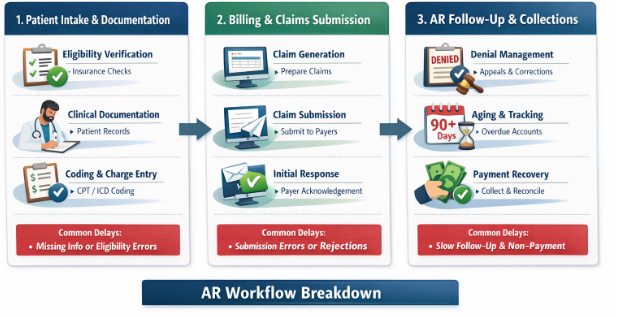
From what I have seen in real billing workflows, this kind of breakdown actually makes things more clear. Many teams thinks AR delay is only about collections, but thats not true. Most issues starts earlier—like wrong eligibility or incomplete documentation—and then it keeps flowing till AR stage.
Conclusion
In today’s complex healthcare environment, AR Recovery is no longer optional—it’s essential. A structured approach helps organisations reduce revenue leakage and improves cash flow.
By combining better processes, technology, and expert support, healthcare providers can turn AR from a problem area into a strong financial advantage.
And honestly, once you start fixing AR properly, you will notice the difference not just in numbers, but in how smoothly the whole system runs.
About the Creator
Enjoyed the story? Support the Creator.
Subscribe for free to receive all their stories in your feed.
Comments
There are no comments for this story
Be the first to respond and start the conversation.