
One Business Enquiry Can Contain Several Different Locations
A simple brief keeps one company contact while making each location’s needs clear.

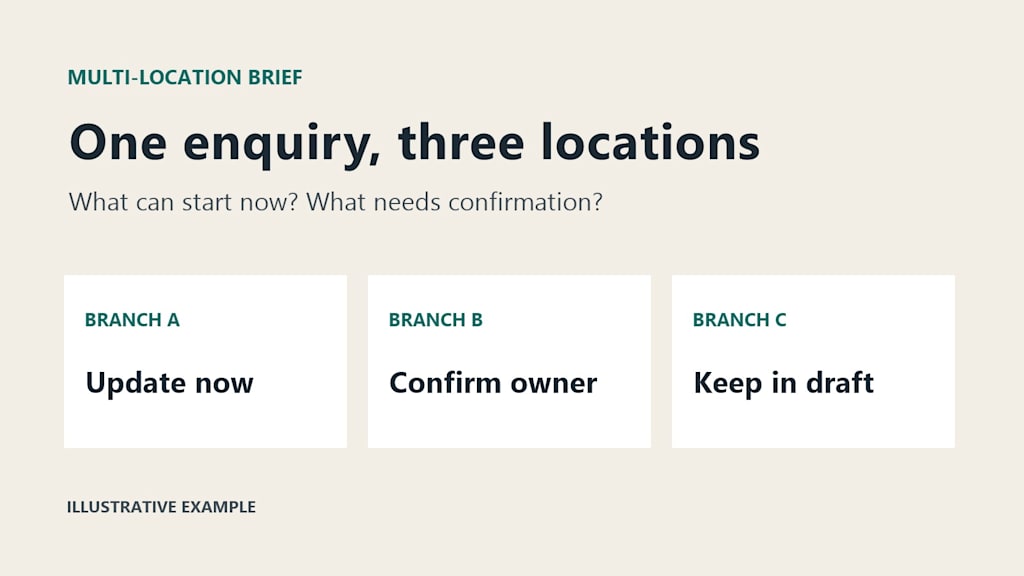
Disclosure: This draft was prepared with OpenAI’s ChatGPT. The locations and scenarios below are fictional. The accompanying graphic is a diagram prepared with ChatGPT.
An enquiry that says “We need to update the website for three locations” sounds like one job. It might be three different jobs with the same owner. One branch needs its hours corrected before a holiday. Another has everything ready for a new enquiry form. A third hasn’t opened and cannot yet confirm its opening date. Treating all three as one identical task obscures what can start and what must wait.
The solution is to keep one contact for the company, then write one line for each location. That makes it possible to agree on an order of work without pretending the locations have the same needs.
Start with what is shared
Write down the company name, one person who can approve the work, and a reply address. State the overall outcome in one sentence. For example: “Customers should see accurate information and reach the right branch.” Mention any work that needs to happen everywhere, such as agreeing on a common layout or deciding how enquiries will be forwarded.
A central contact does not have to answer every local question. Their job is to settle priorities and approve changes that affect more than one branch. A local contact is useful when someone needs to confirm a detail such as opening hours or whether a branch can take appointments.
Give each location one row
Use five fields: location, request, readiness, local contact and priority. Readiness means what is actually available today, not how important the task feels. Priority means what should go first and why. These two columns often tell different stories.
Branch A: Update holiday hours. The branch manager has approved the dates. Start here because the old hours are already causing confusion.
Branch B: Replace the enquiry form. The branch inbox exists, but nobody has confirmed who handles new messages. Start after the branch names an owner and confirms the destination address.
Branch C: Add an opening page. The address is confirmed, but the opening date is not. Prepare the page as a draft. Decide separately whether an undated notice is useful.
Avoid writing “high priority” in every row. Add a reason a reader can act on, such as a deadline, an incorrect public statement or another task that cannot start until this one is done. A location without a local contact should say “contact to be confirmed”, rather than naming someone without checking.
Separate a local change from a shared change
A new telephone number may belong to one branch. A change to the logic that routes forms may affect all of them. Before making the edit, ask whether it applies to one page or to a shared template. If form routing changes across the business, agree on where messages go when a visitor does not pick a location. Then test the routing for one branch and the default path before rolling it out more widely.
The brief can distinguish what may be done now from what is only an option. For example, a team can correct an address without waiting for someone to decide whether every branch needs a separate landing page. Keeping those decisions apart also helps the company understand why estimates or dates differ by location.
Use the brief to end the first meeting
At the end of the call, read back three things: the first location to work on, what is waiting for confirmation, and who will give it. A good reply might be: “We will correct Branch A’s hours today. Branch B follows after you confirm the inbox owner. Branch C stays in draft until we have a decision on the opening date.”
That is enough to move the enquiry forward. It gives the company one place to confirm decisions and makes the differences between branches visible without turning the first message into a long questionnaire.
About the Creator
Vladyslav Yanchenko
Marketer at Salestudia in Idstein, Germany. I write about websites, SEO, digital marketing and e-commerce, plus how people choose services and products.
Enjoyed the story? Support the Creator.
Subscribe for free to receive all their stories in your feed. You could also give them a one-off tip, letting them know you appreciate their work.
Comments
There are no comments for this story
Be the first to respond and start the conversation.