
Neuroprosthetics Are Rewiring Human Possibility
How brain-connected devices are transforming lives and redefining recovery
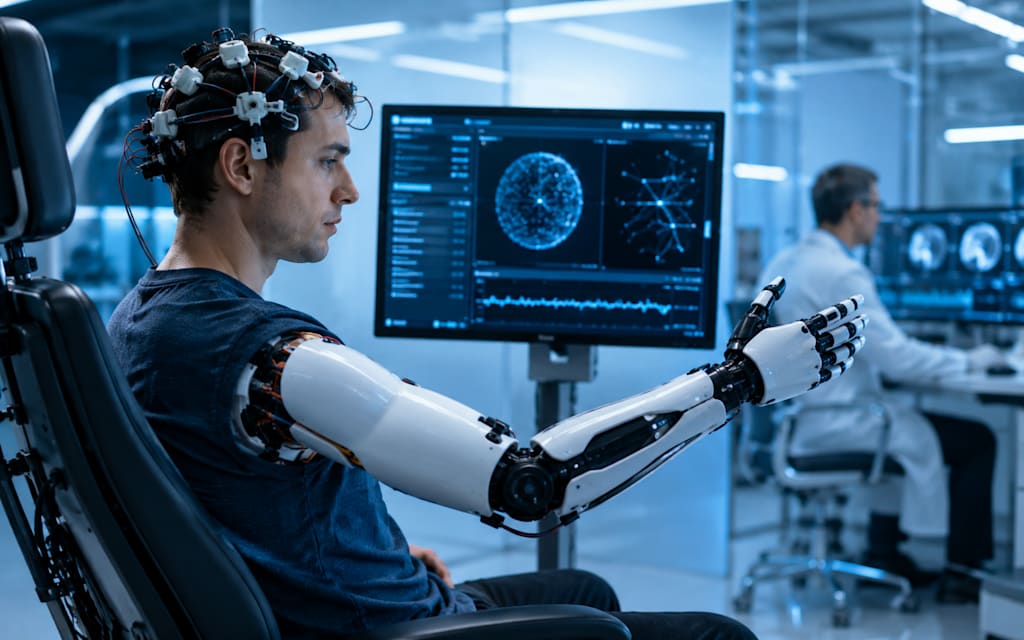
The hand moved slowly at first.
Not because the machine failed—but because the man controlling it hadn’t moved his fingers in years. Around him, doctors and engineers watched in silence as a robotic arm lifted a small cup from the table. A simple action for most people. A life-changing moment for him.
He wasn’t using muscles. He was using thought.
Somewhere between medicine, neuroscience, and artificial intelligence, neuroprosthetics are turning science fiction into reality. Devices that once seemed impossible are now helping people hear again, move again, and reconnect with parts of life they feared were lost forever.
At the center of this extraordinary transformation is the rapidly expanding - a sector where technology is no longer just assisting the human body, but communicating directly with the nervous system itself.
---
### When Technology Meets the Human Brain
For decades, neurological disorders and physical impairments carried limitations medicine could only partially address. Paralysis, hearing loss, limb dysfunction, and neurodegenerative conditions often meant adapting to permanent change.
Neuroprosthetics are changing that narrative.
Unlike traditional prosthetics, neuroprosthetic devices interact with the nervous system. They interpret neural signals, stimulate nerves, and restore functions that were once considered irretrievable.
According to Mordor Intelligence, the Neuroprosthetics market size in 2026 is estimated at USD 14.99 billion, growing from 2025 value of USD 13.43 billion with 2031 projections showing USD 25.96 billion, growing at 11.62% CAGR over 2026-2031.
Source: https://www.mordorintelligence.com/industry-reports/neuroprosthetics-market?utm_source=vocal.media. The growth reflects rising demand for advanced neurological treatment solutions, expanding research in brain-machine interfaces, and increasing prevalence of neurological disorders globally.
But behind the market data lies something far more profound: restored independence.
---
### A Revolution Built on Human Need
The demand for neuroprosthetics is being driven by a convergence of medical and technological realities.
Aging populations worldwide are increasing the incidence of neurological diseases. Stroke cases, spinal cord injuries, Parkinson’s disease, epilepsy, and hearing impairments continue to rise. At the same time, advances in computing power, miniaturization, and neural mapping are making previously experimental technologies commercially viable.
This combination has accelerated innovation across several categories:
* Cochlear implants for hearing restoration
* Deep brain stimulation devices for neurological disorders
* Motor prosthetics controlled by neural signals
* Brain-computer interface technologies
What once required bulky experimental systems can now fit into increasingly compact and precise medical devices.
And with every advancement, the gap between biology and technology narrows further.
---
**Quick Insight Break (For Mobile Readers):**
* What are neuroprosthetics?
→ Devices that connect with the nervous system to restore function
* What conditions do they help treat?
→ Paralysis, hearing loss, Parkinson’s disease, epilepsy
* Why is the market growing?
→ Rising neurological disorders and breakthroughs in neural technology
---
### The Emotional Side of Restoration
Market reports often discuss growth, adoption rates, and innovation pipelines. But neuroprosthetics are deeply personal technologies.
A cochlear implant is not just a device—it’s a child hearing their parent’s voice clearly for the first time.
A neural-controlled prosthetic arm is not just engineering—it’s someone feeding themselves independently again.
These moments matter because they restore more than function. They restore identity, confidence, and connection.
For many patients, the psychological impact is just as significant as the physical outcome.
That emotional dimension is one reason the neuroprosthetics field attracts such intense global interest. It represents hope in a tangible form.
---
### How AI and Neuroscience Are Converging
One of the most fascinating developments in the neuroprosthetics market is the growing integration of artificial intelligence.
Modern neuroprosthetic systems are becoming smarter, more adaptive, and more responsive. AI algorithms can now analyze neural signals faster and improve device accuracy over time.
This evolution is driving new search behaviors online, including AI-focused queries such as:
* “How do brain-computer interfaces work?”
* “Can prosthetic limbs respond to thoughts?”
* “Future of neuroprosthetics and AI”
* “Neural implants restoring movement”
These searches reflect a rising public fascination with technologies that blur the boundary between medicine and machine intelligence.
And importantly, they’re expanding awareness beyond hospitals and research labs into mainstream conversation.
---
### The Challenge of Accessibility
Despite rapid progress, neuroprosthetics still face significant barriers.
Advanced devices can be expensive. Specialized surgical procedures and rehabilitation requirements add complexity. Access to treatment remains uneven across regions, particularly in developing healthcare systems.
There are also technical challenges:
* Long-term device compatibility
* Precision of neural signal interpretation
* Battery life and durability
* Regulatory and ethical considerations
As neuroprosthetics become more sophisticated, questions about privacy, data security, and human augmentation are also emerging.
Yet innovation continues to push forward.
Researchers are working on less invasive implants, wireless neural systems, and devices capable of more natural sensory feedback. The goal is not simply to create functional devices—but seamless human integration.
---
### Beyond Disability: The Future of Human Enhancement?
Today, neuroprosthetics are primarily focused on restoring lost function. But many experts believe the technology could eventually move beyond restoration into enhancement.
That possibility raises profound questions.
Could future devices enhance memory?
Improve reaction speed?
Expand sensory perception?
While these concepts remain largely experimental, they illustrate how quickly the field is evolving.
And they explain why the neuroprosthetics market is attracting attention not only from healthcare providers, but also from technology companies, AI researchers, and investors worldwide.
Because the future of neurotechnology may redefine what human capability means altogether.
---
### The Healthcare Industry’s Next Frontier
Hospitals and rehabilitation centers are increasingly integrating neuroprosthetic therapies into patient care strategies. At the same time, governments and research institutions are increasing funding for neuroscience and neural engineering initiatives.
This growing ecosystem is accelerating collaboration across disciplines:
* Neuroscience
* Robotics
* Artificial intelligence
* Biomedical engineering
* Rehabilitation medicine
Together, these fields are building a healthcare frontier centered on neural connectivity and adaptive recovery.
And the impact could extend far beyond current expectations.
---
### More Than Machines
The rise of the **Neuroprosthetics Market** is not simply a story about advanced devices.
It’s a story about possibility.
About a patient gripping a coffee cup again.
About hearing laughter after years of silence.
About reconnecting the brain to the body in ways once unimaginable.
Technology alone cannot create these moments. Human determination, scientific persistence, and compassionate innovation make them possible.
And that may be what makes neuroprosthetics so compelling. They remind us that medicine isn’t only about survival—it’s about restoring the experiences that make life feel fully human.
---
### The Question We’re All Moving Toward
As neuroprosthetics continue advancing, society is approaching a new era—one where the boundary between biology and technology becomes increasingly fluid.
The question is no longer whether these devices can change lives.
They already are.
The real question is:
**How far are we willing to go when technology can reconnect the human body to the human mind?**
About the Creator
Enjoyed the story? Support the Creator.
Subscribe for free to receive all their stories in your feed.
Comments
There are no comments for this story
Be the first to respond and start the conversation.