
Nathan Haslick on Innovation Through Analytics: Solving Modern Business Challenges
How Data-Driven Thinking Helps Organizations Navigate Complexity and Create Meaningful Change

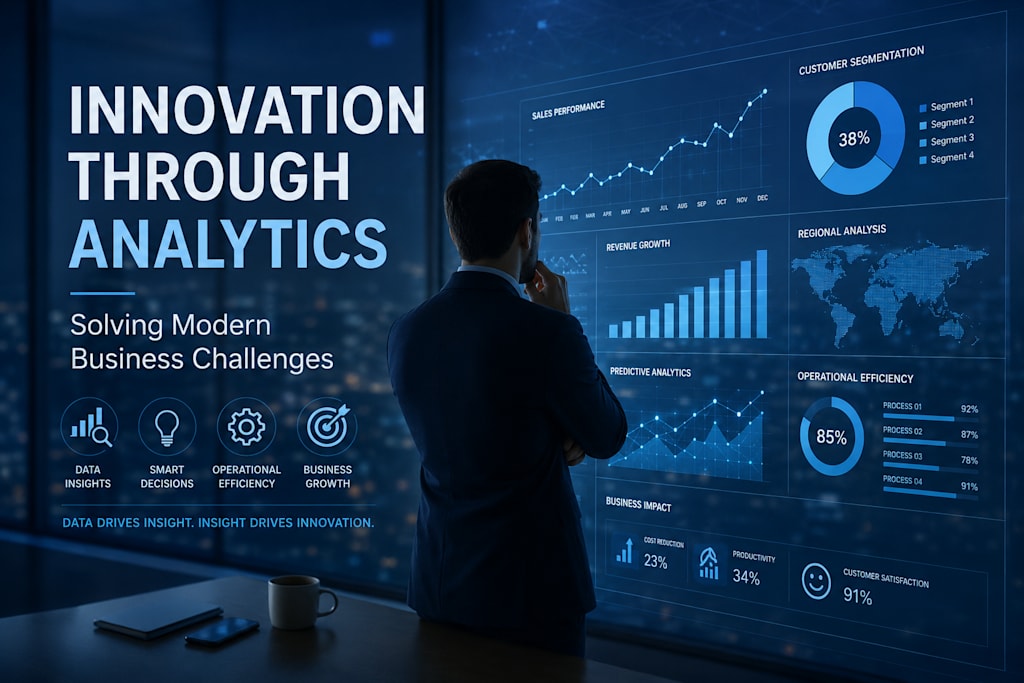
Nathan Haslick is a skilled data scientist with a strong foundation in both theory and real-world applications. He holds a Master’s in Data Science and has experience applying analytical methods across industries including technology, finance, and healthcare.
Innovation is often associated with breakthrough ideas, disruptive technologies, and creative problem-solving. While these elements are certainly important, modern innovation increasingly relies on another critical resource: data. Organizations today generate vast amounts of information through customer interactions, operational processes, digital platforms, and market activities. The challenge is no longer obtaining data—it is understanding how to use it effectively.
Analytics provides a pathway for transforming raw information into actionable insights. By identifying patterns, predicting outcomes, and supporting evidence-based decisions, analytics helps businesses solve problems that would otherwise be difficult to understand. As industries continue to evolve in response to technological change, organizations that embrace analytical thinking are often better equipped to adapt and innovate.
The Growing Importance of Analytics in Business
Businesses operate in an environment characterized by constant change. Consumer expectations shift rapidly, competitive pressures increase, and technological advancements reshape industries at an unprecedented pace. In such conditions, relying solely on intuition or historical practices may not be enough.
Analytics enables organizations to make decisions based on evidence rather than assumptions. Through the collection and examination of data, businesses can gain a clearer understanding of customer behavior, operational performance, and market trends.
For example, a company may use analytics to determine which products generate the highest customer satisfaction, identify inefficiencies in supply chain operations, or forecast future demand based on historical patterns. These insights help leaders make informed decisions that improve outcomes while reducing uncertainty.
Rather than replacing human judgment, analytics enhances it by providing a stronger foundation for decision-making.
Understanding Modern Business Challenges
Today's organizations face a variety of challenges that require thoughtful solutions. These challenges often include managing costs, improving efficiency, adapting to technological disruption, and meeting evolving customer expectations.
One significant challenge is information overload. Businesses collect more data than ever before, yet many struggle to extract meaningful value from it. Without effective analytical processes, important insights can remain hidden within large datasets.
Another challenge is uncertainty. Economic fluctuations, changing regulations, and shifting consumer behaviors make long-term planning increasingly complex. Organizations must often make decisions with incomplete information and rapidly changing conditions.
Analytics helps address these challenges by creating clarity. Through data visualization, predictive modeling, and performance measurement, organizations can identify opportunities, anticipate risks, and respond more effectively to changing circumstances.
Turning Data Into Actionable Insights
Data alone does not create value. The true benefit emerges when information is translated into actionable insights.
This process typically begins with collecting relevant data from multiple sources. These sources may include customer transactions, website activity, operational metrics, financial reports, or external market information. Once collected, the data is cleaned, organized, and analyzed to uncover meaningful patterns.
For example, customer purchasing behavior may reveal trends that indicate changing preferences. Operational data might highlight bottlenecks that reduce productivity. Financial data may identify areas where resources can be allocated more effectively.
The goal is not simply to generate reports but to create knowledge that informs action. When organizations connect analytical findings to strategic objectives, they are better positioned to implement meaningful improvements.
This ability to move from information to action is a key driver of innovation.
Predictive Analytics and Future Planning
One of the most valuable applications of analytics is prediction. Predictive analytics uses historical data, statistical models, and machine learning techniques to estimate future outcomes.
While no prediction can guarantee certainty, predictive analytics helps organizations make more informed forecasts. Businesses can anticipate customer demand, identify emerging market trends, and assess potential risks before they become significant problems.
Retail companies may use predictive models to manage inventory more efficiently. Healthcare organizations can analyze patient data to improve resource planning. Financial institutions often use predictive analytics to evaluate risk and detect unusual activity.
The ability to anticipate future developments allows organizations to become more proactive rather than reactive. This shift often leads to better planning, improved resource allocation, and stronger long-term performance.
Improving Customer Experiences Through Analytics
Customer expectations continue to rise across nearly every industry. Consumers increasingly expect personalized experiences, fast service, and products that meet their specific needs.
Analytics plays an important role in helping organizations understand and respond to these expectations. By examining customer interactions and behavior patterns, businesses can gain valuable insights into what customers value most.
For instance, companies can analyze website engagement data to identify which content attracts the most attention. Customer feedback analysis may reveal recurring concerns or opportunities for improvement. Purchase histories can help organizations understand preferences and tailor recommendations accordingly.
These insights allow businesses to improve products, enhance services, and create experiences that better align with customer needs.
Innovation often begins with understanding people more effectively, and analytics provides tools that support that understanding.
Operational Efficiency as a Competitive Advantage
Innovation is not limited to creating new products or services. It also involves improving the processes that support organizational success.
Operational analytics helps businesses identify inefficiencies, reduce waste, and optimize performance. Even small improvements can generate significant benefits when applied across large systems.
For example, manufacturing organizations may analyze production data to reduce downtime and improve equipment utilization. Logistics companies often use analytics to optimize delivery routes and manage transportation costs. Service organizations can evaluate workflow performance to improve productivity and customer response times.
By continuously measuring performance and identifying opportunities for improvement, organizations create a culture of ongoing innovation.
This approach helps businesses remain competitive while maximizing the value of available resources.
Building a Data-Driven Culture
Technology alone does not guarantee successful analytics initiatives. Organizations must also develop a culture that values evidence-based decision-making.
A data-driven culture encourages employees at all levels to use information when evaluating options and solving problems. Leaders play a critical role by promoting transparency, supporting analytical tools, and encouraging curiosity.
Education and collaboration are equally important. Employees should understand how data supports organizational objectives and how analytical insights contribute to better outcomes.
When analytical thinking becomes part of everyday operations, innovation becomes more sustainable. Decisions are guided by evidence, learning becomes continuous, and organizations become more adaptable to change.
The Future of Innovation Through Analytics
As technology continues to advance, the role of analytics will likely become even more significant. Artificial intelligence, machine learning, and advanced data platforms are expanding the ways organizations can analyze information and generate insights.
However, the fundamental objective remains the same: helping people make better decisions.
Organizations that successfully combine human expertise with analytical capabilities are likely to be better prepared for future challenges. They will have greater visibility into their operations, stronger understanding of customer needs, and improved ability to respond to emerging opportunities.
Innovation is rarely the result of a single breakthrough. More often, it emerges through a series of informed decisions, continuous improvements, and a willingness to learn from data.
Nathan Haslick is a skilled data scientist with a strong foundation in both theory and real-world applications. He holds a Master’s in Data Science and has experience applying analytical methods across industries including technology, finance, and healthcare. His professional perspective highlights the growing importance of analytics in helping organizations solve complex challenges, adapt to changing environments, and drive meaningful innovation through informed decision-making.
About the Creator
Nathan Haslick
Skilled data scientist with a strong foundation in both theory and real-world applications. He holds a Master’s in Data Science and has several years of experience working across industries such as tech, finance, and healthcare.
Enjoyed the story? Support the Creator.
Subscribe for free to receive all their stories in your feed.
Comments
There are no comments for this story
Be the first to respond and start the conversation.