
Nano Fertilizer Market: Shifting Precision Agriculture Into a $7.59 Bn Feeding Revolution
How nanocarrier technology, satellite imaging, and sustainable farming pressure are making conventional fertilizers look increasingly outdated

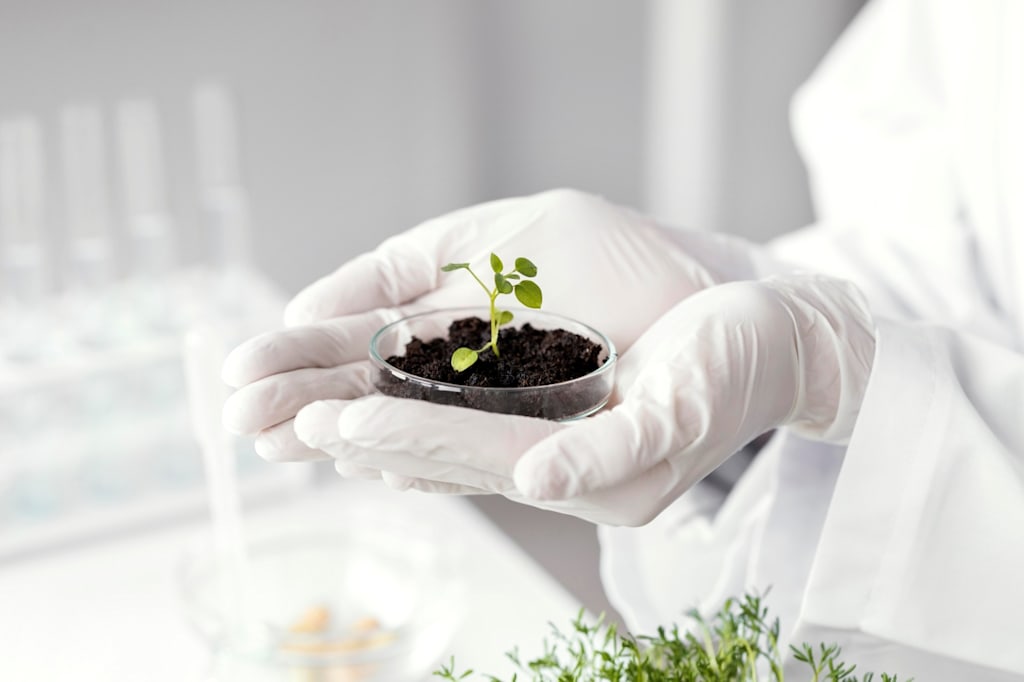
The way humanity feeds its crops has not fundamentally changed in decades. Nano fertilizers are the most serious challenge to that status quo in a generation.
Agriculture has a fertilizer problem that most people outside the industry do not think about.
Conventional fertilizers work. They have fed the world's growing population through the twentieth century and into the twenty-first in ways that would not have been possible without them. That is not in dispute. What is increasingly difficult to ignore is how inefficient the process is. A significant portion of the nitrogen, phosphorus, and potassium applied to fields never reaches the plants it is intended to feed. It leaches into groundwater. It runs off into rivers and coastal areas, where it drives algal blooms and oxygen depletion. It evaporates into the atmosphere as greenhouse gases. The crop gets some of what it needs. The environment absorbs the rest.
Nano fertilizers represent a fundamentally different approach to the same problem. Instead of applying nutrients in bulk and hoping enough reaches the plant, nano-scale delivery systems carry nutrients in particles small enough to be absorbed directly through plant tissue, release them in response to specific soil and plant conditions, and dramatically reduce the waste that makes conventional fertilization both environmentally costly and economically inefficient.
According to Mordor Intelligence, the global nano fertilizers market is estimated at USD 3.89 billion in 2026, and projected to reach USD 7.59 billion by 2031 at a 14.32% CAGR. That growth rate reflects a technology moving from early adoption into mainstream agricultural practice at a pace that signals genuine commercial validation rather than speculative enthusiasm.
What Nano Fertilizers Actually Do Differently
The core innovation in nano fertilizers is not a new nutrient. It is a new delivery mechanism for nutrients that agriculture has always relied upon.
Conventional fertilizers release their nutrient content rapidly and indiscriminately when they contact soil moisture. The plant absorbs what it can at the moment it is available. What it cannot absorb in that window is lost to leaching, volatilization, or chemical reactions that make the nutrients unavailable. The timing mismatch between nutrient availability and plant uptake capacity is the fundamental inefficiency that conventional fertilization has never resolved.
Nano-scale particles and nanocarrier systems address this mismatch in two distinct ways. First, their small size allows them to use plant uptake pathways that larger particles cannot access, increasing the proportion of applied nutrients that enter plant tissue rather than remain in the soil. Second, responsive formulations can be designed to release their nutrient payload in response to specific triggers, including soil pH, temperature, moisture levels, or enzymatic activity associated with plant root systems. A fertilizer that releases nitrogen when and where the plant is actively ready to absorb it wastes considerably less than one that releases its entire content on contact with moisture.
The reduction in input waste that results from these improvements is not a marginal efficiency gain. Studies comparing nano fertilizer applications with conventional equivalents have consistently shown meaningful reductions in the quantity of nutrient input required to achieve equivalent or superior crop outcomes. For a farmer operating on tight margins where input costs directly affect profitability, reducing fertilizer application rates while maintaining or improving yields represents a genuine economic argument for adoption independent of any environmental consideration.
How Precision Agriculture Is Accelerating Adoption
Nano fertilizers do not exist in isolation. They are entering agricultural practice at exactly the moment when the broader precision agriculture infrastructure required to use them most effectively is becoming widely accessible.
Satellite imaging that maps crop health, nutrient status, and soil variability across entire fields at resolutions that were prohibitively expensive a decade ago is now available to major agricultural producers as a routine operational tool. Drone-based application systems that can deliver inputs to specific zones of a field rather than applying uniformly across the whole area are increasingly practical and affordable. Soil testing technologies that provide rapid and detailed nutrient profile data at multiple sampling points across a field give farmers the information needed to calibrate variable-rate application strategies.
Nano fertilizers are the logical input for this infrastructure. A precision application system that can target specific field zones based on detailed satellite and soil data is most valuable when combined with a fertilizer formulation that delivers its nutrients with the precision and timing control that nano-scale delivery enables. The two technologies reinforce each other commercially and technically in ways that are accelerating adoption of both.
Major agricultural producers incorporating nano fertilizers into integrated farming systems are finding that the combination of precision application data and controlled-release nano formulations produces outcomes that neither technology achieves independently. The satellite data tells the farmer where each nutrient is needed. The nano fertilizer delivers it there without the waste that would undermine the precision of the application in a conventional fertilizer system.
Addressing the Cost Barrier
The primary obstacle to faster nano fertilizer adoption has been price. Producing nano-scale nutrient particles and the carrier systems that deliver them has historically cost substantially more than manufacturing conventional fertilizers and that cost differential has slowed uptake among price-sensitive farmers who can achieve adequate results with cheaper conventional inputs.
Two developments are reducing this barrier in ways that are visible in market growth data.
Bio-based nanocarriers derived from natural materials, including chitosan, cellulose derivatives, and plant-based polymers, have been developed as alternatives to synthetic nanocarrier systems. These bio-based materials are not only cheaper to produce than synthetic alternatives in many cases but also carry the additional commercial benefit of fitting more comfortably within the clean and sustainable positioning that increasingly underpins premium agricultural product marketing. A nano fertilizer built on bio-derived carrier systems can be positioned as both technologically advanced and environmentally responsible simultaneously.
Liquid nano fertilizer formulations compatible with existing irrigation and spraying equipment have reduced the adoption barrier that would exist if farmers needed to invest in new application equipment to use the products. A nano fertilizer that works through systems already present on the farm requires no capital expenditure beyond the product itself. That compatibility with existing infrastructure has made trial and adoption considerably more practical for producers who are evaluating the technology for the first time.
Where the Market Is Growing and Why
The adoption of nano fertilizers is advancing fastest in the large agricultural producing nations, where both the scale of farming operations and the sophistication of existing precision agriculture infrastructure make the economics most compelling.
Asia, with its enormous agricultural sectors in China and India and its intense pressure on arable land productivity given population density, represents both the largest growth opportunity and a region where government policy has been actively supportive of agricultural technology adoption. The combination of regulatory pressure on conventional fertilizer overuse, which has caused significant soil and water pollution across parts of the region, and government incentive programs supporting sustainable farming inputs creates favorable conditions for nano fertilizer market expansion.
North America and Europe bring different dynamics. Regulatory frameworks around the environmental impact of agricultural runoff have been tightening and creating compliance pressures that make more efficient nutrient delivery commercially attractive beyond its direct economic benefits. The well-developed precision agriculture infrastructure in these regions means that the complementary technologies required to use nano fertilizers optimally are already in place on many large farms.
The environmental regulations driving adoption in developed markets are significant. Nitrogen and phosphorus runoff from agriculture is a documented contributor to water quality problems across multiple regions, and regulators have been moving toward stricter limits on application rates and accountability for nutrient losses. Nano fertilizers that demonstrably reduce nutrient runoff give producers a compliance tool that conventional alternatives cannot provide.
A Closing Thought
Feeding a growing global population from a land base that is not growing requires getting more from every input applied to every field. That is not a new problem. What is new is that the technology to address it with genuine precision is becoming commercially viable at an agricultural scale.
Nano fertilizers are not a replacement for the agricultural knowledge and practice that has fed the world for generations. They are a tool that makes that knowledge more effective by closing the gap between what is applied and what the plant actually receives.
With the market heading toward USD 7.59 billion by 2031, the farming world appears to be arriving at the same conclusion. Efficiency applied at the nanoscale turns out to matter enormously at the global scale.
About the Creator
Harvey Specter
I am passionate about Food & Beverage, Ag, & Animal Nutrition companies. I help organizations unlock their data's potential and fuel business growth. My expertise transforms raw data into actionable insights for strategic decisions.
Enjoyed the story? Support the Creator.
Subscribe for free to receive all their stories in your feed.
Comments
There are no comments for this story
Be the first to respond and start the conversation.