
Modi Just Won West Bengal — a State He Has Chased for 30 Years. India Will Never Be the Same.
For the first time in history, India's ruling BJP has wrested control of West Bengal from Mamata Banerjee's TMC. Modi swept four state elections in a single day. The opposition is in collapse. Here's what it means for the world's most populous democracy — and why it matters globally.
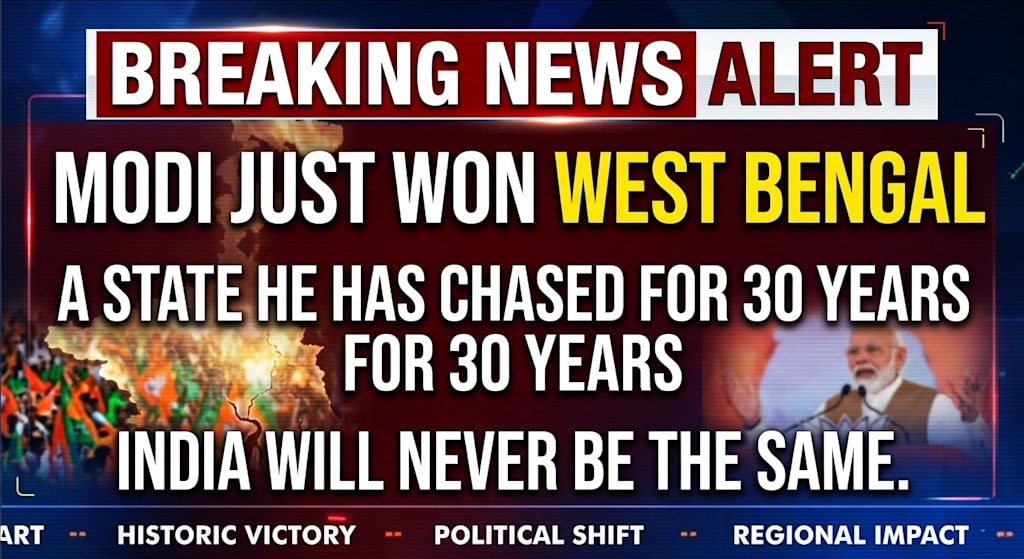
On Monday, May 4, Indian Prime Minister Narendra Modi walked to a stage at BJP headquarters in New Delhi as confetti rained down around him and told a cheering crowd: "A new chapter has been added to Bengal's destiny." He was not wrong. For the first time in its modern political history, West Bengal — one of India's most populous, politically influential, and culturally distinctive states — had voted to remove the All India Trinamool Congress from power and hand control to Modi's Bharatiya Janata Party. The BJP had tried and failed for decades to break into Bengal. On Monday, it broke through.
The Election Commission of India's partial results showed the BJP winning at least 124 seats in the 294-seat West Bengal assembly and leading in 83 more. Chief Minister Mamata Banerjee — who had defiantly insisted days before the count that "the BJP is not coming, take my word for it" — watched her party's stronghold of fourteen consecutive years disintegrate in real time. Beyond Bengal, the BJP also won Assam for a third consecutive term and secured victory in Puducherry. In Tamil Nadu, Bollywood megastar-turned-politician Joseph Vijay toppled the ruling DMK with his two-year-old party TVK in one of Indian politics' most stunning electoral debut performances in decades. In Kerala, the Indian National Congress defeated the ruling communist government, ending leftist rule in one of its last national strongholds.
"A new chapter has been added to Bengal's destiny." — Prime Minister Narendra Modi, May 4, 2026
The West Bengal result is consequential far beyond state politics. Banerjee had positioned herself as the single most credible figurehead of India's fragmented opposition alliance — the INDIA coalition of regional parties that had modestly dented the BJP's supermajority in the 2024 national elections. Her defeat, analysts say, will critically weaken the opposition's ability to coordinate a unified national challenge ahead of the 2029 general election, in which Modi is expected to seek a fourth consecutive term. The BJP victory in Bengal also delivers crucial political momentum to Modi at a moment when his government has faced unusual external pressure from Trump's tariffs and the ripple effects of the Iran war on India's oil-dependent economy.
But the victory was not without controversy. Before polling in West Bengal, India's Election Commission conducted a "Special Intensive Revision" of its electoral rolls — an exercise that removed more than nine million people, nearly 12 percent of the state's 76 million registered voters, from the voting lists. Opposition parties and civil society organisations have sharply criticised this removal as disenfranchisement of minority voters, particularly Bengali Muslims who form roughly 27 percent of West Bengal's population. The BJP's campaign, meanwhile, leaned heavily into Hindu nationalist themes and accusations that Banerjee's government had favoured Muslim communities at the expense of Hindus — a charge Banerjee denied furiously but which analysts say resonated deeply among urban Hindu voters.
Professor Uday Chandra of Ashoka University told Al Jazeera: "This is a much-needed win for the Modi government, which has come under pressure since Trump's tariffs and in particular after the war in Iran." For Shyama Prasad Mukherjee — the BJP's ideological forefather, who was himself from West Bengal and founded the party's predecessor in 1951 — it would have been the realisation of a lifelong dream. Modi made that historical connection explicit in his victory speech, casting Monday's result as the culmination of a 75-year ideological journey.
What it means practically is a governing party that now controls most of India's major states, a fragmented opposition with its most visible leader defeated, and a Prime Minister with four years remaining in his term and no serious domestic challenger in sight. For a democracy of 1.4 billion people navigating a treacherous global moment — rising energy prices, U.S. tariffs on Indian exports, a war blocking its oil supply routes — the political consolidation of power under a single dominant party carries implications that will take years to fully understand.
India's democracy just experienced one of its most seismic single days in decades. The tremors will be felt for far longer.
About the Creator
Enjoyed the story? Support the Creator.
Subscribe for free to receive all their stories in your feed.
Comments
There are no comments for this story
Be the first to respond and start the conversation.