
Mobile Boat Hoist Steering Systems: Types and Benefits
How Advanced Wheel Configurations Maximize Yard Density, Operational Speed, and Vessel Safety
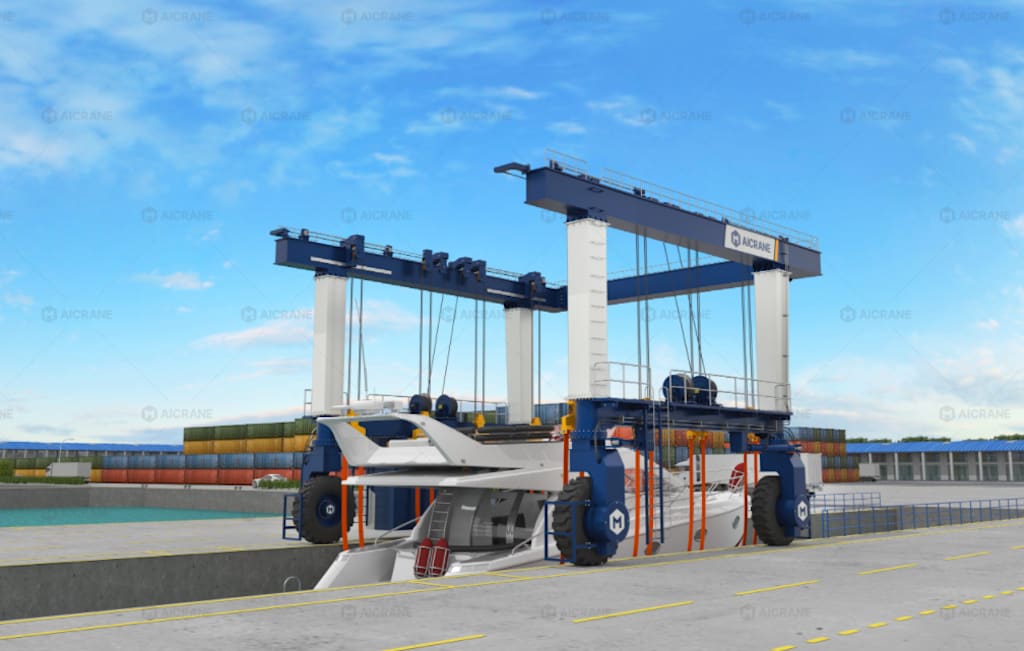
In modern shipyards, marinas, and ports, optimizing space and ensuring the safe transit of high-value vessels are paramount operational goals. At the center of these operations is the Mobile Boat Hoist (MBH)—frequently referred to as a mobile boat gantry or travel lift. While the hoist's lifting capacity often dominates purchasing discussions, the machine's steering system is the true driver of yard efficiency, spatial utilization, and overall safety.
This article provides a detailed technical analysis of the steering system types available for mobile boat hoists and explores how choosing the right system directly impacts shipyard productivity and bottom-line profitability.
The Engineering Behind Mobile Boat Hoist Steering
Unlike standard highway vehicles, a mobile boat hoist must carry massive, top-heavy loads across uneven gravel, concrete, or asphalt yard surfaces. Steering these structures requires managing immense vertical and lateral forces.
The steering mechanism typically relies on heavy-duty hydraulic slewing drives or hydraulic cylinders connected to steering arms on each wheel assembly. On modern, high-capacity hoists, these mechanical components are managed by a centralized Programmable Logic Controller (PLC). The PLC coordinates the angles of each wheel set to prevent tire scrubbing (dragging), structural twisting, and unstable load shifts during turns.
Core Steering Configurations and Modes
Depending on the manufacturer and the operational requirements of the yard, mobile boat hoists are equipped with varying levels of steering complexity. These are generally classified into three tiers of capability.
1. Two-Wheel / Standard Ackerman Steering
This is the most basic steering configuration, comparable to the steering system of a standard truck. Only one pair of wheels (typically the front or rear pair) pivots to guide the machine, while the other pair remains fixed in a straight line.
How it works: The system utilizes Ackerman steering geometry, meaning the inner wheel turns at a sharper angle than the outer wheel to trace concentric circles, minimizing tire slippage.
Best suited for: Small-scale marinas with straightforward layouts, wide runways, and minimal tight corners. It is the most cost-effective initial investment.
2. Four-Wheel / Coordinated Steering
In this configuration, all four wheel groups are steerable. This is often the entry-level standard for mid-to-high capacity hoists.
How it works: The front and rear wheels turn in opposite directions. If the front wheels turn left, the rear wheels turn right, effectively pivoting the machine around a much tighter center point.
Best suited for: Medium-sized yards that need to navigate moderate corners and lanes but do not require complex parallel or lateral parking maneuvers.
3. Multi-Mode / All-Wheel Electronic Steering
This is the gold standard for modern yard management. Using electronic-over-hydraulic synchronization controlled by a PLC, all wheel groups can be steered independently or in unison. This allows the operator to switch between multiple steering modes at the push of a button.
The primary modes in a multi-mode system include:
Carb/Diagonal Steering: All wheels turn in the same direction at the same angle. The hoist moves diagonally without changing its heading. This is invaluable for shifting a boat slightly to the side or navigating tight corridors.
Carousel / Spin Steering: The wheels orient themselves in a circular pattern, allowing the hoist to rotate 360 degrees around its own geometric center. The footprint required to turn the machine is virtually reduced to the length of the hoist itself.
90-Degree / Lateral Steering: The wheels turn a full 90 degrees, allowing the hoist to move directly sideways. This enables "parallel parking" of vessels and sideways travel down narrow yard lanes.
Concentric / Custom Pivot Steering: The operator can choose a pivot point outside the machine's footprint—for example, pivoting precisely around the stern of a blocked boat.
Operational Benefits of Advanced Steering Systems
Upgrading from basic two-wheel steering to a multi-mode electronic system requires a higher capital expenditure, but the operational returns in yard density, speed, and safety are substantial.
Maximize Yard Storage Density
Real estate in marinas and shipyards is exceptionally expensive. Every square foot of unused space represents lost revenue.
With standard steering: Hoists require wide turning corridors and significant clearance between blocked boats to align themselves for parking or retrieval. This results in wide, empty "dead zones" throughout the yard.
With multi-mode steering: Features like 90-degree lateral travel and carousel spinning allow operators to park vessels side-by-side and end-to-end with mere inches of clearance. The hoist can slip sideways into a narrow slipway, drop a boat, and slide directly back out. Yards utilizing advanced steering frequently report a 20% to 40% increase in boat storage capacity within the exact same physical footprint.
Drastic Reduction in Tire Wear and Maintenance Costs
The tires of a mobile boat hoist or travel lift are massive, specialized, and highly expensive components. Replacing a set of shredded or prematurely worn tires can cost tens of thousands of dollars.
When a multi-axle machine turns without precise alignment, the tires undergo "scrubbing"—literally dragging sideways across the ground.
Standard or poorly synchronized steering configurations cause high lateral friction, rapidly wearing down tire treads and straining the hoist's steel frame.
PLC-controlled multi-mode systems recalculate the exact required angle for every single wheel set during a turn, ensuring true rolling motion. This eliminates tire scrubbing, extends tire lifespans by years, and reduces stress on the structural weldments of the gantry.
Enhanced Operator Safety and Control
Manipulating a 100-ton machine carrying a multi-million dollar yacht leaves zero margin for error.
Advanced steering systems are almost always paired with industrial wireless remote controls. This allows the operator to walk around the hoist, maintaining a direct line of sight to the tightest clearances. If the hoist starts to drift close to a blocked boat, the operator can instantly switch to crab mode to drift the machine safely away without having to execute a complex multi-point turn.
Faster Cycle Times
In peak spring launch or autumn haul-out seasons, shipyard throughput is the primary metric of success. The faster a hoist can pick up a boat, transport it, park it, and return to the slipway, the more revenue the yard generates.
By eliminating the need for "three-point turns" and tedious repositioning maneuvers, multi-mode steering reduces transit and parking times significantly. A turn that takes five minutes of back-and-forth maneuvering with standard steering can be completed in under 30 seconds using carousel or lateral steering.
Selecting the Right Configuration for Your Yard
When specifying a mobile boat hoist, consider the following decision matrix to determine the appropriate steering system:
Yard Geometry: If your yard features long, straight lanes and wide open spaces, a simpler 2-wheel or 4-wheel coordinated system may suffice. If your yard has tight corners, dead ends, or narrow slips, multi-mode electronic steering is practically mandatory.
Vessel Mix: Yards handling deep-draft sailboats or wide-beam catamarans require more precise placement. Catamarans, in particular, occupy vast footprints; maneuvering them requires the extreme agility offered by crab and carousel steering.
Future Expansion Plans: If you plan to increase the density of your yard storage in the future to boost winter storage revenues, investing in advanced steering now will save you from having to replace or retroactively upgrade your hoist later.
Conclusion
A mobile boat hoist is a long-term capital investment expected to serve a facility for decades. While structural steel and lifting winches provide the raw capability to lift heavy vessels, the steering system determines how efficiently and safely those vessels are managed once they are out of the water. By investing in advanced, multi-mode steering configurations, yard operators protect their assets, maximize their storage revenue per square foot, and ensure highly efficient yard flow during peak operational seasons.
About the Creator
Aicrane01
Welcome to the Aicrane Blog, your practical guide to lifting solutions. Discover articles covering overhead cranes, gantry cranes, winches, steel structures, boat lifts, and more.
Website: https://steelmillcranes.com/
Enjoyed the story? Support the Creator.
Subscribe for free to receive all their stories in your feed.
Comments
There are no comments for this story
Be the first to respond and start the conversation.