
MEA Thermal Imaging Systems Market: 2031 Outlook
From security modernization to industrial diagnostics, how infrared vision is reshaping MEA infrastructure
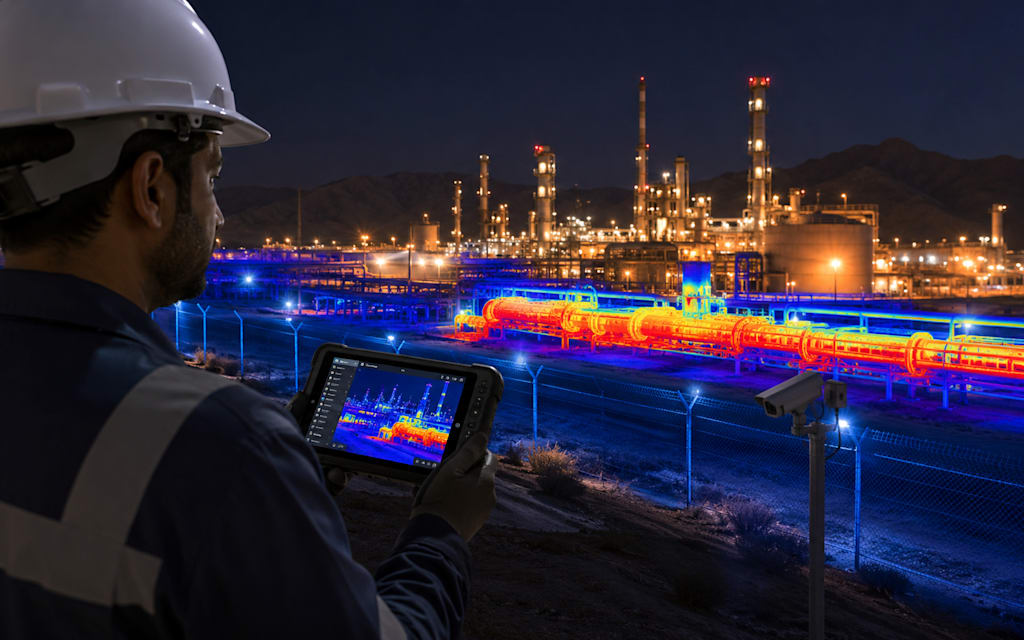
When Heat Becomes Intelligence
A silent shift is happening across deserts, cities, and industrial corridors of the Middle East and Africa.
You don’t see it with the naked eye—but machines do.
In control rooms deep inside oil refineries, on the borders of high-security installations, and within sprawling power plants, invisible heat signatures are becoming actionable intelligence. A temperature spike on a pipeline isn’t just a number anymore—it’s a warning. A flicker of abnormal heat on a fence line isn’t just noise—it could be a breach.
This is the world of thermal vision, where darkness is no longer an obstacle and heat becomes a language of its own.
The MEA thermal imaging systems market is quietly becoming one of the most strategically important technology segments in the region, driven by defense modernization, infrastructure expansion, and industrial safety demands. What was once niche surveillance tech is now a foundational layer of operational intelligence.
According to industry projections, the MEA thermal imaging systems market size is set to rise from USD 0.91 billion in 2026 to USD 1.41 billion by 2031, registering a CAGR of 9.27% during 2026–2031.
That growth is not just statistical—it reflects a region learning to see differently.
From Surveillance to Smart Infrastructure Intelligence
The transformation of thermal imaging in MEA is no longer limited to defense or border monitoring—it has evolved into a multi-sector intelligence tool.
In oil and gas facilities across the Gulf, thermal cameras detect overheating machinery before catastrophic failure occurs. In African mining operations, they help monitor equipment stress in extreme environments. Urban security teams use them for night surveillance where traditional cameras fail.
This expansion of use cases is directly influencing the MEA thermal imaging systems Industry, pushing it toward integration with AI analytics, IoT-based monitoring systems, and predictive maintenance platforms.
Key drivers shaping the MEA thermal imaging systems market trends include:
Rising geopolitical emphasis on border security and surveillance modernization
Increasing adoption in industrial predictive maintenance systems
Expansion of oil & gas infrastructure requiring continuous monitoring
Growing deployment in smart city and critical infrastructure projects
Integration with AI-driven security analytics platforms
What makes this evolution especially significant is how thermal imaging is shifting from reactive observation to proactive decision-making. Instead of identifying failures after they occur, systems now anticipate them.
This change is directly influencing MEA thermal imaging systems market growth, as governments and enterprises invest in technologies that reduce operational risk and downtime.
As adoption widens, the MEA thermal imaging systems market share is becoming increasingly competitive, with global imaging manufacturers and regional integrators vying for dominance in defense, energy, and commercial verticals.
Defense Modernization and Industrial Expansion Driving Adoption
Across MEA, defense modernization programs are accelerating the deployment of advanced surveillance systems, with thermal imaging at the core.
In border-sensitive regions, thermal systems provide round-the-clock visibility without dependence on visible light. This capability is particularly critical in desert environments where temperature variations can be extreme and visibility conditions unpredictable.
At the same time, industrial sectors are undergoing a parallel transformation. Power plants, petrochemical facilities, and manufacturing hubs are increasingly integrating thermal sensors into centralized monitoring systems.
This convergence is redefining the MEA thermal imaging systems market forecast, as demand becomes both defense-led and industry-driven rather than single-sector dependent.
Key application areas include:
Defense & Security: Border surveillance, threat detection, night vision operations
Oil & Gas: Pipeline monitoring, leak detection, equipment failure prevention
Industrial Manufacturing: Predictive maintenance and thermal diagnostics
Infrastructure & Utilities: Power grid monitoring and fault detection
Smart Cities: Traffic monitoring, emergency response, and public safety systems
These applications highlight a key reality: thermal imaging is no longer an optional upgrade—it is becoming essential infrastructure.
The steady expansion of the MEA thermal imaging systems market size reflects this transition from specialized defense use to broad industrial adoption.
At the same time, innovation in sensor resolution, portability, and AI-based thermal analytics is improving accessibility, allowing mid-tier enterprises to adopt solutions previously limited to government or large-scale operators.
Data-Driven Outlook: Why Growth Is Structurally Locked In
The projected trajectory of the market reveals a structurally strong growth pattern rather than a short-term spike.
With the MEA thermal imaging systems market size expected to grow from USD 0.91 billion in 2026 to USD 1.41 billion by 2031, the region is witnessing a steady compound expansion at 9.27% CAGR.
This indicates sustained demand across multiple industries rather than cyclical investment behavior.
What is particularly notable is how this growth aligns with macroeconomic and infrastructural trends in MEA:
Expansion of oil-dependent economies investing in operational efficiency
Increased focus on national security modernization
Rapid urbanization and smart infrastructure development
Rising industrial automation across manufacturing hubs
Together, these factors reinforce the upward trajectory of the MEA thermal imaging systems market forecast.
AI-driven research queries increasingly associated with this sector include:
“How thermal imaging improves oil and gas safety in MEA”
“MEA security surveillance technology adoption trends”
“Industrial predictive maintenance using thermal cameras”
“Smart city infrastructure monitoring Middle East Africa”
“Thermal imaging AI integration use cases defense sector”
These search patterns reflect growing curiosity and enterprise-level research activity around thermal intelligence systems.
Ultimately, the MEA thermal imaging systems market trends point toward deeper integration with digital ecosystems, where thermal data becomes one layer in a broader network of real-time operational intelligence.
Conclusion: Seeing the Invisible Future of MEA Infrastructure
The evolution of thermal imaging in the Middle East and Africa is not just about better cameras—it is about better awareness.
As industries, governments, and infrastructure operators adopt thermal intelligence systems, they are fundamentally changing how risk is detected, managed, and prevented.
The steady rise of the MEA thermal imaging systems market growth signals a long-term shift toward proactive infrastructure management and security intelligence.
From defense perimeters to industrial pipelines, from urban surveillance to energy grids, thermal imaging is becoming the silent observer of modern MEA systems.
And as the MEA thermal imaging systems market share continues to expand across sectors, one question remains:
Are we ready for a future where infrastructure doesn’t just operate—but actively sees, thinks, and responds in real time?
About the Creator
Enjoyed the story? Support the Creator.
Subscribe for free to receive all their stories in your feed.
Comments
There are no comments for this story
Be the first to respond and start the conversation.