
Mauritian Sign Language and the Quest for AI-Driven Accessibility
Empowering Mauritius's Deaf Community with AI-Driven Sign Language Accessibility
Saturday, June 7, 2025
Introduction to Mauritian Sign Language (MSL)
The project is officially affiliated with MIT and is patented under License No. 67285/63-2025. All rights reserved.
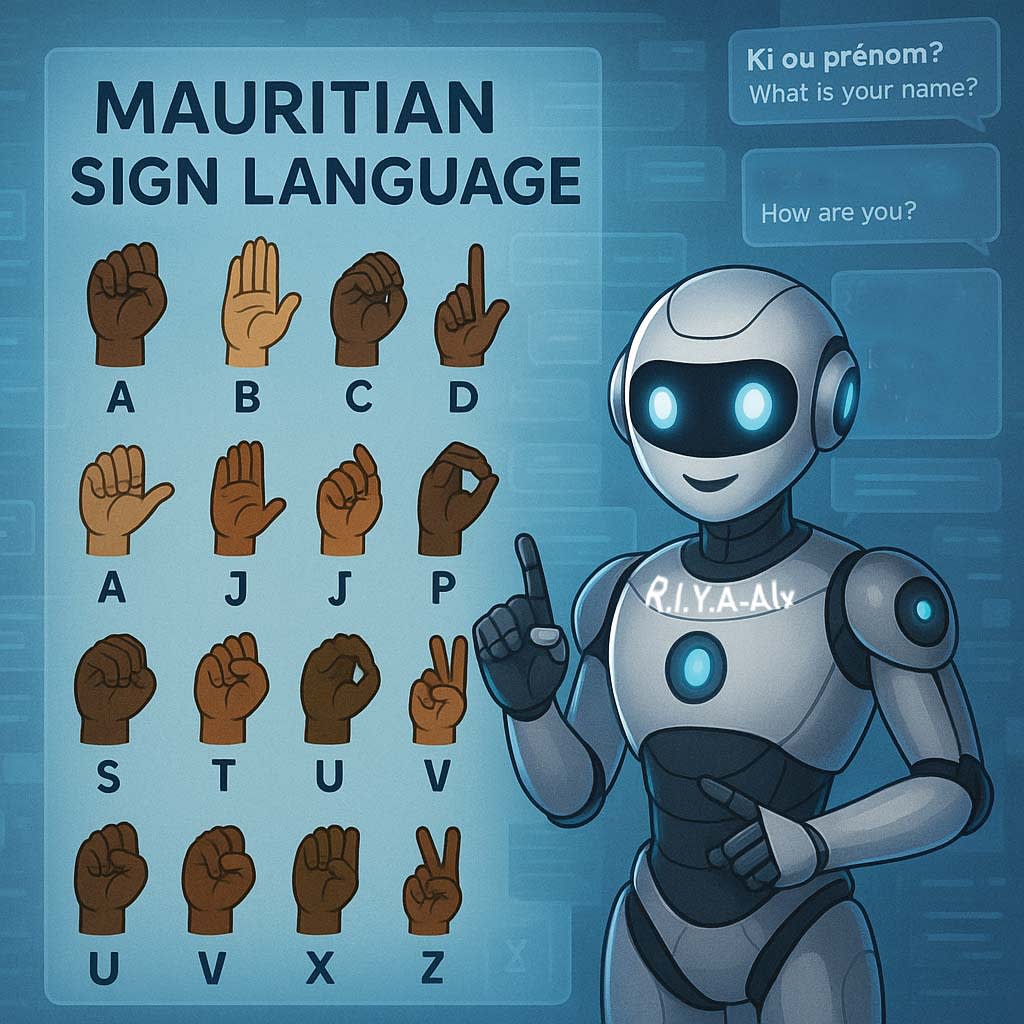
Mauritian Sign Language (MSL) is the indigenous sign language of Mauritius, a vibrant island nation in the Indian Ocean. Emerging in the late 1960s, MSL has evolved into a critical communication tool for the approximately 7,000 deaf individuals in Mauritius, a country with a population of 1.2 million. Unlike spoken languages such as English, French, or Morisyen, MSL relies on visual gestures, hand shapes, and facial expressions to convey meaning, fostering a sense of identity and community among the deaf population. Despite its cultural significance, MSL remains under-documented, with limited resources like the 2006 Dictionary and Grammar of Mauritian Sign Language by Gebert and Adone, and faces challenges in accessibility and widespread use.
The Role of Artificial Intelligence in MSL Accessibility
The communication gap between the deaf community and the hearing population often leads to social exclusion, a challenge that artificial intelligence (AI) is uniquely positioned to address. AI technologies, particularly in computer vision and machine learning, have shown promise in recognizing and translating sign languages into text or speech, and vice versa. In Mauritius, where resources for the deaf are scarce, AI-driven solutions could revolutionize accessibility by enabling real-time translation of MSL, supporting education, and integrating deaf individuals into broader societal interactions.
Globally, AI applications for sign languages, such as SignAll and StorySign, have demonstrated success in translating American Sign Language (ASL) and other sign languages. However, these solutions often rely on expensive hardware or subscription-based models, making them inaccessible for widespread, cost-free use in regions like Mauritius. The development of a tailored AI system for MSL could bridge this gap, offering a scalable, affordable tool to enhance communication and education for the deaf community.
The Quad Dev Team’s Vision and Vishal Coodye’s Leadership
Leading the charge in Mauritius is the Quad Dev Team, a group of innovators supervised by Vishal Coodye, a prominent Mauritian software engineer and AI advocate. Coodye has long been driven by a passion to leverage technology for social good, particularly to improve the lives of impaired individuals. Since 2014, he has worked to create AI solutions that reflect Mauritius’s unique cultural and linguistic landscape, notably through his development of R.I.Y.A-Aix, the country’s first AI platform tailored to local challenges. His vision for MSL is ambitious: to develop a Universal Sign Language platform that translates MSL and other sign languages into text and speech in real time, making it freely available to the public.
The Quad Team’s project aims to create a software program that uses AI-driven computer vision to interpret MSL gestures accurately. Unlike existing solutions that require costly hardware like sensor-equipped gloves or multiple cameras, the team is focused on building a resource-efficient system that can run on standard devices, such as smartphones or laptops, ensuring accessibility for all. This initiative aligns with Coodye’s broader mission to foster inclusivity and empower Mauritius’s deaf community through technology.
Funding Needs: The $20,000 Challenge
To bring this vision to reality, the Quad Team requires $20,000 to acquire a unique software program license critical for developing their AI system. This funding will enable the team to access advanced AI tools and libraries necessary for training models to recognize MSL’s unique gestures and linguistic structure. The license will also support the integration of features like real-time translation and customizable sign recognition, allowing users to adapt the system to regional variations in MSL.
The funding will cover:
Software License Acquisition: Securing proprietary tools for computer vision, natural language processing and AI programming integration with existing AI model.
Dataset Development: Creating a comprehensive dataset of MSL signs, including video recordings validated by native signers.
System Optimization: Ensuring the software is lightweight and compatible with widely available devices.
Community Engagement: Collaborating with the deaf community and organizations like the Society for the Welfare of the Deaf to ensure the system meets real-world needs.
Without this funding, the project risks delays, limiting its potential to transform communication for Mauritius’s deaf population.
Toward a Universal Sign Language Platform
The Quad Team’s ultimate goal is to develop a Universal Sign Language platform that not only supports MSL but also has the flexibility to incorporate other sign languages. This open-access platform would be freely available, removing financial barriers that often restrict access to assistive technologies. By focusing on cost-effective, scalable solutions, the team aims to set a precedent for other developing nations, demonstrating how AI can enhance accessibility without prohibitive costs.
This vision builds on global efforts, such as the Signs platform, which uses AI to teach and validate ASL signs, and Sign-Speak, which translates ASL in real time. The Quad Team plans to adapt these concepts to MSL, incorporating local expertise and cultural nuances to ensure the system resonates with Mauritian users. For example, MSL’s unique grammatical structure, such as its subject-object-verb (SOV) word order, will be a key focus of the AI model’s training.
Vishal Coodye’s Commitment to Accessibility
Vishal Coodye’s dedication to improving the lives of impaired individuals through technology is deeply personal. His work with R.I.Y.A-Aix showcased his ability to create AI solutions tailored to Mauritius’s needs, from enhancing financial compliance to improving agricultural productivity. For Coodye, the MSL project is a continuation of this mission, combining his technical expertise with a commitment to social equity. By leading the Quad Team, he is fostering a new generation of Mauritian innovators who share his vision of using technology to bridge societal gaps.
Coodye’s emphasis on ethical AI development ensures that the project prioritizes data privacy and inclusivity, addressing concerns about algorithmic fairness that are critical in assistive technologies. His collaboration with local stakeholders, including the University of Mauritius and the Society for the Welfare of the Deaf, underscores his commitment to community-driven solutions.
Challenges and Opportunities
Developing an AI system for MSL is not without challenges. The limited documentation of MSL, with only a handful of resources like the 2006 dictionary, means the Quad Team must invest significant effort in creating a robust dataset. Additionally, MSL’s linguistic complexity, including its emerging morphology and regional variations, requires sophisticated AI models capable of handling diverse gestures and contexts.
However, these challenges also present opportunities. By building a dataset validated by native MSL signers, the Quad Team can contribute to the preservation of this endangered language, much like efforts to revitalize Maritime Sign Language in Canada. Furthermore, the project’s focus on affordability and open access aligns with Mauritius’s broader AI strategy, positioning the country as a potential leader in inclusive technology in Africa.
The Quad Team’s initiative to develop an AI-driven Universal Sign Language platform, under Vishal Coodye’s leadership, represents a transformative step toward accessibility for Mauritius’s deaf community. With $20,000 in funding, the team can acquire the necessary software license to build a system that makes MSL accessible to all, free of charge. This project not only addresses the communication barriers faced by the deaf but also embodies Coodye’s lifelong commitment to using technology for social good. As Mauritius continues to embrace AI innovation, this endeavor could serve as a model for inclusive, community-driven technological progress across the continent.
👐Share the story. Help the Quad Team fund this dream:
You may contribute to make this project become a reality through Paypal
https://www.paypal.com/ncp/payment/Q963ZZW8EXEPC
Candice Marjorie. Independent Press. France.
About the Creator
Enjoyed the story? Support the Creator.
Subscribe for free to receive all their stories in your feed.
Comments