
Mason Gooding on the Dissonance of Growing Up with Cuba Gooding Jr.: "A Different Guy at Home"
The ‘Scream 7’ star opens up about the confusion of “speed-parenting,” the jarring contrast between his father’s public charisma and private exhaustion, and how becoming an actor himself finally bridged that emotional gap.

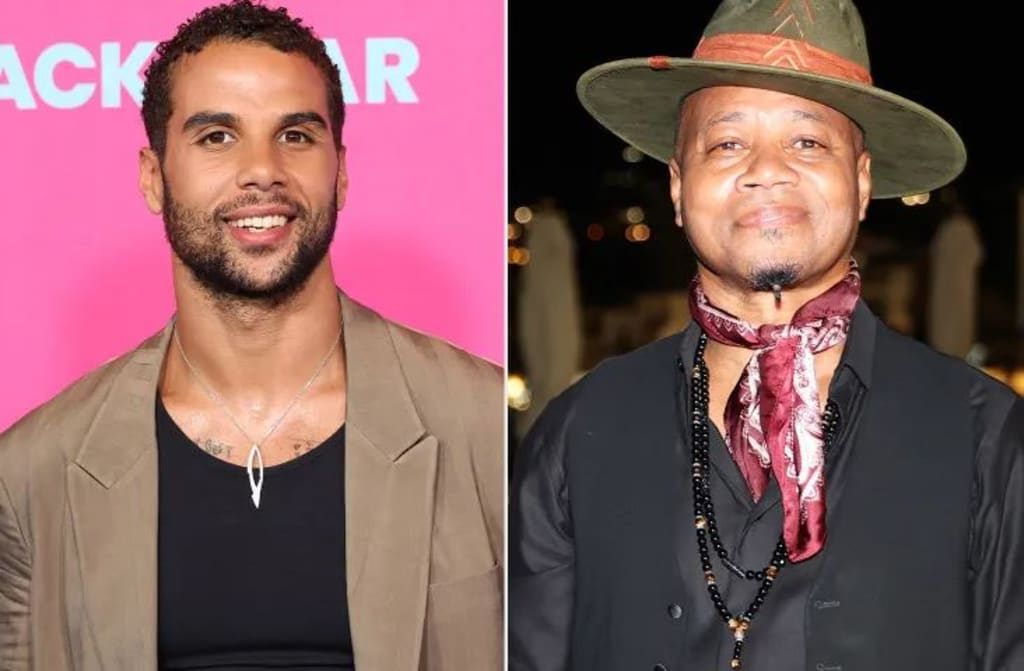
Mason Gooding has built a successful acting career in his own right, but navigating the shadow of his famous father, Cuba Gooding Jr., required reconciling two vastly different versions of the same man. On the July 28 episode of the Wildmen podcast with Dylan Sprouse and Brenden Columbus, the 29-year-old actor offered a candid reflection on his childhood, revealing how his father’s celebrity created a complex dynamic defined by absence, performative positivity, and what he calls “speed-parenting.” Now an adult in the same industry, Mason says he finally understands the pressures that shaped their relationship but not before urging fellow actor-parents to recognize that their children consume their public image just as critically as any audience does.
The Jarring Contrast Between Public Charm and Private Reality
Cuba Gooding Jr. was at the peak of his fame when Mason was born in 1996, fresh off his Oscar-winning role in Jerry Maguire. For young Mason, this meant his primary exposure to his father came through screens and interviews rather than daily presence. “I have probably a stronger relationship and understanding based on who they were publicly than who they were privately,” Mason admitted. This created a profound cognitive dissonance: “You’re so positive and charismatic in these interviews, and then you come home, and it’s a different guy. And I didn’t get that correlation, or lack thereof.”
The disconnect wasn’t merely about personality shifts; it was structural. Cuba’s demanding schedule meant long absences followed by intense, compressed periods of parenting upon return. Mason described this as “speed-parenting,” a frantic attempt to cram weeks of guidance, criticism, and connection into a narrow window. For a child, this inconsistency could feel destabilizing, making it difficult to form a coherent sense of who his father truly was beyond the curated persona.
Empathy Through Shared Experience
Despite the early confusion, Mason’s perspective has evolved now that he’s experienced the same professional demands. He recognizes that his father’s behavior stemmed from a universal parental fear amplified by Hollywood’s rigors: missing milestones and losing time. “An actor’s worst fear is leaving their family for a project for months at a time and subsequently missing their spouse’s or their kids’ major milestones,” Mason explained. That anxiety manifests as an overwhelming need to compensate upon return, which can inadvertently create pressure rather than presence.
“All people fear the creep of time, and how it affects their relationships,” he reflected. This insight hasn’t erased the complexity of his upbringing, but it has replaced judgment with compassion. Understanding that his father’s “different guy” at home was often exhaustion, guilt, or desperation to reconnect, not rejection has allowed Mason to integrate both versions of Cuba into a more complete picture.
A Warning to Actor-Parents
Mason’s reflections carry a pointed message for current and future actor-parents: your public performance doesn’t stop at the doorstep. “Your public image is being consumed by your child the way an audience does,” he cautioned. Children don’t separate the red carpet smile from the kitchen table silence; they absorb both as data points in constructing their understanding of you. This awareness, Mason suggests, should inform how performers manage their careers and their homes not to eliminate the tension entirely, but to acknowledge its impact openly.
His advice isn’t prescriptive perfection but mindful intentionality. Recognizing that children are active interpreters of parental duality can foster honest conversations about work, absence, and identity conversations that might have eased his own childhood dissonance.
Family Legacy and Moving Forward
Mason’s openness adds nuance to the Gooding family narrative. His parents, Cuba and Sara Kapfer, raised three children: Spencer (b. 1994), Mason (b. 1996), and Piper (b. 2005) before separating in 2014 after 20 years of marriage. Despite the challenges of spotlight-raised kids, Cuba stated in 2014 that they’d “raised real good kids” who navigated fame “pretty well.” Mason’s podcast appearance validates that resilience while honoring its cost.
Today, as Mason promotes Scream 7 and builds his own legacy, his willingness to articulate these complexities serves dual purposes: personal catharsis and cultural contribution. In an era where celebrity offspring increasingly speak candidly about inherited fame’s psychological toll, his voice adds maturity to the conversation one that acknowledges pain without blame, and growth without erasure. For fans who’ve only known Cuba as the exuberant Oscar winner or the troubled tabloid figure, Mason offers something rarer: the human truth beneath both.
About the Creator
Mark Lim
Hi I am mark an automotive student and a car, tech and food enthusiast ! Im gonna try and post daily & hope you enjoy what I write and do share my page with people you know. I would gladly appreciate it! Cheers
Enjoyed the story? Support the Creator.
Subscribe for free to receive all their stories in your feed.
Comments
There are no comments for this story
Be the first to respond and start the conversation.