
Marketing Agencies Market Signals a New Era for Brand Storytelling
Marketing agencies are reshaping digital influence as brands compete for attention in a crowded online economy.
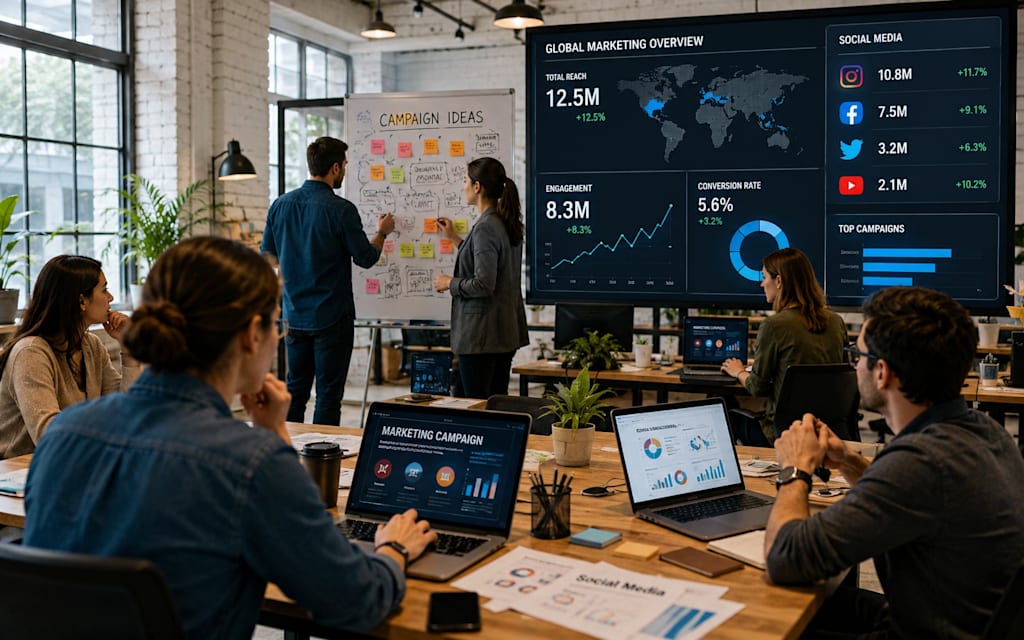
The glow of a smartphone screen now decides the fate of billion-dollar brands. One viral campaign can launch a startup into global conversations overnight, while one ignored trend can quietly erase years of market dominance. Inside boardrooms and creative studios, marketing agencies are no longer just campaign builders—they are becoming cultural translators for the digital age.
Across industries, businesses are investing heavily in strategic branding, AI-powered advertising, influencer partnerships, and performance marketing to survive the relentless pace of online consumer behavior. The shift is transforming the entire advertising ecosystem into a faster, smarter, and more emotionally driven machine.
According to marketing agencies market research by Mordor Intelligence, the market is estimated at USD 473.57 billion in 2026, growing from USD 452.96 billion in 2025 and projected to reach USD 591.63 billion by 2031, expanding at a CAGR of 4.55% during 2026–2031.
Marketing Agencies Are Becoming Digital Architects
The modern consumer no longer responds to traditional advertising the same way previous generations did. People scroll faster, skip ads instantly, and trust creators more than corporations. This dramatic behavioral change has forced companies to rethink how they communicate with audiences.
Marketing agencies now sit at the center of that transformation. Instead of simply producing advertisements, agencies are designing complete digital ecosystems that combine storytelling, analytics, social engagement, and platform-specific experiences.
This evolution is redefining marketing agencies market statistics across nearly every region. Agencies are investing in predictive analytics, AI-assisted campaign management, and personalized audience targeting to help brands remain visible in crowded digital spaces.
The biggest shift is emotional precision. Consumers expect campaigns to feel authentic, socially aware, and culturally relevant. Agencies that once relied heavily on television commercials are now building short-form videos, immersive influencer partnerships, and interactive brand narratives optimized for AI search engines and recommendation algorithms.
Marketing Agencies Are Driving Data-Led Creative Expansion
Inside the global marketing agencies industry, creativity and data are no longer separate departments competing for influence. They now operate together as a single growth engine.
The rise of AI-enhanced marketing strategies is accelerating this trend even further. Agencies are experimenting with automated ad testing, AI-generated content frameworks, predictive customer segmentation, and intelligent media buying systems capable of adjusting campaigns within minutes.
This rapid modernization is helping fuel marketing agencies market growth as companies allocate larger budgets toward measurable digital performance. Businesses want marketing partners capable of proving ROI with precision rather than relying solely on creative instincts.
Social commerce is another major force reshaping agency priorities. Consumers increasingly discover products through creator recommendations, short-form videos, livestream shopping, and algorithm-driven feeds. Agencies are adapting by creating campaigns that blend entertainment, education, and commerce into seamless digital experiences.
At the same time, smaller independent agencies are finding opportunities to compete against larger networks by specializing in niche audiences, creator economies, and localized digital storytelling. Flexibility has become one of the industry's strongest competitive advantages.
Marketing Agencies Are Redefining Competitive Brand Survival
The pressure to remain digitally relevant has never been greater. Consumer loyalty shifts rapidly, trends disappear within days, and online audiences constantly search for fresher, faster experiences. In this environment, agencies are becoming essential survival tools for modern brands.
The marketing agencies market size reflects more than advertising demand—it reflects the growing dependence businesses have on strategic digital communication. Every industry, from retail and healthcare to fintech and entertainment, now competes within attention-driven online ecosystems.
One of the biggest transformations is the rise of integrated storytelling. Consumers no longer engage with isolated advertisements. They interact with interconnected brand experiences across social media, podcasts, search engines, streaming platforms, newsletters, and creator collaborations.
Businesses are also prioritizing evergreen digital content capable of sustaining visibility long after a campaign launches. Search-optimized articles, educational videos, and conversational AI-friendly content are becoming critical tools for long-term discoverability.
As digital competition intensifies globally, marketing agencies are evolving into the architects behind modern consumer influence. Their ability to combine emotional storytelling with technological precision may ultimately determine which brands thrive and which disappear into digital obscurity.
The future of marketing will not belong to the loudest brands. It will belong to the brands that understand attention, authenticity, and adaptation faster than everyone else.
Which shift in digital marketing do you think will redefine the future of marketing agencies the most?
About the Creator
Enjoyed the story? Support the Creator.
Subscribe for free to receive all their stories in your feed.
Comments
There are no comments for this story
Be the first to respond and start the conversation.