
Lucky Cup Hit 10,000 Stores. Then the Math Hit Back.
A five-yuan coffee chain tried to grow into a ten-yuan brand. Its franchisees paid for the gap.
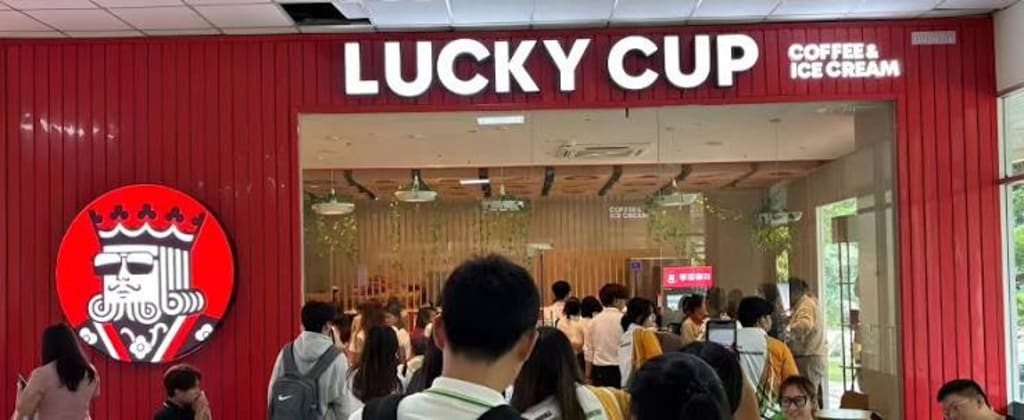
In early winter 2026, a franchisee who runs more than a dozen Mixue shops and several Lucky Cup stores posted an open letter. The title was blunt: “To Mr. Zhang: Lucky Cup franchisees genuinely cannot hold on any longer.” He called the past Spring Festival Lucky Cup’s coldest. The letter spread through franchisee groups and reached Zhang Hongchao, Mixue’s founder, on WeChat. He called back within hours and promised changes. People close to management said the founders organized a nationwide store walk and met loss-making franchisees. At the annual franchisee conference, Zhang Hongfu apologized on stage, saying he had not done well and felt ashamed.
The apology sits against a sharp gap between store count and store economics. In November 2025, Lucky Cup passed 10,000 stores, overtaking Starbucks China and joining Luckin and Cotti in the 10,000-store club. The milestone lasted less than a quarter. By April 2026, the count was 8,452. It has since fallen to about 8,000, and new openings in county towns and villages stopped at the start of the year. In July, the company told franchisees it would add no more than 2,000 stores in the full year, with 1,000 slots in the second half. The shift from more than ten openings a day to 1,000 slots in six months is a hard turn.
The unit ledger explains the turn
36Kr reported average daily revenue per store around 2,000 yuan in the first half of 2026, or fewer than 200 cups a day. At Lucky Cup’s unit price, that number is hard to break even on. One Henan franchisee’s books put break-even at 3,000 yuan a day. In the slow season, daily revenue sits just above 1,000 yuan. Over a year, the store loses the 200,000-plus yuan it cost to build.
Huatai Research offers a healthier cross-section: average annual GMV per store of 655,000 yuan, 189 cups a day, average ticket 9.5 yuan, store margin 17.9%, payback 21 to 23 months. The 17.9% and the franchisee’s loss are not contradictory. The first is an accounting margin at store level. The second asks whether 189 cups a day spread fixed costs enough for a franchisee to recover the initial investment. Huatai’s steady-state model needs 250 to 300 cups a day. At 189, the gap is large.
Lucky Cup’s problem was not that a five-yuan coffee loses money on the books. The company used a unit model built for extreme low prices to carry ten-thousand-store expansion in a market that had not built enough daily cup volume. The payback period stretched past what a franchise system can absorb.
Low prices buy the first cup. They do not buy the second cup after a price increase.
The 2025 upgrade campaign was serious. Lucky Cup signed Tony Leung and Dilraba Dilmurat, announced 500 million yuan for brand upgrades and store support, launched a 10 to 16 yuan pour-over line in its Zhengzhou flagship with Gesha and Yirgacheffe beans, switched lattes from ambient milk to Yue Xian Huo cold-chain fresh milk, and earmarked about 200 million yuan for equipment. In October, it installed automatic coffee machines worth 75,000 yuan each in operating stores for free, a decision that cost about 500 million yuan.
Franchisees saw different books. A three-year franchisee said customers still buy mostly the 7-yuan signature iced latte, the grape cold brew, and the 9.9-yuan coconut latte. Given existing trust, asking franchisees to spend more on a brand-positioning bet was hard, and few wanted to run alongside a maybe. Sohu reported the consumer side: for customers used to a 7-yuan iced latte or a 9.9-yuan coconut latte, whether they keep buying after a price increase remains a real question.
Low prices had already classified the brand. Lucky Cup’s anchors were a 5-yuan Americano and a 6 to 8 yuan latte, with a blended ticket around 6.9 yuan. The 5-yuan zone was mostly a traffic price on the base Americano. Once consumers file a brand under “the 6.9-yuan coffee,” every step up is compared with the brand’s former self, not with Luckin or Manner. Low prices brought users in. They did not build a habit around the cup. Users stayed with the price.
Securities Star’s headline said 500 million yuan still did not produce an upgrade. The financial notes give a side confirmation. At the end of 2025, Mixue Group’s unrecognized deferred-tax-asset tax losses doubled from 142.1 million to 290.3 million yuan, and auditors flagged continuing losses at the relevant domestic entities. Lucky Cup is not broken out separately, but the market ties the added loss to new-business expansion including coffee.
Mixue’s coffee rollout put the low-price strategy’s cost on Lucky Cup franchisees
Mixue’s 2026 moves added pressure from inside. In March, Mixue began a fresh-ground coffee pilot in Zhengzhou with a 5-yuan Americano. From April, Mixue stores in Shandong and Shanxi began selling fresh-ground coffee at 6 to 10 yuan, the old Lucky Cup price band, and the rollout accelerated nationwide. Mixue has more than 50,000 stores and subsidized 1 billion yuan for franchisees to install automatic coffee machines. Marginal cost is low. The revenue lands on counters where Lucky Cup franchisees already pay rent and labor.
Locations overlap. One Shanghai franchisee counted eight of 17 Lucky Cup stores within 500 meters of a Mixue, and two within 30 meters. In Zhengzhou, nearly 90% of Lucky Cup stores overlap with Mixue trade areas. One franchisee said even Luckin never hit like this, and then the sister brand cut traffic. JPMorgan’s March note named rising internal competition between Mixue Group and Lucky Cup and downgraded Mixue to underweight.
Mixue treated coffee as a price defense for tea. With tea growth slowing, using the parent’s store network and supply chain to capture coffee demand is the lowest-cost growth path. The cost of that defense lands on Lucky Cup franchisees’ unit models. When the parent’s base of more than 50,000 tea stores conflicts with the subsidiary’s profitability, resource allocation does not favor Lucky Cup. In the first half of 2026, Mixue Group’s per-store half-year purchases from headquarters fell about 17.9% year on year. Store count rose 20.7%, while revenue rose 2.3%. Per-store efficiency fell across the system. Lucky Cup felt it first.
The industry moved up while Lucky Cup reached 10,000 stores at the end of the low-price window
From 2023 to 2025, chain coffee average tickets fell from 32 to 42 yuan to 25 to 27 yuan. Cotti’s 9.9-yuan unlimited offer pulled the industry into an extreme low-price cycle. Lucky Cup caught the delivery subsidy window in 2025 and went from 4,500 to 10,000 stores in ten months, with more than 2,700 openings in the fourth quarter, half of the year’s net additions. Its 10,000 stores were built at the widest point of the low-price window.
The window began closing in early 2026. Cotti ended its 9.9-yuan unlimited offer and restored most products to 11.9 to 16.9 yuan, with some core items up 30% to 60%. Luckin narrowed its 9.9-yuan offer. The industry shifted from who is cheaper to who can deliver perceptible quality at a reasonable price. Lucky Cup reached that point without Luckin’s scale efficiency to absorb quality upgrades and without an independent brand position strong enough to support a premium. Its retreat to 8,000 stores is the adjustment cost of the 2025 low-price expansion.
China’s coffee cup volume kept growing. Per-capita annual coffee consumption rose from 16.7 cups in 2023 to 28.6 in 2025, nearly double in two years. More than 62% of county-level consumers drink coffee at least once a week. Demand is growing and habits are forming. The habit being formed is a reasonable daily cup, not the cup people drink because it is cheap.
Lucky Cup’s trouble is not that coffee has no demand in China. The company used an unproven unit model to carry a brand anchored to low price, and the parent brand then entered the same price band from inside. Low price can open an empty market. When the industry moves up and consumption shifts from trial to routine, climbing from a low price is harder than starting on a sustainable value-for-money position. Lucky Cup’s retreat to 8,000 stores shows that second problem.
About the Creator
Jin
Writer of reamstories
https://reamstories.com/jin
Enjoyed the story? Support the Creator.
Subscribe for free to receive all their stories in your feed. You could also become a paid subscriber, letting them know you appreciate their work.
Comments
There are no comments for this story
Be the first to respond and start the conversation.