
Landscape Plan for AI Landscape Design: What Could This Outdoor Space Become?
You can stare at the same backyard for months and still have no clue what to do with it.


You can stare at the same backyard for months and still have no clue what to do with it. There is a tree you want to keep, too much lawn, maybe a patio that feels a little sad. You save a few garden photos. One looks great, another looks even better. But none of them tells you what those ideas would look like at your house. That is usually where the guessing starts.
Work With What Is Already There
A landscape plan can start from a photo rather than a blank drawing. Upload the place as it is now — weeds, old paving, awkward fence and all — and work from there.
For me, that makes more sense for early ideas. Most people are not starting with an empty piece of land. They are trying to figure out what to do with a space that already has a shape and a history.
Maybe the Tree Is Not the Problem
Take a fairly ordinary front yard. There is a mature tree close to the driveway, grass across most of the ground and not much happening near the house.
At first, you might think the whole yard needs changing. But once you start describing what you actually want, the job gets smaller.
Keep the tree. Put more plants near the house. Take out some of the lawn. Add a path, but nothing too formal.
A landscape plan gives those rough thoughts somewhere to go. You get to see them on your own yard, rather than on a beautiful house that happens to have completely different proportions.
And you might hate the path. Good. Now you know.
“Modern” Can Mean Almost Anything
This happens all the time with style references. Someone says they want a Modern yard, and everyone nods as if the picture is obvious.
It isn't.
One version might have large pavers and clipped plants. Another has grasses everywhere and barely any lawn. Put both against the same house and one may suddenly feel completely wrong.
Trying Modern, Natural, Cottage or Mediterranean on the actual photo makes the choice less abstract. The landscape plan is useful here because you can stop talking about whether a style sounds right and just look at it.
You do not even need to pick a winner immediately. Ruling something out is progress too.
The Useful Part Often Comes After the First Image
The first result will probably give you an opinion pretty quickly.
Maybe you like it. Maybe your first reaction is, “Why is there a bench there?”
That reaction is part of the process.
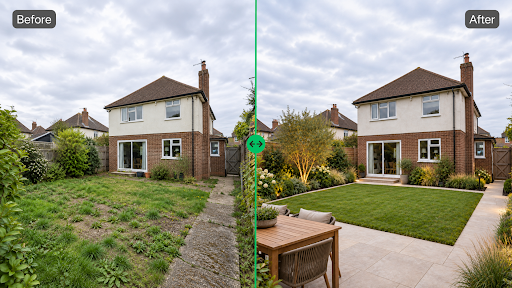
Put the Old and New Space Side by Side
Say you are looking at a small courtyard behind an office. Right now it is mostly paving, with a few plants pushed against the walls.
A new version has more greenery and a seating area. It feels warmer. Then you switch back to the original photo and realize the redesign has also made the courtyard feel much tighter.
That is hard to notice when you only look at the new image.
Before / After comparison gives the landscape plan a reference point. You are not asking whether the new version looks nice. You are asking whether it improves the place you started with.
Those are not quite the same question.
Keep the Good Part, Change the Weird Part
Sometimes almost everything works except one thing.
The planting is fine. You like the paving. The entrance looks much better. But there is a giant flower bed taking over a corner you wanted to keep open.
Starting again would be annoying because the next image could change all the parts you already liked.
Instead, that area can be selected in Landscape Editor and changed with a new prompt. Maybe you ask for lower planting. Maybe you remove it and put back some open paving.
This makes a landscape plan feel less disposable. You can mess with one part for a while without throwing away the rest.
A Backyard Has Its Own Little Problems
Home gardens tend to get much more specific.
You may not be wondering about the whole layout at all. You might just want to know whether the backyard needs denser planting, whether a water feature is too much, or whether the patio would feel nicer with greenery along one side.
A garden planner fits that narrower kind of project, with controls aimed more directly at residential gardens, including vegetation density, water features, time and weather.
A landscape plan has a wider job. The same photo-based approach can be used when the space is a rooftop, park, street, plaza or commercial outdoor area instead of somebody's garden.
You Do Not Need to Write Like a Landscape Designer
Prompts are another place where people make things harder than they need to be.
You know what bothers you about the space. Start there.
“Less Concrete, More Green” Is a Valid Starting Point
Suppose the entrance to a small business is mostly concrete. There are two trees, both healthy, so those should stay. The rest feels bare.
You could write: “Keep both trees. Add planting along the wall and around the entrance. Reduce some of the paving, but keep the middle open.”
Nothing fancy.
Once the landscape plan shows that version, you have something new to complain about — which is actually useful. Perhaps the planting hides too much of the building. Perhaps reducing the paving makes the entrance look smaller.
So you adjust it.
This back-and-forth is much closer to how people figure out what they want than writing one enormous prompt and hoping it gets everything right.
A Rooftop Is Not a Backyard
This sounds obvious, but outdoor design tools can make very different spaces start to look suspiciously similar.
A backyard might need privacy around the fence and a better connection to the patio. A rooftop may need separate areas for sitting and planting. A plaza could already have enough open space but need something around its edges.
Starting from the photograph helps keep those differences in the room.
A landscape plan for a public or commercial space should respond to that space. It does not need to turn every empty patch of ground into a lush residential garden.
Use the Landscape Plan While You Are Still Unsure
There is a stage in almost every redesign where nothing is decided yet.
You know the space could be better. You have a few references. Maybe you have talked about adding plants, changing the paving or putting a seating area somewhere. But the ideas are still floating around separately.
That is a good time for a landscape plan.
Not because an AI image can tell you exactly what should be built. It cannot. What it can do is make those half-formed ideas visible while they are still easy to change.
Look at one direction. Decide the planting is too much. Try another. Keep the old tree after all. Move the seating. Go back to the first style.
Eventually, you have something more useful than a folder full of inspiration images: a clearer sense of what you actually want to explore on the real site.
About the Creator
Enjoyed the story? Support the Creator.
Subscribe for free to receive all their stories in your feed.
Comments
There are no comments for this story
Be the first to respond and start the conversation.