
🦠 KILLER VIRUS ON A TRAPPED CRUISE SHIP: 3 Dead, 7 Infected, 149 Passengers Stranded — The Terrifying Hantavirus Outbreak Nobody Saw Coming
They boarded for the adventure of a lifetime. Now they’re quarantined in the middle of the Atlantic with a deadly rodent-borne virus — and no port will let them in.
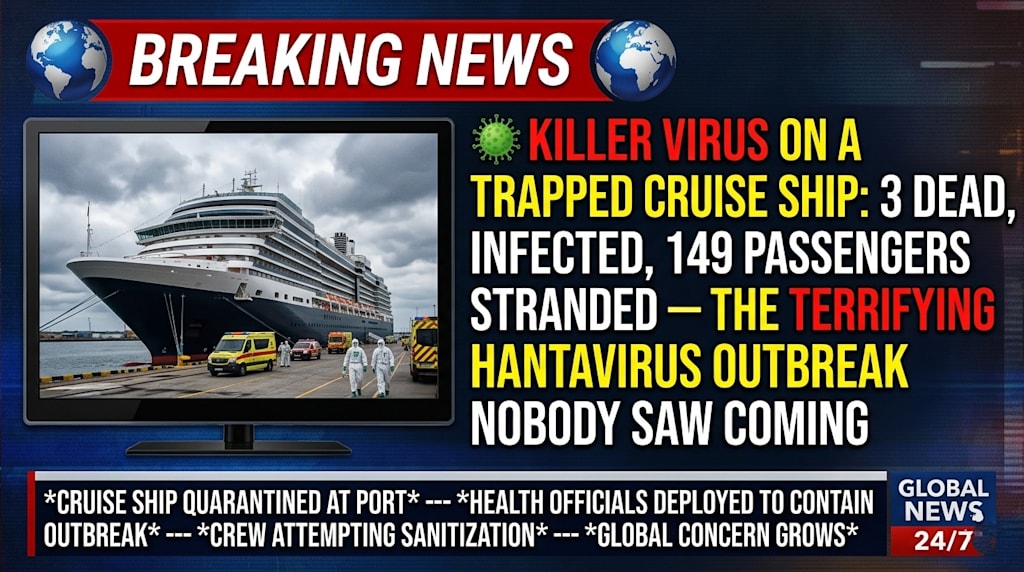
KILLER VIRUS ON A TRAPPED CRUISE SHIP: 3 Dead, 7 Infected, 149 Passengers Stranded — The Terrifying Hantavirus Outbreak Nobody Saw Coming
They boarded for the adventure of a lifetime. Now they’re quarantined in the middle of the Atlantic with a deadly rodent-borne virus — and no port will let them in.
It began, as so many tragedies do, with what seemed like a perfectly ordinary illness at sea. A 70-year-old Dutch man suddenly fell ill aboard the MV Hondius — a polar expedition cruise ship that had departed Ushuaia, Argentina, on April 1, bound for Antarctica and remote South Atlantic islands. He developed a fever, a headache, abdominal pain, and diarrhea. Then he went into respiratory distress. On April 11, he died on board. The ship sailed on. His wife, 69, became ill and was evacuated to South Africa. She collapsed at an airport while trying to fly home to the Netherlands, was rushed to a hospital, tested positive for a variant of hantavirus, and died on April 26.
By the time the Hondius anchored off Praia, the capital of Cape Verde — an archipelago nation off the west coast of Africa — the scope of the outbreak had become deeply alarming.
Seven cases of the rare rodent-borne hantavirus have been identified so far, including two confirmed cases and five suspected cases, the World Health Organization said Monday. The vessel with 149 people on board was refused entry to Cape Verde’s port due to public health concerns. A German passenger’s body remains on board. A British man evacuated to South Africa tested positive and is in critical condition in intensive care. Two crew members — one British and one Dutch — are experiencing acute respiratory symptoms requiring urgent care.
Among the 87 remaining passengers, 17 are Americans, 19 are from the U.K., and 13 are from Spain, alongside 61 crew members. The tour operator, Oceanwide Expeditions, is considering sailing the ship to the Canary Islands — Spain’s Las Palmas or Tenerife — where additional medical screening and handling could be organized with oversight from the WHO and Dutch health services. Dutch authorities are preparing two specialized aircraft equipped with medical equipment to evacuate the most seriously ill.
All cruise ship victims became ill between April 6 and 28, reporting symptoms including fever, gastrointestinal distress, rapid progression to pneumonia, acute respiratory distress syndrome, and shock — according to WHO.
Hantavirus is a rare, rodent-borne illness spread through contact with infected rodents or their urine, saliva, or droppings. It is not commonly associated with ocean-going vessels, which makes the origin of this outbreak deeply puzzling. Argentine provincial health authorities confirmed no passengers showed symptoms when the Hondius departed, but noted that symptoms can appear up to eight weeks after exposure, meaning passengers could have been silently incubating the disease before boarding. There has never been a reported case of hantavirus in Argentina’s Tierra del Fuego province, where Ushuaia is located. How the outbreak started remains under active WHO investigation.
Cape Verde’s Health Ministry sent a medical team of two doctors, a nurse, and a laboratory specialist to the ship across three visits, said Dr. Ann Lindstrand, a WHO official in Cape Verde — calling the situation “very tricky” for local authorities who must balance a public health event against their responsibility to protect the local population.
For the 149 people trapped aboard the Hondius, the uncertainty is its own form of trauma. One passenger captured the mood precisely: “We’re people, people with families, with lives, with people waiting for us at home. There’s a lot of uncertainty, and that’s the hardest part.” No disembarkation timeline exists yet. The ship drifts, waiting, while the WHO scrambles and governments negotiate who bears responsibility for a medical emergency in the middle of the Atlantic Ocean.
About the Creator
Enjoyed the story? Support the Creator.
Subscribe for free to receive all their stories in your feed.
Comments
There are no comments for this story
Be the first to respond and start the conversation.