
Key Factors to Consider Before Developing a Mobile App
Why Proper Mobile App Planning Matters

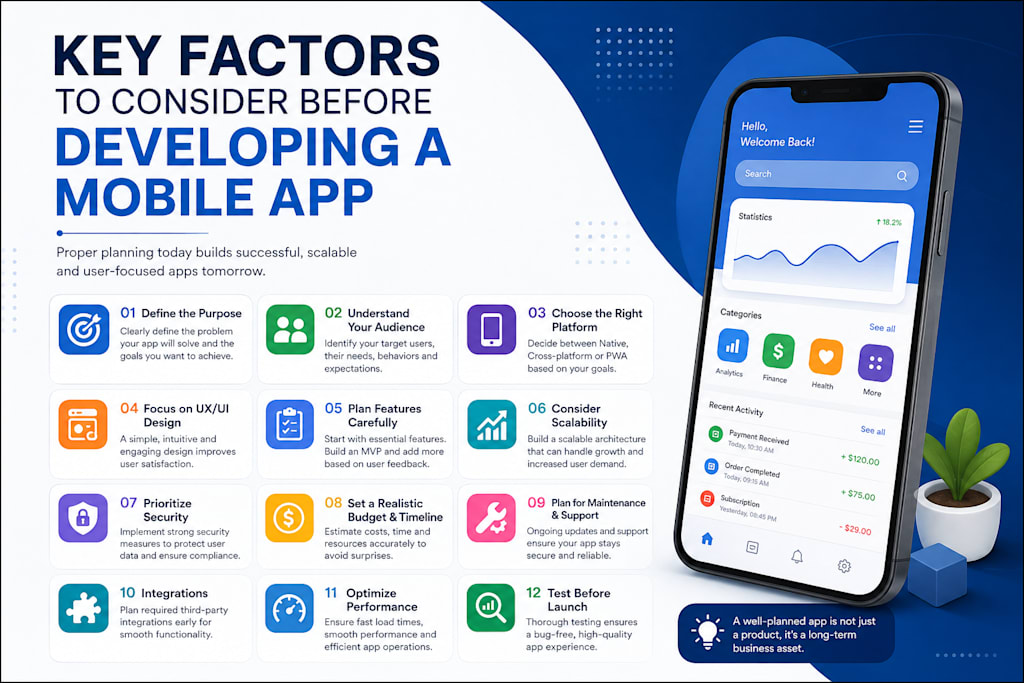
Mobile applications have become an essential part of modern business growth. From startups to enterprises, companies across industries are investing in mobile apps to improve customer engagement, streamline operations, and create better digital experiences. However, successful app development involves much more than simply turning an idea into code.
Many businesses rush into development without proper planning and later face issues related to budget overruns, poor user adoption, security vulnerabilities, or scalability limitations. Understanding the key factors before starting mobile app development can help businesses avoid costly mistakes and build applications that deliver long-term value.
Understand the Purpose of the Mobile App
Before writing a single line of code, businesses should clearly define why the app is being developed. A mobile app should solve a real problem or improve a specific user experience.
Questions to consider include:
What problem will the app solve?
Who is the target audience?
What business goals will the app support?
How will users benefit from the application?
Without a clear objective, mobile applications often become overloaded with unnecessary features that reduce usability and increase development complexity.
Identify the Target Audience
Understanding the audience plays a major role in determining app functionality, design, and overall experience. User expectations vary based on demographics, industry, location, and usage behavior.
For example:
Younger audiences may prioritize speed and modern UI
Business users may value productivity and security
E-commerce users may expect simplified checkout experiences
Healthcare users may focus on privacy and accessibility
Conducting market research and competitor analysis helps businesses create applications that better align with user expectations.
Choose the Right Platform
One of the most important decisions in mobile app development is selecting the right platform strategy.
Businesses generally choose between:
Native app development
Cross-platform app development
Progressive web applications (PWAs)
Native Development
Native apps are built specifically for iOS or Android using platform-specific technologies. They typically offer high performance and deeper device integration.
Cross-Platform Development
Cross-platform frameworks like Flutter and React Native allow developers to create apps for multiple platforms using a single codebase. This approach often reduces development time and costs.
Progressive Web Apps
PWAs combine web and mobile experiences, allowing users to access applications through browsers while offering app-like functionality.
The right choice depends on budget, performance needs, timeline, and business objectives.
Focus on User Experience (UX)
Even highly functional apps can fail if users struggle with navigation or usability. User experience should remain a priority throughout the development process.
Important UX considerations include:
Simple navigation
Fast loading times
Mobile responsiveness
Minimal user friction
Accessibility support
Consistent design patterns
Users typically abandon applications that feel confusing or slow. A clean and intuitive experience improves engagement and retention.
Plan the App Features Carefully
Feature overload is one of the most common mistakes in app development. Businesses often attempt to include too many features in the first version, increasing complexity and delaying launch timelines.
Instead, focus on building a Minimum Viable Product (MVP) that includes only the core functionalities needed to solve the primary user problem.
An MVP approach helps businesses:
Reduce initial costs
Test market demand
Collect user feedback early
Improve future iterations
Additional features can be introduced gradually based on user behavior and analytics.
Consider Scalability from the Beginning
Many businesses build apps that work initially but struggle when user traffic grows. Scalability planning ensures the app can handle increased demand over time.
Key scalability considerations include:
Cloud infrastructure
Database optimization
API architecture
Server performance
Modular code structure
Scalable architecture helps businesses avoid expensive rebuilds later.
Security Should Never Be Ignored
Mobile applications often handle sensitive customer data, payment information, and business operations. Weak security practices can damage customer trust and expose businesses to compliance risks.
Important security measures include:
Data encryption
Secure authentication
API protection
Role-based access controls
Regular security testing
Compliance with regulations like GDPR or HIPAA where applicable
Security should be integrated into the development lifecycle rather than treated as an afterthought.
Define a Realistic Budget
Mobile app development costs vary significantly depending on complexity, features, technology stack, integrations, and maintenance requirements.
Businesses should account for:
UI/UX design
Frontend and backend development
Third-party integrations
Testing and QA
Hosting and infrastructure
Ongoing updates and support
Choosing the cheapest option often creates long-term technical problems. Instead, businesses should focus on value, expertise, and development quality.
Think About Maintenance and Updates
App development does not end after launch. Mobile operating systems continuously evolve, requiring regular updates and maintenance.
Post-launch support may include:
Bug fixes
Performance optimization
Security patches
Feature enhancements
OS compatibility updates
User feedback improvements
A long-term maintenance strategy is critical for app stability and customer satisfaction.
Integration Requirements Matter
Modern mobile applications often rely on integrations with external systems and platforms.
These may include:
Payment gateways
CRM systems
Analytics tools
Cloud services
Social media platforms
ERP software
Push notification services
Planning integrations early helps prevent compatibility and performance issues during development.
Performance Optimization Is Critical
Users expect apps to perform smoothly across devices and network conditions. Poor performance directly impacts retention and user satisfaction.
Performance optimization areas include:
Efficient coding practices
Image optimization
API response times
Battery usage optimization
Reduced app size
Offline functionality where needed
A fast and responsive application improves both engagement and app store ratings.
Select the Right Development Partner
Choosing the right mobile app development company is one of the most important business decisions in the process.
An experienced development partner should offer:
Industry expertise
Transparent communication
Strong portfolio
Scalable development practices
Security-focused development
Ongoing support capabilities
Companies like Bytexus help businesses develop scalable, secure, and user-focused mobile applications tailored to industry-specific requirements and long-term growth strategies.
Test Before Launch
Comprehensive testing helps identify usability, security, and performance issues before users encounter them.
Testing should include:
Functional testing
Performance testing
Security testing
Device compatibility testing
User acceptance testing
Regression testing
Thorough QA reduces the risk of negative reviews and app abandonment after launch.
App Store Optimization (ASO) Is Important
Even a well-developed app may struggle if users cannot discover it. App Store Optimization improves visibility in app marketplaces.
ASO strategies include:
Keyword optimization
High-quality screenshots
Strong app descriptions
Positive reviews and ratings
Optimized titles and metadata
Visibility and discoverability are essential for app growth.
Final Thoughts
Developing a mobile app requires careful planning, strategic decision-making, and a strong understanding of user expectations. Businesses that focus only on development speed often overlook critical areas such as scalability, security, user experience, and long-term maintenance.
By carefully evaluating goals, audience needs, technology choices, and development partnerships before starting the project, businesses can significantly improve their chances of building a successful mobile application.
A well-planned mobile app is not just a digital product. It becomes a long-term business asset that supports growth, customer engagement, operational efficiency, and competitive advantage in an increasingly mobile-first world.
About the Creator
Vishwajeet Singh
A proven leader in digital transformation, Vishwajeet drives innovation, scalability, and business impact at Bytexus. His role focuses on strategic direction, enterprise-level execution, and building long-term value for global clients .
Enjoyed the story? Support the Creator.
Subscribe for free to receive all their stories in your feed.
Comments
There are no comments for this story
Be the first to respond and start the conversation.