
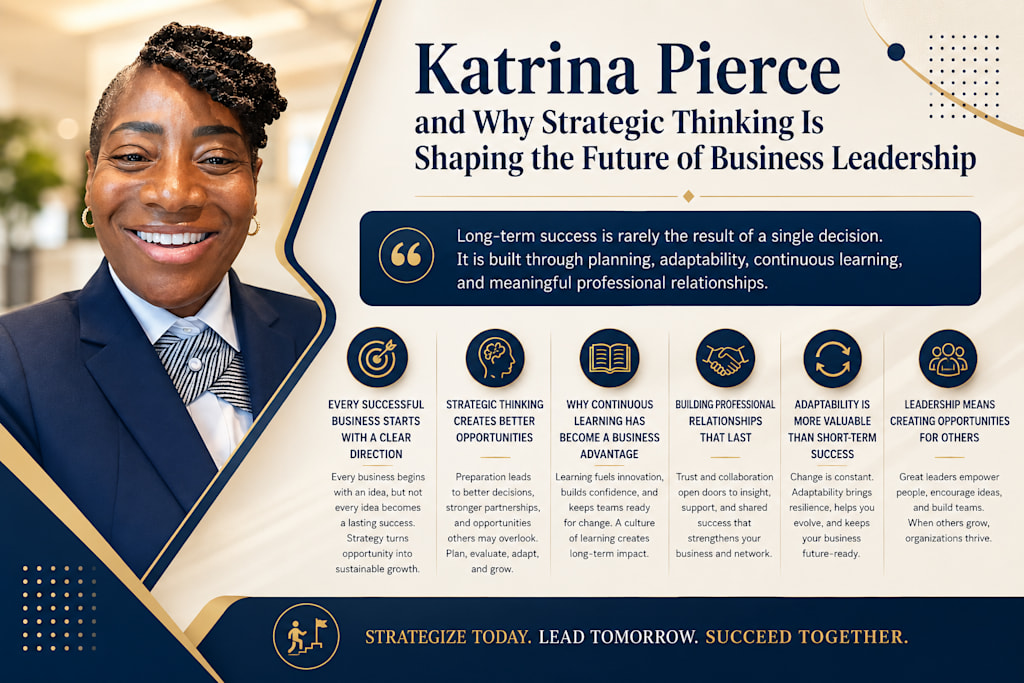
Katrina Pierce and Why Strategic Thinking Is Shaping the Future of Business Leadership
Long-term success is rarely the result of a single decision. It is built through planning, adaptability, continuous learning, and meaningful professional relationships.

Every Successful Business Starts With a Clear Direction
Every business begins with an idea, but not every idea becomes a lasting success. The difference often lies in strategy rather than opportunity alone. Companies that grow steadily usually spend time understanding their goals, identifying challenges, and creating a roadmap for the future instead of focusing only on immediate results.
The business environment today changes faster than ever before. New technologies, shifting customer expectations, and global competition require organizations to think beyond short-term achievements. They must prepare for change before it happens.
The perspective associated with Katrina Pierce reflects this broader understanding that sustainable business development depends on thoughtful planning and consistent execution. Rather than chasing every opportunity, successful organizations often focus on building a strong foundation that supports future growth.
Strategic Thinking Creates Better Opportunities
Many people believe success comes from reacting quickly, but experienced professionals understand that preparation often creates better outcomes. Strategic thinking allows businesses to evaluate risks, understand market trends, and make informed decisions.
Organizations that plan ahead can allocate resources more effectively, strengthen partnerships, and identify opportunities that competitors may overlook. This process is not about predicting the future with certainty. Instead, it is about preparing for multiple possibilities and remaining flexible enough to adapt.
Businesses that encourage strategic thinking among their teams often develop stronger problem-solving abilities. Employees become more confident in making decisions because they understand the larger goals of the organization.
Why Continuous Learning Has Become a Business Advantage
Learning does not end when formal education is complete. In modern business, continuous learning has become one of the most valuable competitive advantages.
Industries evolve rapidly. New regulations, technologies, and customer preferences require professionals to update their knowledge regularly. Companies that invest in learning create teams capable of responding to change with confidence.
Continuous learning also encourages innovation. When individuals explore new ideas and perspectives, they discover better ways to improve products, services, and internal processes. Small improvements made consistently often produce significant long-term results.
For organizations seeking sustainable growth, learning should become part of everyday culture rather than an occasional activity.
Building Professional Relationships That Last
Strong professional relationships create opportunities that cannot always be measured through immediate financial results. Trust, reliability, and mutual respect encourage collaboration between individuals and organizations.
Businesses frequently encounter unexpected challenges, from changing market conditions to operational disruptions. During these moments, dependable relationships become valuable assets because partners can work together toward practical solutions.
Professional networks also expand access to knowledge and experience. Conversations with industry experts, suppliers, customers, and colleagues often generate insights that improve decision-making.
Rather than viewing networking as simply exchanging contact information, successful professionals focus on creating genuine relationships built on long-term value and shared goals.
Adaptability Is More Valuable Than Short-Term Success
History shows that many successful organizations survived because they adapted when circumstances changed. Markets evolve, customer needs shift, and technology transforms entire industries.
Adaptability allows businesses to remain relevant without abandoning their core values. It encourages experimentation, learning from experience, and adjusting strategies when necessary.
Companies that resist change often struggle to compete, while organizations willing to learn and evolve are better prepared for future opportunities.
The ability to adapt is not a sign of weakness. Instead, it demonstrates resilience and a commitment to continuous improvement.
Leadership Means Creating Opportunities for Others
Modern leadership extends beyond managing tasks and achieving financial goals. Effective leaders create environments where people can develop skills, contribute ideas, and work together toward common objectives.
As businesses continue adapting to new challenges and opportunities, the perspective associated with Katrina Pierce highlights the importance of strategic planning, continuous learning, and strong professional relationships. Organizations that invest in these principles are better positioned for sustainable long-term success.
Encouraging collaboration increases motivation and strengthens organizational culture. Team members who feel valued are more likely to share innovative ideas and take responsibility for solving problems.
Leadership is therefore measured not only by individual accomplishments but also by the ability to help others succeed.
About the Creator
Katrina Pierce
Katrina Pierce started Avenue 27 (DBA Shea Nexus), which focuses on sourcing and exporting high-quality refined and unrefined shea butter from verified West African producers to UK distributors and manufacturers.
Enjoyed the story? Support the Creator.
Subscribe for free to receive all their stories in your feed.
Comments
There are no comments for this story
Be the first to respond and start the conversation.