
Japan's Imperial Succession Debate: Why 83% Support for a Female Emperor Still Won't Change the Law
The recent revision of the Imperial House Law allows for adoption of male-line descendants and lets imperial women retain their titles after marriage but the ban on female succession remains firmly in place, reflecting a deeper cultural and political divide.

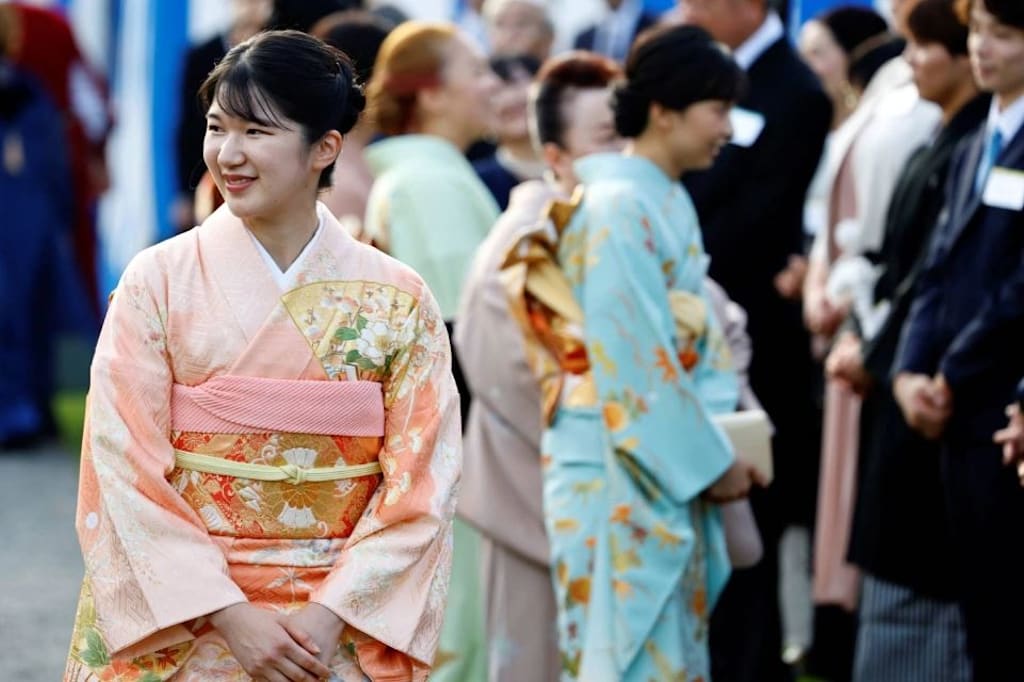
Japan's Upper House recently passed the first substantive revision of the Imperial House Law since it took effect in 1947. Beginning October 24, the imperial family may adopt male-line descendants of the eleven princely branches stripped of their royal status after World War II, although the adoptees themselves will not be eligible to inherit the throne. Imperial women also may retain their titles after marrying commoners. What the law still does not do, however, is allow a woman to inherit the throne.
Yet a ban on women inheriting the Japanese throne runs counter to public opinion. In June, a Mainichi Shimbun survey found more than 70% in favor of a female emperor. Kyodo News put support at 83%. Standing against this overwhelming public sentiment are the 316 seats the Liberal Democratic Party won in February's election, more than two-thirds of the Lower House on its own under Prime Minister Sanae Takaichi, the most prominent defender of male-only succession in Japanese politics.
The Democracy Paradox
From outside, this looks like a democracy that has stopped working. In fact, it is how consensus politics works in Japan, and to understand why, one must recognize that the succession fight and another apparently unrelated one over whether married couples may keep separate surnames are one fight.
First, the distinction that rarely survives translation: A female emperor, josei tenno, and a female-line emperor, jokei tenno, are different things. Japan has had eight reigning empresses, but every one was born of the male line, and none passed the throne to a child fathered by a man outside the bloodline. They were temporary custodians of the imperial line.
In the traditionalist reading, all 126 emperors descend from the first through fathers only, an unbroken mythical chain reaching back more than 2,600 years. That chain is not a feature of the institution. To conservative cultural nationalists, it is the institution.
This explains the shape of the new law. If Princess Aiko took the throne tomorrow, she would still be male-line because her father is the emperor. What alarms traditionalists is the step after. Her child's link to the imperial house would run through a mother, making that child a female‑line emperor seen by the more orthodox as not the continuation of the world's oldest dynasty but its end, and the quiet founding of a new one through her husband's family.
This is why Parliament would rather graft in distant cousins who have lived as commoners for 80 years than let the line pass through a woman standing right there. The adopted men will not reign, only sons born to them afterward. The blood must move through fathers, even fathers retrieved from the far end of a family tree.
The Household as the Atomic Unit of the State
That logic has a source. In the traditional Japanese ie, or family household, the name, the headship, and the register all pass through the father's line, and a wife enters her husband's family. The imperial house is not an analogy for that arrangement. It is the main house. Conservatives hold that every Japanese family is a branch of the emperor's one nation under one father and that this, not territory or language, is what makes the Japanese a people. Break the line, and you have not ended a dynasty. You have dissolved the family.
The register is where the two arguments fuse. Imperial family members have no ordinary koseki, the household registry that defines a legal family for every other Japanese citizen. When a princess marries a commoner, she leaves the record of imperial lineage and enters her husband's koseki, under his surname, as Princess Mako did in 2021. A female-line emperor would force lawmakers to answer, for the first time, how a commoner husband and his children fit into the state's register at all.
And the bloc that defends the male line is the bloc blocking selective separate surnames for ordinary couples. The overlap is not a coincidence of temperament. It is definitional. Both fights ask whether the household with its single name, its paternal headship, and its tidy register remains the atomic unit of the Japanese state.
The Gap Between Polling and Voting
The polling runs in parallel. In a Kyodo constitutional survey in May 2025, 71% favored letting couples keep separate surnames. Support has led opposition for years. In other words, the forms bend; the ie does not.
So why does an electorate that wants both changes keep re-electing the party that refuses them?
Because survey answers and votes measure different things. Ask whether a woman should reign and people answer on general fairness. By that standard the answer is obviously yes. But it is an opinion held at a low temperature. The imperial family does not affect anyone's rent.
The surname rule is a different matter. In 94% of marriages, it is the woman who gives up her name. The cost comes in the bank account, the driver's license, the published work that no longer carries your name, the professional identity built over twenty years and filed under someone else's. Many loathe it. Some marry late rather than accept it. Some never register their marriages at all.
The cost is real and it is not borne by a minority. The rule affects nearly every married woman. Yet conformity makes it difficult to know how many resent it, because the complaint is so often kept private.
The Political Problem
That is the political problem, and it is what foreign coverage misses when it frames Japan as a culture war waiting to erupt. There is no war because the same force operates on both sides. Conformity took the name, and conformity keeps the grievance private, so a burden carried by millions rarely becomes a political demand. It works twice.
The legislation tells the story. The Imperial House Law revision reached the Lower House on July 10 and passed it that same day, cleared the Upper House committee on July 16 and the full chamber on July 17, all in the session's final week. The maiden-name bill went nowhere. The LDP and the Japan Innovation Party pledged it in writing last October, but on May 12 the government decided not to submit it, citing a crowded legislative calendar. It now awaits an extraordinary session in the autumn.
Kyodo reported another reason. The opposition bloc that had campaigned on separate surnames was routed in February's election, reducing the pressure on the government to pursue a compromise. A party with a two-thirds majority in the Lower House found time for the throne but not for its own compromise on surnames once the political pressure had disappeared.
The Takaichi Landslide
February's general election was decided on the economy, tax cuts, and security, and Takaichi Japan's first female prime minister won it in a landslide on those terms. Her position on succession was not hidden. It simply was not the question. Japanese voters do not convert a survey preference into a vote until they sense that society as a whole has settled on a new consensus. Until that moment, 83% is not a mandate. It is a mood.
Change in Japan rarely arrives as a verdict. It accumulates out of sight, crystallizes at once, and is then declared to have been inevitable. The 70% and 83% who polled in favor of a female emperor are not hypocrites for failing to vote their conscience. They are waiting for the moment the question stops being abstract.
The Future of the World's Oldest Monarchy
Prince Hisahito is 19. The future of the world's oldest monarchy now rests on whether one young man has a son. When that wager begins to look precarious, the silent majority will stop being silent and the change will look sudden.
It will not have been.
Japan's Imperial House Law revision represents a significant if incremental step toward modernizing the world's oldest continuous monarchy. Yet the fundamental question of female succession remains unresolved, caught between overwhelming public support and deeply entrenched cultural and political forces.
The debate over the imperial succession is not merely a constitutional issue but a reflection of broader tensions within Japanese society. The parallel fight over separate surnames for married couples reveals that the ie the traditional family household with its single name, paternal headship, and unified registry remains the atomic unit of the Japanese state. The two debates are the same, and the outcome of one will inevitably shape the other.
For now, the male line endures, and the majority that favors change waits in silence. But as Prince Hisahito approaches adulthood and the pressures of succession mount, Japan's quiet revolution may eventually find its voice. Until then, the world's oldest monarchy continues its careful, deliberate march toward a future that may look very different from its past.
About the Creator
Mark Lim
Hi I am mark an automotive student and a car, tech and food enthusiast ! Im gonna try and post daily & hope you enjoy what I write and do share my page with people you know. I would gladly appreciate it! Cheers
Enjoyed the story? Support the Creator.
Subscribe for free to receive all their stories in your feed.
Comments
There are no comments for this story
Be the first to respond and start the conversation.