
It's Victory Day. Putin's Parade Has No Weapons, No Tanks, and No Confidence. Russia's Most Important National Celebration Has Become a Symbol of Its Own Failure.
May 9 is the date Putin has spent 25 years turning into the ultimate symbol of Russian power. This year, for the first time since 2000, the parade will have no military hardware. Internet is blocked in Moscow. A Ukrainian drone hit a building near the Kremlin this week. This is what four years of war have actually done.
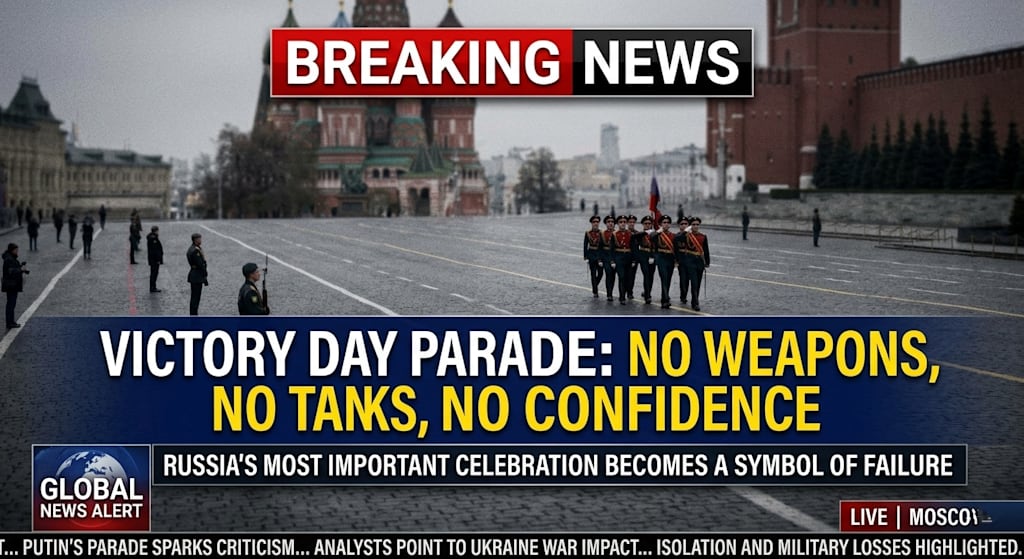
Victory Day — May 9, the date Russia commemorates the Soviet victory over Nazi Germany in 1945 — has been the cornerstone of Vladimir Putin's political identity for a quarter century. Each year, on the same square where Soviet leaders once stood to review the Red Army, Putin has presided over a parade of ever-more-sophisticated Russian weapons: intercontinental ballistic missiles on mobile launchers, T-90 tanks in formation, Iskander short-range ballistic systems, and — in recent years — the unveiling of hypersonic missiles designed to signal Russia's technological supremacy to adversaries watching from Washington, Brussels, and Beijing. The parade is not mere ceremony. It is Putin's annual proof of concept — evidence that Russia is a great power, that the war is winnable, that the sacrifices demanded of the Russian people are justified by an outcome worth achieving.
This year, for the first time in nearly two decades, there are no weapons. Russia's Defense Ministry confirmed that the 2026 parade will proceed without tanks, missiles, armored vehicles, or any heavy military hardware. The official explanation is "security concerns" over the threat of Ukrainian drone attacks on the event. Moscow's cell phone internet has been restricted for customers across the city in the lead-up to the parade. Banks have warned customers of limits on text messaging. Russian telecoms operators have issued blanket advisories. A drone — suspected of being Ukrainian in origin — successfully struck a luxury high-rise apartment building kilometres from the Kremlin earlier this week, penetrating Moscow's multiple-layered air defense system and detonating close enough to the seat of Russian power to make the paranoia entirely rational.
"More than four years since he launched what was supposed to be a quick conquest of Ukraine, he is unable even to hold the parade he wants on Red Square — never mind in Kyiv." — James Rodgers, author, The Return of Russia, May 2026
The political symbolism is devastating and deliberate. Russia launched its full-scale invasion of Ukraine on February 24, 2022, with many Western analysts and some Ukrainian officials predicting Kyiv could fall within days. Putin has spoken of Ukraine not as a legitimate country but as a historical mistake, a temporary aberration of Russian identity that the war would correct. Victory Day 2022 was supposed to be a celebration of that correction — a parade showcasing the trophies of a finished campaign. Four years later, the campaign is not finished. The weapons that were supposed to have won it have been expended at enormous rate against a Ukrainian military that has proved far more resilient, innovative, and internationally supported than Russian planners anticipated. The parade that was supposed to celebrate Ukraine's absorption now cannot safely include the weapons still being used to try to force it.
Ukraine has contributed to the humiliation with deliberate precision. President Zelensky announced Ukraine's own unilateral ceasefire starting midnight May 5 — two days before Russia's own proposed pause — in a move that simultaneously demonstrated goodwill and mocked Putin's ultimatum. "Russia's Defense Ministry believes it cannot hold a parade in Moscow without Ukraine's goodwill," Zelensky said on X, in a line that became instantly quotable precisely because it is true. Russia's threat to launch a "massive missile strike on the centre of Kyiv" if Ukraine disrupted the celebrations was itself a confession: to threaten Kyiv for an action taken in Moscow is to admit that Ukraine is not defeated and that Russia cannot guarantee its own security in its own capital during its own national holiday.
In smaller Russian cities, Victory Day parades have been cancelled entirely. Local governors have preemptively restricted public gatherings. Ukraine's new "Flamingo" cruise missiles struck a weapons manufacturing plant in Cheboksary — deep in central Russia — destroying navigation components for Russian naval and aerospace systems. Ukraine is now regularly striking targets more than 1,200 kilometres from the Ukrainian border. The war that was supposed to be over in days has reached the outskirts of Moscow and beyond. Putin will stand on Lenin's Mausoleum on May 9 and watch veterans march past. There will be music. There will be flags. There will be the faces of veterans who survived the actual Second World War and who are watching their country unable to win a war against its smaller neighbour four years in. The weapons will not be there. They are busy — being fired at people who refuse to stop fighting back.
About the Creator
Enjoyed the story? Support the Creator.
Subscribe for free to receive all their stories in your feed.
Comments
There are no comments for this story
Be the first to respond and start the conversation.