
Is Canada’s EU Courtship Realpolitik or Romance?
As Canadian Prime Minister Mark Carney prepares to address the European Parliament in Strasbourg, a question once relegated to the realm of political fantasy is gaining traction in Ottawa and Brussels: Could Canada join the European Union? While full membership remains a legal labyrinth and a political long shot, the surge in dialogue signals a profound strategic realignment driven by transatlantic friction and a shared desire for democratic resilience.

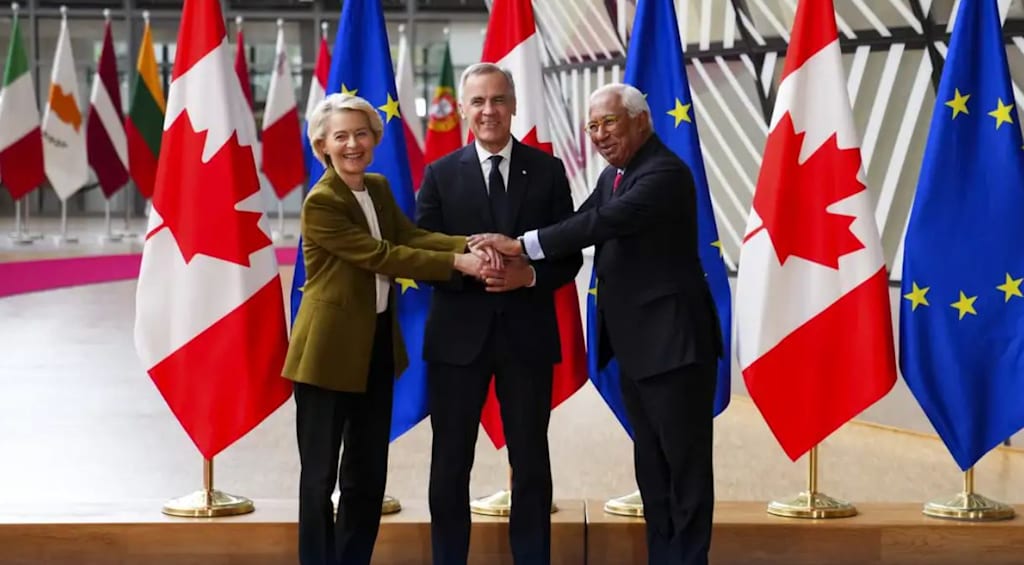
The timing of Prime Minister Carney’s visit is no coincidence. Arriving in Strasbourg on September 16 to speak at the State of the European Union (SOTEU) address, Carney steps onto the stage at a moment when Europe is redefining its security architecture and Canada is seeking to diversify its geopolitical dependencies. Although EU membership is not officially on the agenda, the subtext of the visit is clear: Canada is seeking a deeper, more institutionalized bond with the bloc, potentially exploring models like "associate status" that go beyond traditional trade agreements.
The Legal Labyrinth: Can a Non-European Country Join?
The immediate hurdle to Canadian membership is Article 49 of the Treaty on European Union, which states that any "European State" may apply to join. The definition of "European" is both geographic and political. While countries like Turkey and Cyprus have applied despite complex geographic realities, Canada’s location in North America presents a fundamental treaty barrier.
Amending the EU treaties to allow for non-European members would require unanimity among all 27 member states, a politically Herculean task. Furthermore, the EU’s current focus is on internal consolidation and the accession of Western Balkan nations, Ukraine, Moldova, and Georgia. Adding a G7 economy from another continent would require a complete overhaul of the EU’s institutional balance, budgetary contributions, and voting weights.
However, the concept of "associate status" offers a more feasible, albeit undefined, pathway. Unlike full membership, associate status could grant Canada participation in specific EU programs such as Horizon Europe for research, Galileo for satellite navigation, or even aspects of the single market for critical minerals without requiring adherence to the full acquis communautaire (the body of EU law). This model would allow for deep integration without the political toxicity of treaty change.
The Political Driver: Washington’s Unreliability
The primary catalyst for this rapprochement is not necessarily a love affair with Brussels, but a growing estrangement from Washington. Under the second term of President Donald Trump, the US-Canada relationship has been strained by aggressive tariff policies, demands for higher defense spending, and a transactional approach to alliances that unsettles Ottawa.
For Canada, the EU represents a stable, rules-based counterweight to American unpredictability. By deepening ties with Europe, Canada can reduce its economic overdependence on the US, which currently accounts for nearly 75% of its exports. For the EU, Canada is an attractive partner: a stable democracy, a rich source of critical minerals needed for the green transition, and a like-minded ally in the Indo-Pacific strategy.
The discussions around critical minerals are particularly significant. As the EU seeks to decouple its supply chains from China and Russia, Canada’s vast reserves of lithium, cobalt, and rare earths offer a secure alternative. A formalized partnership could see Canadian resources integrated into European battery and tech manufacturing, creating a transatlantic industrial base that is resilient to external shocks.
Beyond Trade: Security and Values
The upcoming talks are expected to cover joint high-tech and security-infrastructure projects, reflecting a shift from purely economic cooperation to strategic alignment. With Europe ramping up its defense capabilities in response to Russian aggression, Canada’s involvement in NATO and its technological prowess in AI and cybersecurity make it a valuable partner.
Moreover, both Ottawa and Brussels are grappling with the rise of authoritarianism and the erosion of democratic norms globally. A closer alliance would signal a commitment to defending liberal democratic values, from press freedom to judicial independence, in an increasingly multipolar world.
A Temporary Flirtation or a New Era?
Skeptics argue that this surge in interest is a temporary response to tensions with Washington, likely to fade if US-Canada relations improve under a different administration. However, the structural shifts in the global economy and security landscape suggest otherwise. The era of unquestioned American hegemony is giving way to a more fragmented world where middle powers like Canada must cultivate multiple strong partnerships.
While full EU membership remains a legal and political fantasy for now, the exploration of associate status and deeper integration is a serious strategic move. It reflects a recognition that Canada’s future security and prosperity are inextricably linked to Europe’s stability and success.
As Mark Carney takes the podium in Strasbourg, he will not be asking for a seat at the table of EU ministers. But he will be laying the groundwork for a new kind of table, one where Canada and Europe sit as equal partners, bound not just by trade, but by shared values, security interests, and a common vision for a resilient democratic order. Whether this leads to a formal union or just a stronger friendship, the message is clear: the North Atlantic bridge is being rebuilt, and this time, it’s being strengthened against the storms ahead.
About the Creator
Mark Lim
Hi I am mark an automotive student and a car, tech and food enthusiast ! Im gonna try and post daily & hope you enjoy what I write and do share my page with people you know. I would gladly appreciate it! Cheers
Enjoyed the story? Support the Creator.
Subscribe for free to receive all their stories in your feed.
Comments
There are no comments for this story
Be the first to respond and start the conversation.