
Iran's Parliament Speaker Just Told 90 Million Citizens to Practice "Frugality" as a Weapon Against America. What That Speech Reveals About the True State of Iran's Economy.
Iran's parliament speaker called "frugality" a "missile that people can fire into the heart of the enemy" and urged all citizens to practice saving as a form of economic warfare. Behind that extraordinary language is an extraordinary truth: Iran's economy is under devastating strain — and its government is asking its people to absorb the pain.
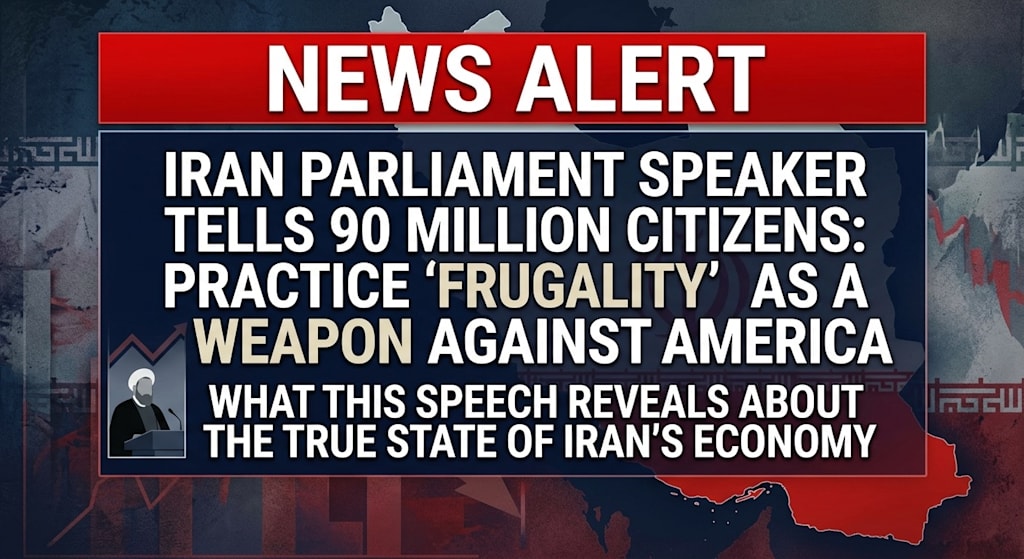
In a recorded audio message distributed to Iranian media in recent days, Iranian parliament speaker Mohammad Bagher Ghalibaf made a plea to the Iranian people that revealed more about the state of his country's economy than any official statistics could. "My request to all people is that you yourselves practice saving and frugality, and also seriously encourage others to do the same," Ghalibaf said, calling all "intellectuals and specialists" to approach the government directly with ideas to "solve the problems that arise because of the war." He described frugality as "a missile that people can fire into the heart of the enemy" — casting domestic austerity as an act of national resistance against American economic pressure. And then, in a moment of revealing comparison, he noted: "The people of America are facing a serious challenge from rising living costs." He was right about that. But the contrast he implied — that Iranians, by virtue of their "independence, dignity, faith and beliefs," would endure more — was also a confession: there is an enormous amount to endure.
Iran's economic situation after more than two months of war and blockade is severe by any objective measure. The country's oil exports — the primary source of government revenue — have been choked off by the U.S. naval blockade of Iranian ports, which has been in place since April 13. Iran's strategic petroleum reserve is being drawn down. Its currency, the rial, had already lost over 80 percent of its value against the dollar since 2018 due to previous rounds of U.S. sanctions, and the war has accelerated that depreciation. The national internet shutdown, imposed on February 28, has cut off tens of millions of Iranians from the digital platforms through which they earned income, conducted business, and accessed international financial systems. Iran's informal digital economy — which had become remarkably sophisticated precisely because it had to survive previous sanctions regimes — has been largely paralysed since the war began.
"Frugality is a missile that people can fire into the heart of the enemy." — Iranian Parliament Speaker Mohammad Bagher Ghalibaf, May 2026
The "experts say Iranians will endure" framing that Ghalibaf deployed is a standard feature of Iranian official communication in periods of economic crisis. It has been used before — during the 2012 sanctions regime, during the 2018 sanctions reimposition after Trump's withdrawal from the nuclear deal, and during the COVID-19 pandemic. Each time, the government has asked the Iranian public to bear costs it did not choose and was not consulted about. Each time, significant numbers of Iranians have complied — and significant numbers have protested. The 2022-2023 "Woman, Life, Freedom" uprising that followed the death of Mahsa Amini in morality police custody demonstrated the depth of Iranian public frustration with a government that demands sacrifice while delivering repression. That uprising was suppressed, but its underlying grievances were not resolved. The war has added new economic pain to pre-existing political discontent.
The practical consequences of Ghalibaf's "frugality" call are visible in Iranian markets and daily life. Reports from within Iran — filtered through journalists, diaspora networks, and the limited social media access that remains available via VPN — describe price surges of 40 to 70 percent on basic commodities, including cooking oil, rice, and meat, since the war began. Medicine availability has become patchy as pharmaceutical import chains have been disrupted. Fuel, despite Iran being a major oil producer, has been rationed in some regions as refinery output has been interrupted by infrastructure damage. The government's own budget projections, according to Iranian economists speaking to international media, are based on oil revenue assumptions that the naval blockade has made impossible to achieve.
Ghalibaf's comparison of Iran's suffering to America's rising gas prices is politically purposeful and economically misleading. American consumers are paying $4.46 per gallon of gas — a painful record. Iranian consumers are navigating a full wartime economic siege with no internet, no international banking access, rationed fuel, and a currency that has lost almost all its external value. The two situations are not comparable. But the comparison reveals something important about the Iranian government's strategy: it is trying to reframe a domestic economic crisis as evidence of shared suffering — to unite its population against an external enemy rather than redirect anger toward an internal government. Whether that framing continues to hold as the war drags on without resolution is one of the most important questions in the diplomacy underway today. Iran's negotiators are not just responding to American proposals. They are responding to a clock — the clock that runs on their own people's capacity to endure.
About the Creator
Enjoyed the story? Support the Creator.
Subscribe for free to receive all their stories in your feed.
Comments
There are no comments for this story
Be the first to respond and start the conversation.