
Iran's Foreign Minister Just Flew to Beijing. The Meeting With China Is the Most Important Diplomatic Encounter Before Trump's Summit — and Here Is Why It Changes Everything.
For the first time since the war began, Iran's top diplomat walked into the Chinese Foreign Ministry. He briefed Wang Yi on the state of talks with Washington. China pressed Iran to reopen the Strait. The meeting one week before Trump's Beijing summit could determine whether a deal gets done — or falls apart.
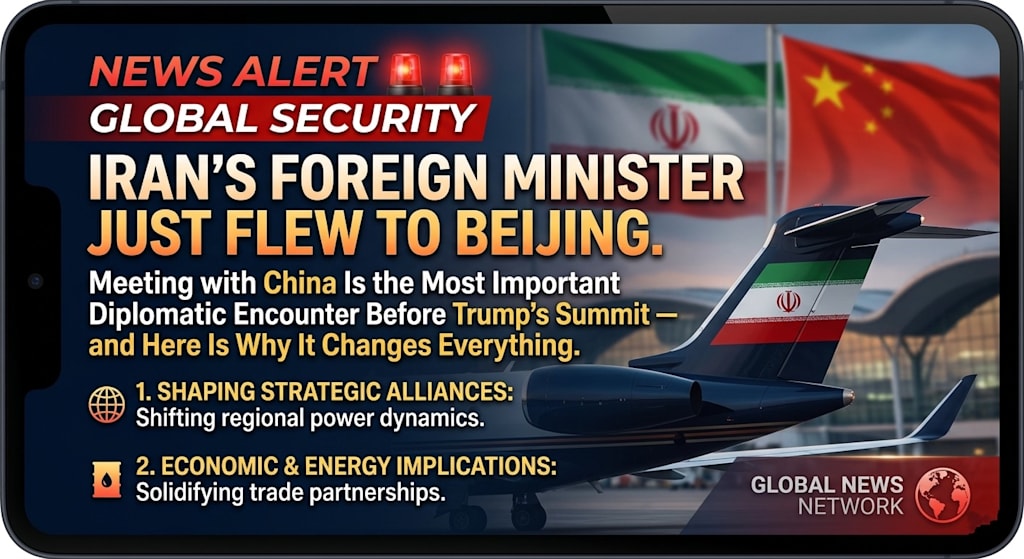
On Wednesday morning, May 6, Iranian Foreign Minister Abbas Araghchi landed in Beijing for a meeting with Chinese Foreign Minister Wang Yi — his first visit to China since the U.S.-Israel war on Iran began on February 28, triggering the most severe global oil supply crisis in history. The meeting, announced by China's official Xinhua news agency and confirmed by Iran's foreign ministry, came at a moment of maximum diplomatic intensity: one week before President Trump is scheduled to arrive in Beijing for a summit with President Xi Jinping on May 14-15, and just hours after Trump paused his Project Freedom military operation in the Strait of Hormuz to create space for a potential deal.
The timing is not coincidental. It is the most carefully orchestrated piece of diplomatic choreography the Iran conflict has yet produced. Araghchi's visit is part of a broader diplomatic tour that has taken him to Oman, Pakistan, and Russia — the constellation of countries that together form Iran's external support network and diplomatic lifeline. But the Beijing stop carries the most strategic weight. China is Iran's most important economic partner, purchasing the majority of Iranian oil exports in defiance of U.S. sanctions that have tried to cut Tehran off from global markets. China is also the only country on earth whose economic leverage over both the United States and Iran gives it a genuine capacity to move both sides toward a deal.
China pressed for the Strait to reopen "as soon as possible," calling continued hostilities "even more unacceptable." — Chinese Foreign Ministry statement, May 6, 2026
During the meeting, Wang Yi pressed Araghchi clearly and directly. According to a statement from China's Ministry of Foreign Affairs, Wang called for Iran and the United States to reopen the Strait of Hormuz "as soon as possible," declared that "a complete cessation of fighting must be achieved without delay," and stated that "it is even more unacceptable to restart hostilities." The language is unusually blunt for Beijing's typically diplomatic communications style — and it signals that China's patience with Iran's continued closure of the waterway, which is costing Beijing billions in higher energy costs and supply chain disruption, is running thin.
For Iran, the Beijing visit served three purposes identified by Al Jazeera's correspondent on the ground: presenting Iran's position in the peace talks to its most powerful ally; reaffirming China-Iran ties before Trump's arrival — a signal to Washington that Iran is not isolated; and securing continued economic and diplomatic backing against resumed American military action. Araghchi told his host that China is a "close friend" and that bilateral cooperation "will even become stronger under current circumstances." He also made Iran's negotiating position explicit: "We only accept a fair and comprehensive agreement. We will do our best to protect our legitimate rights and interests in the negotiations."
What Iran appears to be seeking, analysts say, is clarity from Beijing: will China give Trump concessions on Iran during the summit — such as agreeing to reduce Iranian oil purchases — in exchange for tariff relief? Or will China hold firm and protect Iran's economic interests? The answer to that question will significantly affect Iran's bargaining position in its talks with Washington. As analyst Danny Russel of the Asia Society Policy Institute put it: Tehran is looking for assurances "on oil flows, financial channels, and diplomatic backing against renewed U.S. military action." In return, Beijing is expected to push Iran to stop threatening Gulf infrastructure and move toward reopening the Strait.
China's own frustration with the Hormuz closure is real and growing. As the world's largest crude oil importer, China receives roughly a third of its oil supply through the strait. The closure has forced it to draw down strategic reserves, scramble for alternative supplies, and absorb higher energy costs across its economy — contributing to inflationary pressure at a moment when China's post-COVID economic recovery is already fragile. Beijing wants the strait open. Beijing also wants to position itself as the responsible power that helped end the crisis, enhancing its standing ahead of the Trump summit. Whether Beijing can square this circle — supporting Iran while pressing it toward concessions — is the central strategic question of the next ten days.
About the Creator
Enjoyed the story? Support the Creator.
Subscribe for free to receive all their stories in your feed.
Comments
There are no comments for this story
Be the first to respond and start the conversation.