
Iran Just Bombed the UAE for the First Time in a Month. A Major Oil Port Is on Fire. Four Missile Alerts Sent Planes Fleeing Dubai Airspace.
The fragile Gulf ceasefire has been shattered. Iran launched a barrage of missiles and drones at the United Arab Emirates — hitting the only remaining UAE oil export route outside the Strait of Hormuz. Dubai flights turned around mid-air. Residents sheltered in place. This is the biggest escalation in weeks.
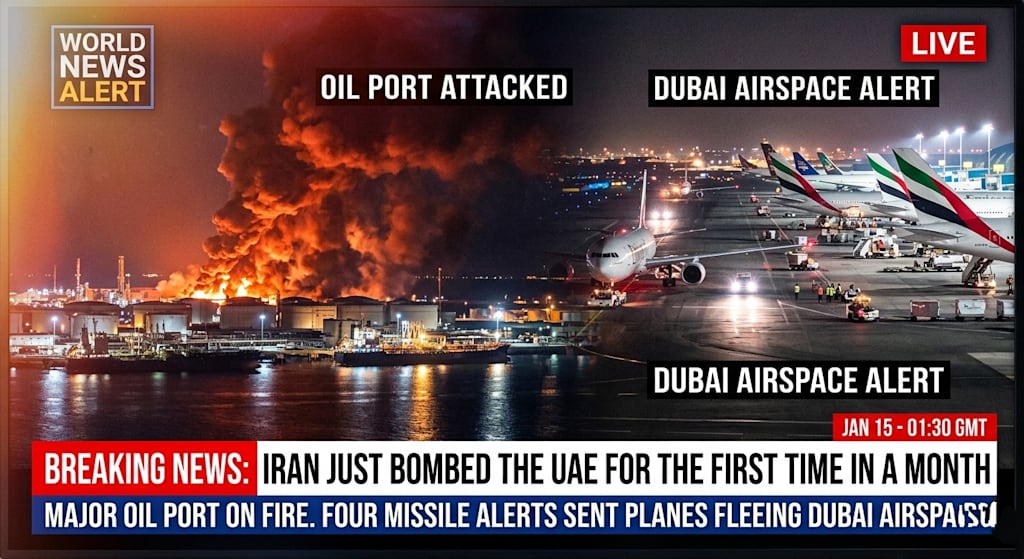
For nearly a month, the UAE had been spared. Since the shaky ceasefire between the U.S. and Iran took hold on April 8, the Gulf state that had previously endured hundreds of Iranian ballistic missiles, cruise missiles, and drones — including strikes on Dubai International Airport and Abu Dhabi's oil infrastructure — had begun to cautiously hope the worst was behind it. On Monday, May 4, that hope was destroyed.
Iran launched what the UAE Defense Ministry described as a barrage of 19 missiles and drones at the country. Air defense systems engaged 15 of the incoming projectiles; the rest were shot down over the sea or coastal waters. But one Iranian drone penetrated the UAE's layered air defense network and struck the Fujairah Oil Industry Zone — a critical oil terminal on the UAE's eastern coast, beyond the Strait of Hormuz, and home to the country's primary remaining oil export route that bypasses the closed waterway entirely. A "major fire" broke out at the facility. Three Indian nationals were moderately injured. Emirati authorities issued four missile alert notifications across the country — the first since the ceasefire began — urging residents to seek immediate shelter.
"These attacks represent a dangerous escalation and an unacceptable violation." — UAE Foreign Ministry statement, May 4, 2026
The timing and target of the Fujairah strike were not random. The Fujairah Oil Industry Zone is specifically significant because it sits at the terminus of a pipeline the UAE constructed precisely to avoid routing its oil exports through the Strait of Hormuz. Abu Dhabi National Oil Company (ADNOC) — which operates a refinery capable of producing 922,000 barrels per day — has been using Fujairah as its lifeline throughout the Hormuz crisis. By striking Fujairah on the same day the U.S. launched Project Freedom, Iran was sending a message: if America tries to break the blockade by sea, Iran will break the land-based alternatives too. The strike was not aimed at the Strait — it was aimed at the entire global oil infrastructure that has been trying to work around the Strait.
Commercial aircraft felt the impact immediately. Flights bound for Dubai International Airport — one of the world's busiest travel hubs, handling connections for hundreds of millions of passengers annually — turned around mid-air when the missile alerts were issued. Emirates Airlines temporarily suspended inbound flights. Passengers already in the air were redirected. Emirati schoolchildren, who had already spent weeks doing online learning since the war began, were told to continue remote education through the remainder of the week pending a security reassessment scheduled for Friday, May 8.
Iran's unified military command issued a statement attributing the Fujairah strike to what it called "U.S. military adventurism" in the Strait of Hormuz — directly linking the UAE strike to Trump's Project Freedom operation. Iranian Foreign Minister Abbas Araghchi warned the U.S. and UAE against getting drawn into a "quagmire," saying the events in the strait prove "there's no military solution to a political crisis." The UAE's Foreign Ministry condemned the attacks as "renewed treacherous Iranian aggression," called for an immediate halt, and said it reserves the "full and legitimate right" to respond.
The attack on the UAE fundamentally changes the calculus of the regional conflict. Until now, the Gulf states — Saudi Arabia, Qatar, Kuwait, Bahrain, the UAE — had largely been bystanders to a conflict between the U.S., Israel, and Iran. The resumption of strikes on Emirati territory drags them back into active danger. It also puts enormous pressure on the UAE government to respond, request further U.S. military assistance, or both — actions that risk further escalation in a region already on the edge of a full return to war.
In the streets of Dubai, residents who had been slowly returning to normalcy — reopening restaurants, resuming gym routines, allowing children to play outside again — described the moment they received the missile alert on their phones as deeply jarring. "I thought it was over," one Dubai-based journalist told Al Jazeera. "We all thought it was over. It's not over." No — it is not.
The ceasefire is cracking in real time. Share this article to keep people informed. A tip helps this reporting continue.
About the Creator
Enjoyed the story? Support the Creator.
Subscribe for free to receive all their stories in your feed.
Comments
There are no comments for this story
Be the first to respond and start the conversation.