
Investment Casting Market: Precision Manufacturing Behind Modern Engineering
How advanced casting technologies are enabling high-performance components across aerospace, automotive, energy, and industrial sectors
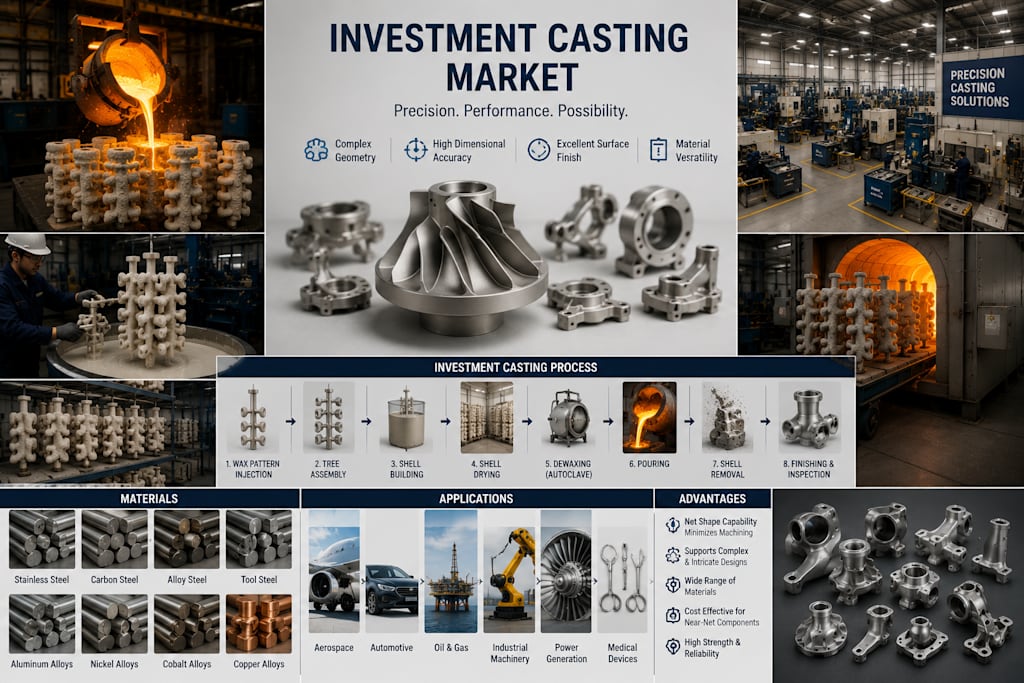
Some of the world's most advanced machines begin with a process that dates back thousands of years. Yet today, investment casting is anything but traditional.
From aircraft turbine blades and medical implants to automotive components and industrial machinery, investment casting produces highly precise metal parts with exceptional strength and accuracy. As manufacturers demand lighter, stronger, and more complex components, the Investment Casting Market is becoming an essential part of modern manufacturing.
What was once known as the "lost wax process" is now driving innovation across industries that demand precision without compromise.
Why Investment Casting Matters Today
Manufacturers today face increasing pressure to produce complex components while minimizing waste, improving efficiency, and reducing production costs.
Investment casting addresses these challenges by producing near-net-shape components with tight tolerances, excellent surface finishes, and minimal machining requirements. This not only improves manufacturing efficiency but also reduces material waste and overall production costs.
According to Mordor Intelligence, the Investment Casting Market size is projected to grow from USD 18.45 billion in 2026 to USD 23.82 billion by 2031, registering a CAGR of 5.25% during the forecast period. Growth is being fueled by rising demand from aerospace, automotive, energy, and industrial manufacturing sectors.
Understanding Investment Casting Market Size and Share
The Investment Casting Market size continues to expand as manufacturers increasingly adopt precision casting for complex, high-performance applications. Industries are seeking components that offer superior dimensional accuracy while reducing secondary machining operations.
The aerospace and defense sector accounts for 36.07% of the market, making it the largest end-user segment. The industry's demand for lightweight, high-strength, and heat-resistant components continues to drive investment casting adoption.
The Investment Casting Market share is led by Asia-Pacific, which holds 43.97% of the global market. The region benefits from strong manufacturing capabilities, expanding aerospace production, growing automotive manufacturing, and increasing industrial investments. Meanwhile, North America is expected to witness significant growth during the forecast period.
Investment Casting Market Trends Driving the Industry
Several Investment Casting Market trends are transforming precision manufacturing.
Silica-sol casting dominates the market with a 50.78% share due to its superior dimensional accuracy and surface finish.
3D-printed wax patterns are reducing tooling costs and accelerating product development.
Superalloy casting is gaining momentum for aerospace and energy applications that require high-temperature resistance.
Advanced ceramic shell technologies are improving casting quality and manufacturing efficiency.
Sustainable manufacturing practices are reducing material waste through near-net-shape production.
These innovations are enabling manufacturers to produce increasingly complex components while improving productivity and reducing overall manufacturing costs.
Why Industries Continue Investing in Investment Casting
Modern engineering applications require components capable of operating under extreme temperatures, pressure, and mechanical stress.
Investment casting delivers exceptional precision while allowing manufacturers to produce intricate geometries that are difficult or expensive to achieve using conventional machining processes.
This continues to strengthen the broader Investment Casting Market analysis, where aerospace, automotive, medical, and energy industries increasingly rely on precision-cast components to improve performance, reliability, and manufacturing efficiency.
As lightweight materials and advanced alloys become more common, investment casting is becoming an even more valuable manufacturing solution.
Challenges Facing the Industry
Despite steady growth, the industry faces several challenges. Investment casting involves relatively high tooling and production costs compared to some conventional manufacturing methods, particularly for low-volume production.
Manufacturers must also manage fluctuations in raw material prices while maintaining strict quality standards for critical applications. Producing highly complex castings requires skilled labor, advanced process control, and specialized equipment.
In addition, supply chain disruptions and increasing demand for specialty alloys continue to influence production costs and delivery timelines.
Investment Casting Market Forecast and the Road Ahead
The Investment Casting Market forecast remains positive as manufacturers continue prioritizing precision, efficiency, and sustainability.
Future growth is expected to be supported by expanding aerospace programs, increasing automotive lightweighting initiatives, rising demand for renewable energy equipment, and wider adoption of additive manufacturing technologies such as 3D-printed patterns.
As industries continue developing more sophisticated products, investment casting will remain one of the most important manufacturing processes for producing high-performance metal components with exceptional precision.
Final Thought
Behind many of the world's most advanced products lies a manufacturing process that most people never see.
From aircraft engines and electric vehicles to medical devices and industrial machinery, investment casting continues to shape the future of precision engineering.
About the Creator
Enjoyed the story? Support the Creator.
Subscribe for free to receive all their stories in your feed.
Comments
There are no comments for this story
Be the first to respond and start the conversation.