
Investing in Northern Italy
What Foreign Buyers Should Know Before Buying, Renting and Paying Taxes

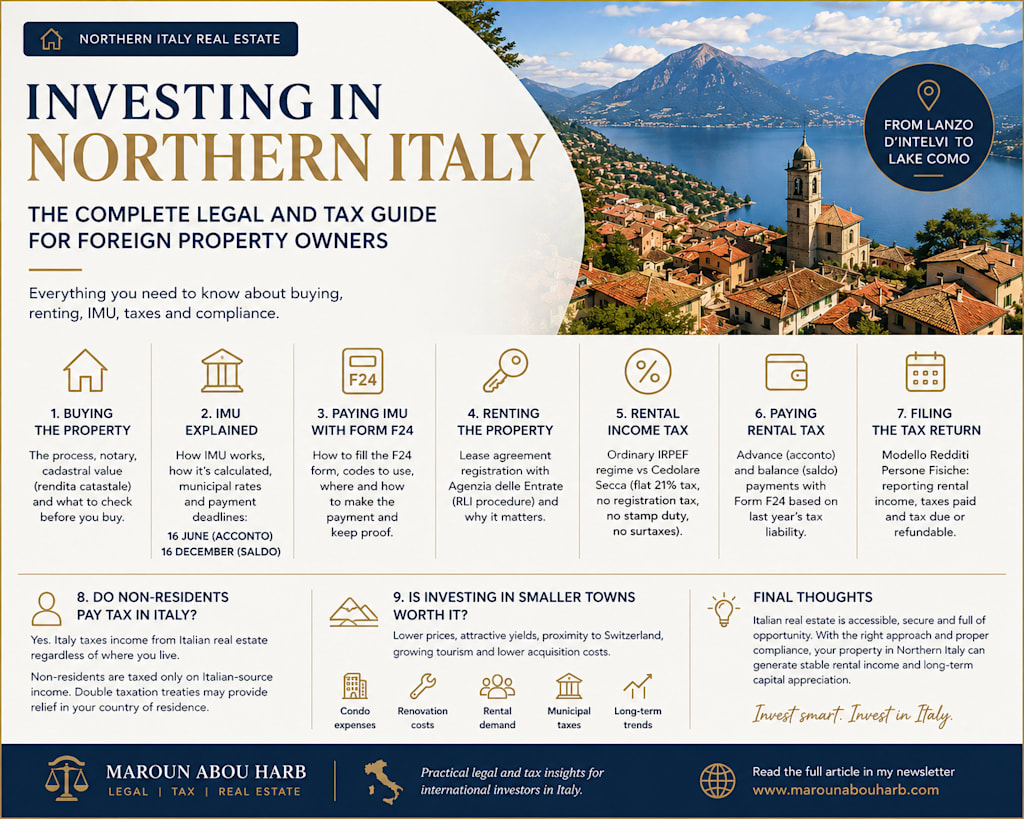
Northern Italy has a special pull.
There are the mountains, the lakes, the old villages, the clean air, the proximity to Switzerland, and the feeling that you can still find something real there. Not every property is priced like Milan. Not every town is as expensive as central Como. In smaller places around Lake Como, including areas such as Lanzo d’Intelvi, foreign buyers may still find apartments at prices that feel surprisingly accessible.
But buying a property in Italy is not only about finding a charming apartment with a mountain view.
It is also about understanding what happens after the purchase.
Who registers the sale? What is IMU? How do you pay it? What is Form F24? Can you rent the apartment legally? How is the rent taxed if you live abroad?
These questions matter because a good investment is not only the property you buy. It is also the system you understand.
The purchase is only the beginning
In Italy, the purchase of real estate is normally completed before an Italian notary. The notary has a central role in the transaction. He verifies the identity of the parties, checks the title, reviews the cadastral information, calculates the taxes due on the purchase, and registers the deed of sale with the competent registries.
Once the deed is signed, the buyer becomes the legal owner of the property. From that moment, the owner is also responsible for the administrative and tax obligations connected to it.
This is particularly important for foreign buyers. You may live outside Italy, but if you own property in Italy, certain Italian obligations will follow.
Each property has cadastral records. These records show where the property is located, its category, its class, and its official cadastral income, known as the rendita catastale. This figure is very important because it is used to calculate certain Italian taxes.
The rendita catastale is not the same as the market value of the property. It is usually much lower. However, it is one of the key figures that an investor should check before buying, because it affects the future cost of owning the property.
Two apartments may have the same market price, but different cadastral values. That means their yearly tax cost may not be the same. Before buying, it is therefore useful to understand not only the purchase price, but also the future holding costs.
IMU: the tax many foreign owners forget
One of the main yearly costs of owning property in Italy is IMU, which stands for Imposta Municipale Unica.
IMU is the annual municipal property tax. It is generally due on properties that are not used as the owner’s principal residence in Italy. For most foreign investors, holiday-home owners, and non-resident landlords, this means IMU will usually be payable.
IMU is not calculated on the price you paid for the property. It is not based on the market value either. Instead, it is calculated by reference to the cadastral value, which is derived from the rendita catastale.
The calculation starts with the cadastral income. That amount is revalued and then multiplied by a coefficient depending on the type of property. The municipality then applies its own IMU rate within the limits permitted by law.
This is why the municipality matters. A similar apartment in a different town may have a different yearly IMU cost. For investors looking at areas such as Lake Como, Lanzo d’Intelvi, Porlezza, Menaggio, or nearby towns, this should be part of the due diligence.
IMU is generally paid twice per year. The first payment, called the acconto, is normally due by 16 June. The second payment, called the saldo, is normally due by 16 December.
Foreign owners should not expect to receive a simple invoice in the mail. The obligation to calculate and pay IMU remains with the taxpayer. Missing the deadline can lead to penalties and interest, although late payments may sometimes be regularised.
The mysterious Form F24
To pay IMU, Italy usually uses a form called the Modello F24.
For someone new to the Italian tax system, the F24 may look intimidating. In reality, it is simply the standard tax payment form used for many Italian taxes.
When paying IMU, the form identifies the municipality, the tax code, the year, the type of payment, the number of properties, and the amount due.
The municipality code is important because it tells the system where the payment should go. The tax code, known as the codice tributo, identifies the type of tax being paid. The form should also show whether the payment is an advance payment or the final balance.
Foreign owners who have an Italian bank account may be able to pay the F24 through online banking. Others may need the assistance of an accountant, tax adviser, or authorised intermediary.
The most important practical rule is simple: keep the receipt. Every F24 payment receipt should be saved. It is your evidence that the tax was paid.
Renting the property legally
If the property is rented out, the lease should generally be registered with the Agenzia delle Entrate, which is the Italian Revenue Agency.
This is an important step. A registered lease gives legal certainty to both the landlord and the tenant. It also makes the rental income transparent from a tax perspective.
Lease registration is commonly completed through the RLI procedure. This can usually be done electronically, either directly by the taxpayer if he has access to the Italian tax portal, or through an authorised intermediary.
For many foreign owners, using a local intermediary is the most practical option. This is especially true where the owner does not have SPID, CIE, CNS, or direct access to the Agenzia delle Entrate online services.
A properly registered lease may also allow the landlord to choose the Cedolare Secca tax regime, where the conditions are met.
How rental income is taxed
Rental income from Italian real estate is taxable in Italy, even if the owner lives abroad.
This is a key point. If you rent out an apartment in Italy, the income is generally considered Italian-source income. It must therefore be considered for Italian tax purposes.
There are generally two main regimes to understand.
The first is the ordinary IRPEF regime. Under this regime, the rental income is included in the taxpayer’s Italian taxable income. The tax is calculated using progressive income tax rates, and regional or municipal surtaxes may also apply.
The second regime is Cedolare Secca. For many private residential landlords, this is often the more attractive option.
Cedolare Secca is a flat substitute tax regime. For most ordinary residential leases, the rate is 21%. When the regime applies, the landlord generally does not pay registration tax or stamp duty on the lease, and the rental income is not subject to the ordinary IRPEF progressive rates or related surtaxes.
There is one important trade-off. By choosing Cedolare Secca, the landlord generally waives the right to increase the rent during the period in which the regime applies, including inflation-based increases.
For many foreign investors with one or two residential apartments in Italy, Cedolare Secca can be simpler, more predictable, and often more efficient than the ordinary regime.
Paying tax on the rent
Rental tax is not usually withheld automatically from ordinary residential rent payments.
This means the landlord is responsible for declaring the rental income and paying the relevant tax.
Payments are normally made using Form F24. Depending on the taxpayer’s position, the payment cycle may include a final balance, known as the saldo, and an advance payment, known as the acconto.
The balance settles the tax due for the previous year. The advance is a payment toward the current year. This is why first-time landlords may find the system confusing. After the first year of rental income, the taxpayer may need to pay both the balance for the previous year and an advance for the following year.
The safest approach is to keep clear records of the lease, rent received, F24 payments, correspondence with advisers, and any relevant property documents.
Filing the annual tax return
Paying through F24 does not necessarily complete the tax obligation.
A foreign landlord who rents out Italian property will generally need to file an annual Italian income tax return.
For most non-resident individuals, this is done through the Modello Redditi Persone Fisiche. The return reports the rental income, the tax regime used, the taxes already paid, and any remaining balance or refund.
The F24 is the payment tool. The tax return is the formal declaration.
This distinction is important. Even where tax has been paid during the year, the income may still need to be declared through the annual return.
For non-resident landlords, using an Italian accountant or tax intermediary is often the easiest way to avoid mistakes, especially in the first year.
Do non-residents pay tax in Italy?
Yes.
Italy taxes income arising from Italian real estate, regardless of where the owner lives.
However, this does not automatically mean that a non-resident is taxed in Italy on worldwide income. In general, non-residents are taxed in Italy only on Italian-source income.
A foreign owner should also consider the tax rules in his or her country of residence. If a double taxation treaty exists, it may provide relief from double taxation. In many cases, Italy keeps the right to tax income from Italian real estate, while the country of residence may offer a credit or other form of relief.
In simple terms, if the property is in Italy and the rent comes from that property, Italy will usually want to tax it.
Why smaller northern towns can be interesting
Many investors focus only on Milan or Como. These markets are attractive, but they are also expensive.
Smaller towns in Northern Italy may offer a different opportunity. In some areas, the purchase price is still relatively low, while rental demand can be supported by tourism, proximity to Switzerland, weekend visitors, remote workers, and people looking for more affordable accommodation near the Lake Como region.
This does not mean every cheap property is a good investment.
Investors should look carefully at condominium expenses, renovation costs, IMU, local rental demand, vacancy risk, property management costs, and demographic trends. A property that is cheap to buy but expensive to maintain may not be a good deal.
The best opportunities are often the properties that offer the right balance between price, condition, location, rental appeal, and future usability.
A well-selected apartment in a smaller northern town can produce rental income, offer personal use, and create long-term exposure to one of Europe’s most attractive regions.
Final thoughts
Italian real estate is not difficult to understand, but it does require patience.
The system has its own language: rendita catastale, IMU, F24, RLI, Cedolare Secca, Modello Redditi. At first, these terms may seem complicated. Once understood, however, the process becomes much more manageable.
For foreign investors, Northern Italy can offer an attractive mix of lifestyle, rental income, and long-term potential.
But the real investment is not only in the property.
It is in understanding the rules well enough to own it confidently.
About the Creator
Maroun Abou Harb
As a Corporate & Commercial Counsel, I design legal and corporate structures that allow founders, investors, and family offices to protect, scale, and control their assets across borders.
https://marounabouharb.com
Enjoyed the story? Support the Creator.
Subscribe for free to receive all their stories in your feed.
Comments
There are no comments for this story
Be the first to respond and start the conversation.