
Industrial Plant Design: 7 Costly Challenges Every Engineer Must Know (And How to Solve Them)
Overcoming the 7 Most Costly Challenges in Industrial Plant Design

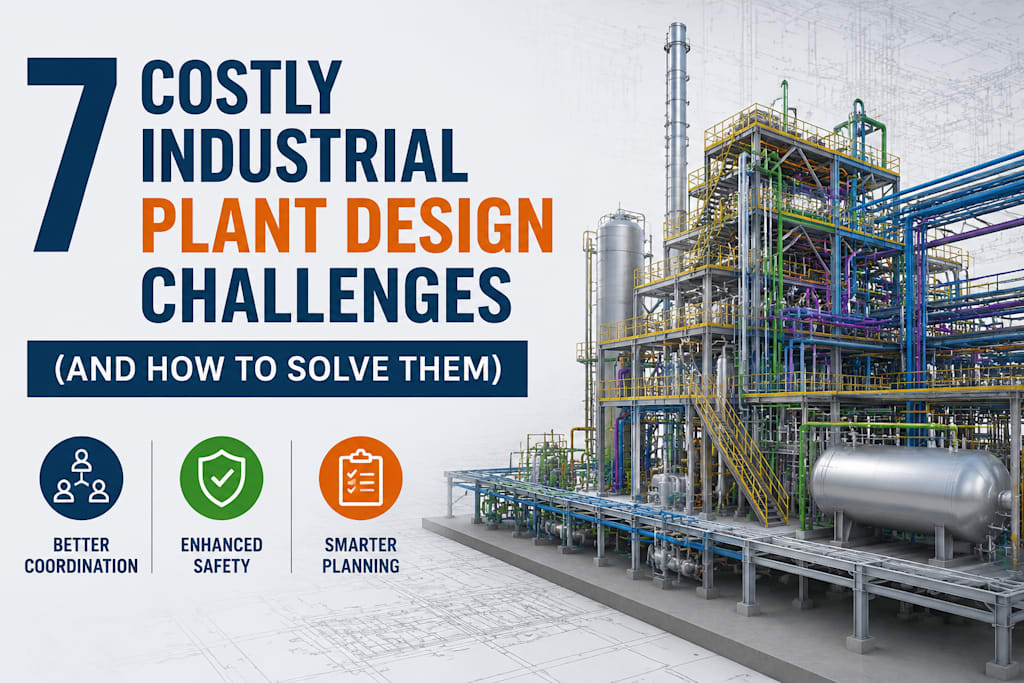
I’ve reviewed many plant design projects over the years, and the ones that hit serious trouble rarely fail because of bad engineering. The technical knowledge is usually there. What gets projects into trouble is everything around the engineering coordination gaps, late-stage surprises, budget pressure at the wrong moment, and decisions that looked fine on paper until they didn’t.
Industrial plant design is genuinely difficult. Not just technically, but organizationally. You’re coordinating multiple disciplines, managing client expectations, navigating regulatory requirements, and trying to hold everything together through a project lifecycle that typically spans years. Here are the 7 challenges that show up most often and what experienced teams actually do to handle them.
Challenge 1: Multi-Discipline Coordination Failures
Here’s something that surprises people outside the industry: you can have a solid process engineering team, a solid mechanical team, a solid civil team, a solid electrical team, a solid instrumentation team every discipline doing technically correct work and still end up with a plant that has serious coordination problems.
Why does it happen:
Each team designs their piece of the plant, not the whole thing:
• Process engineers optimise the flow.
• Mechanical engineers optimise the equipment.
• Civil engineers optimise the structure.
• Electrical teams focus on power distribution.
• Nobody’s job is to make sure it all fits together until a review meeting reveals it doesn’t
A real example of the cost:
A vessel gets upsized in week 14 of a project. The process team logs the change and moves on. Three weeks later:
• Civil discovers the new vessel exceeds foundation load limits.
• Mechanical finds nozzle positions have shifted half the piping isometrics need reworking.
• Structural flags a beam conflict on the new outline
One equipment change. Four weeks of rework across three disciplines.
The fix:
A shared 3D model that all disciplines contribute to from day one. When everyone works in the same environment, a vessel resize immediately shows up as a clash or foundation conflict. The problem gets caught on a Tuesday afternoon, not in a site RFI six months later.
Challenge 2: Getting Plant Layout Wrong From the Start
Plant layout is where a lot of projects quietly commit their most expensive mistakes.
Why engineers underestimate it:
During the design phase, layout decisions feel flexible. You can move things around on a drawing with a few clicks — so there’s a tendency to treat layout as something to finalise later, once the “real” engineering is done.
That instinct is costly.
The actual cost of a post-construction layout change:
Moving an installed vessel means:
• Draining and disconnecting all piping
• Lifting with heavy cranes
• Modifying the foundation
• Rerouting all connected services
• Rebuilding everything from scratch
A change that takes a few hours during design can take weeks on site and cost 100x more.
What actually goes wrong:
Layout reviews happen too late and don’t involve the right people. The operator who runs a particular valve three times per shift knows it needs to be at waist height on a stable platform. The design engineer placed it at 3 meters elevation because that was the tidiest pipe route.
The fix:
• Involve operations and maintenance teams in layout reviews before the design is locked.
• Use 3D virtual walkthroughs at eye level — they reveal access problems and congestion points that plan drawings will never show.
• Treat layout as a design priority from week one, not a finishing task.
Challenge 3: Scope Creep The Problem That Doesn’t Announce Itself
Every project has scope creep. The question is whether you catch it early enough to manage it, or late enough that it manages you.
Common scope change triggers in industrial plant design:
• Client adds a new product line mid-design
• Process licensor revises the flow scheme.
• Local authority issues new safety distance guidance.
• Specified pump is discontinued; replacement has different nozzle positions.
• Regulatory changes impose new requirements.
Each of these sounds manageable individually. Three or four happening at once, on a fixed schedule, is a different story.
Why the damage is always bigger than it looks:
A single secondary product stream addition requires:
1. Additional vessels → affects structural design.
2. Structural changes → affect the civil scope.
3. Civil changes → affect procurement schedule.
4. Procurement delay → pushes commissioning date.
The fix:
A formal Management of Change (MOC) process with actual teeth. Every proposed change regardless of how minor it appears must go through:
• Documented impact assessment across all disciplines
• Cost and schedule estimate
• Sign off before approval
It slows things down slightly. It prevents a lot of expensive surprises.
Challenge 4: Safety and Compliance Treated as an Afterthought
Regulatory compliance in industrial plant design tends to go one of two ways and the difference in cost between them is enormous.
The right way (built-in compliance):
Safety requirements are defined at project start and treated as hard design constraints:
• Hazardous area zones are drawn before the equipment is placed.
• Firebreak distances are established before the layout is developed.
• Egress routes are mapped before the building footprint is fixed.
• When HAZOP happens, it confirms the design rather than breaking it.
The wrong way (bolted-on compliance):
Design the plant first, run a safety review after, then spend weeks redesigning what doesn’t pass. This happens more often than the industry likes to admit — not because engineers are careless, but because safety got treated as a review stage rather than a design input.
The most expensive version:
A compliance issue surfaces during construction or commissioning, after major commitments are already made. This almost always traces back to schedule pressure that pushed the safety review later than it should have been.
The fix:
Run a preliminary HAZOP or hazard identification study before detailed design begins. Yes, it feels early. Yes, the design isn’t fully defined yet. But the risks identified at that stage are almost always cheaper to address in concept than in detailed design and far cheaper than addressing them on site.
Challenge 5: Cutting the Wrong Costs at the Wrong Time
Budget pressure in industrial plant design is constant. Clients want competitive engineering fees. Project managers want to hit milestones. Everyone is looking for somewhere to trim.
The problem with cutting design-phase costs:
The wrong cuts don’t show up as design costs — they show up as construction costs, commissioning delays, and operational inefficiencies that run for the life of the plant.
The fix:
Invest properly in front-end engineering (FEED). The more thoroughly a project is defined before detailed design begins, the fewer expensive surprises appear later. Experienced project owners know this — it’s why they insist on FEED even when it feels like time that could be saved.
Challenge 6: Adopting Technology Without a Clear Purpose
The toolset available for industrial plant design has expanded significantly:
• 3D modelling — now standard on serious projects
• Digital twins — increasingly common on larger facilities
• AI-assisted design tools — beginning to appear in workflows
• Cloud collaboration platforms — enabling real-time work across distributed teams
The mistake most teams make:
Assuming newer technology automatically means better outcomes. A team that adopts a complex 3D workflow under schedule pressure, without proper training or setup time, will produce worse results than a well-coordinated team using simpler tools they know well.
What consistently earns its place:
Integrated 3D modelling with clash detection. The coordination benefits are real and the ROI is clear on almost every complex project.
The fix:
Evaluate technology against actual project needs:
• Does this tool reduce coordination errors on this type of project?
• Does the team have enough experience to use it effectively under pressure?
• Can the client use and interrogate the outputs?
New tools should be adopted because they solve a specific problem not because they’re impressive or new.
Challenge 7: Poor Documentation That Haunts the Plant for Decades
Engineering documentation is not the exciting part of industrial plant design. But it’s what construction teams depend on to build correctly and what operations and maintenance teams depend on for the next 20 to 30 years.
What bad documentation costs:
• Inaccurate piping isometrics → fabrication errors found only at installation.
• Outdated equipment datasheets → incorrect procurement decisions
• Missing as-built records → future modifications become expensive guesswork.
Why documentation quality slips:
When a project is running late and construction pressure is high, updating drawings after field changes is the first thing to fall off the list. It feels low priority. The people who pay for that decision are the maintenance teams working on the plant a decade later trying to understand what was actually built from drawings that don’t match reality.
The fix:
Build documentation discipline into the workflow from the start:
• Assign clear document control responsibility.
• Maintain a single controlled version of every document.
• Record field changes immediately not retrospectively at project close-out
• Use plant design tools that generate documentation directly from the 3D model.
When isometrics, bill of materials, and equipment lists all come from the same model, the risk of discrepancy between what was designed and what the drawings show drops considerably.
The Common Thread Across All 7 Challenges
None of these challenges is a primarily technical problem.
They are coordination problems, process problems, and timing problems.
The engineering knowledge to design a good industrial plant exists. The harder question is whether the project process is structured to apply that knowledge effectively:
• Getting the right information to the right people at the right time
• Catching problems when they’re still cheap to fix
• Managing change before it quietly derails the schedule
That process discipline is what separates plant design teams that consistently deliver from those that consistently struggle. Technical skill is the entry ticket. How you run the project is what determines the outcome.
For a closer look at the tools and technologies shaping modern industrial plant design — including how CAD has transformed the field check out our Part 1 guide: Industrial Plant Design Fundamentals, Benefits, and Core Tools.
About the Creator
Tesla Mechanical Designs
Tesla Mechanical Designs is a global mechanical engineering partner providing machine design, product development, CAD drafting, and CAE analysis to help manufacturers reduce costs and speed up time-to-market.
Enjoyed the story? Support the Creator.
Subscribe for free to receive all their stories in your feed.
Comments
There are no comments for this story
Be the first to respond and start the conversation.