
IKEA’s Matter Bulbs Are Coming to China. Getting Them Online Is the Hard Part.
They pair in twenty seconds. Then they drop offline. The real obstacle is Thread routers, Apple Home, and a standards fight.
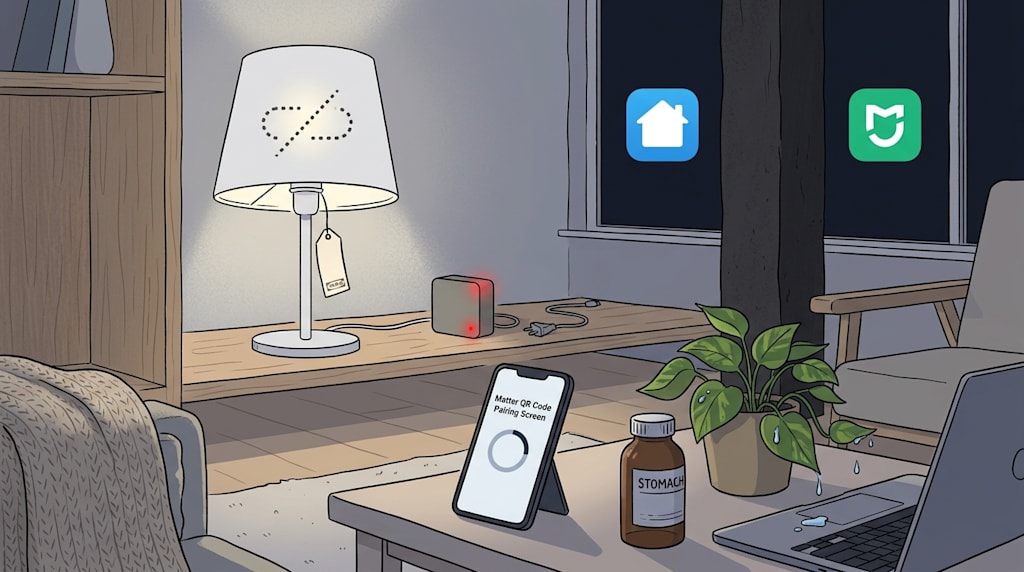
I screwed the KAJPLATS bulb I’d bought through an overseas proxy into the E27 socket in my living room. Scan, Bluetooth pairing, enter WiFi password. Twenty seconds, the light turns on. I glanced at the stomach medicine on the coffee table and went back to writing.
Three days later, the app wouldn’t respond. Siri didn’t react. I unscrewed it and put it back, and it worked. Four days later it went offline again. Unscrew, reinstall, work again. On the Aqara forum, someone wrote: “I have a lot of native Aqara Zigbee bulbs, and they’ve never had this problem.” Another post said the BILRESA button wouldn’t connect; IKEA customer service confirmed the issue. Someone got it paired on iOS, but Android didn’t work. Someone changed the router’s IPv6 setting and got it to connect once; changing it back made it fail again. The pothos on the windowsill had just been watered, and a leaf dripped a drop onto the keyboard cover.
Pairing is only the first step. Stable long-term use is what tests the foundation of your home hardware.
21 new products, and a CCC certificate
In early 2026, IKEA launched 21 Matter-over-Thread products overseas: KAJPLATS bulbs, MYGGSPRAY motion sensors, MYGGBETT door/window sensors, ALPSTUGA air quality sensors, KLIPPBOK water leak sensors, and BILRESA remotes. Prices stay low: bulbs about 30 to 80 yuan, remotes under 40 yuan, most sensors under 70 yuan, and the air quality sensor about 228 yuan. IKEA says new products will be priced the same as, or lower than, the existing Zigbee series. Matter certification is charged per model, not per unit. IKEA ships large volumes, so R&D and certification costs spread thin. An internal cost-control team scrutinizes every component and production step, and the savings turn into numbers on the price tag.
More than half a year after the overseas launch, the Chinese market had no news. In the middle of this year, several new IKEA smart products appeared in the national CCC certification database. CCC is an entry step, not the same as being on shelves. David Granath, IKEA’s global product line lead, gave two words in an interview: prudence, local relevance.
Thread border routers: the first hurdle for Chinese homes
IKEA Matter products use the Thread protocol. For a Thread device to connect to the home network, there must be a Thread border router. The standard answer for overseas users is HomePod mini, Google Nest Hub, or Amazon Echo fourth generation. Nest Hub and Echo are not officially sold in China. HomePod penetration is limited. The practical options for Chinese users are concentrated in Huawei and Xiaomi routers. According to the official Matter certified device database, some Huawei high-end router models, including AX6, BE7 Pro, and others, have registered support for Thread border router functionality.
Between “supported” and “works well” lie firmware iterations, multicast handling, and carrier optical modem settings. A low-cost alternative path circulates in the community: buy a Sonoff MG24 USB dongle, flash OpenThread Border Router firmware, and let an ordinary router moonlight as a border router. That workaround says something: for Chinese users, the more stable border router path may not be buying an off-the-shelf gateway, but flashing open-source firmware yourself.
IKEA’s official support page has a suggestion: if multiple Thread border routers from different brands exist in the home, first cut power to the other brands’ devices, complete pairing, and then reconnect them. Translated, that means multi-brand device coexistence is itself a source of connection instability. Many Chinese homes happen to have Xiaomi, Huawei, and Aqara devices at the same time.
Apple Home is the only big backer, and that is not enough
China’s tech giants treat third-party Matter devices with restraint. Xiaomi and Huawei each sit on large ecosystem networks, and for the sake of commercial closed loops, their support for third-party native Matter devices has remained limited. According to Huawei’s and Xiaomi’s publicly available technical documents and the Matter Alliance compatibility list, there is still no native direct connection support between their devices. Samsung SmartThings has exited China’s core market. OPPO and vivo have large smartphone user bases, but lack home hub hardware such as smart speakers and central gateways.
Apple Home has almost become the only mainstream ecosystem force in China that fully supports Matter. But Apple TV and HomePod penetration in Chinese households is limited, and most Chinese homes do not have ready-made Thread networking capability. Meanwhile, in March 2026, the Smart Home Unified Interconnection Series Standards, led by the GIIC Global Smart IoT Alliance and jointly developed by Huawei, Haier, Midea, China Mobile, China Telecom, JD.com, and others, were officially released. The industry calls it the “Chinese version of Matter.” The goal is to build interconnection channels for 2 billion existing smart devices in China, with underlying protocols and ecosystem governance leaning more toward leadership by domestic vendors.
Matter in China is taking a long dual-track transition. Domestic vendors have already invested large sunk costs in their original private protocols, have insufficient incentive to switch to Matter, and face the risk of technical restructuring. One prediction: private ecosystems continue to deepen service experience while also making gateways compatible with Matter devices; general-purpose protocols will first become widespread mainly in basic categories such as lighting and sensing.
IKEA’s trade-off: sell kits first, talk ecosystem later
For its first batch of Matter products in China, IKEA made a trade-off: prioritize kits that come with Touchlink remotes.
Touchlink was IKEA’s central ease-of-use asset in the Zigbee era. A consumer who knows nothing about smart homes, even without buying a gateway at all, can buy an IKEA bulb and a wireless remote, hold the remote pointed at the bulb for a few seconds, and dim it, or have a motion sensor trigger a light. In the Matter era, IKEA inherited this logic. Even if the user’s home has no Thread networking infrastructure at all, the product can be used directly as a high-quality wireless remote-controlled light.
This is a pragmatic transitional strategy. In the short term, it bypasses the Thread network threshold. In the long term, what IKEA wants to carry forward is its understanding of smart homes: technology should hide behind the product, not become the first problem the user has to solve.
IKEA also undercuts rivals on price. Many tech brands’ Matter devices cost double, while IKEA’s Matter products can be priced the same as, or even lower than, traditional Zigbee products. David Granath said IKEA’s global shipments can dilute fixed costs such as R&D and certification to very low levels, and a dedicated internal cost-control team carefully reviews every component and production step.
Xiaomi and Mi Home: cooperation without dependence
IKEA’s relationship with Xiaomi in China is a variable. Years ago, IKEA reached deep cooperation with Xiaomi, integrating some lighting products into the Mi Home ecosystem, because at the time Xiaomi was China’s most widespread and most relevant smart home platform. IKEA’s official website still keeps the guide “Use the Mi Home app to control IKEA smart devices.”
The logic in the Matter era is different. The core selling point of IKEA Matter products is cross-ecosystem: users can control them with Apple Home, Google Home, or any Matter-compatible app. This creates tension with Xiaomi’s commercial logic of keeping devices locked inside the Mi Home ecosystem.
In the interview, David Granath mentioned that IKEA is reevaluating the development direction of local standards and ecosystems, and will continue to maintain dialogue with local manufacturers. The relationship with Xiaomi is more likely to be cooperation in specific categories and scenarios, rather than full dependence. The door is not closed, but the threshold has changed.
After pairing: BLE, mDNS, and multicast
The pairing process itself has been simplified. Users pick up their phone and scan the QR code on the device, completing discovery and parameter transfer through Bluetooth Low Energy, and pairing finishes in tens of seconds. There is no longer any need to turn the power on and off six times in a row to reset the bulb, as in the Zigbee era.
But BLE operates in the 2.4GHz band. This band is crowded in Chinese homes: routers, microwave ovens, and wireless mice all crowd in here. If pairing fails in the living room, the bulb may not be the problem. The router’s 2.4GHz channel may be too crowded and crowd out the BLE broadcast.
After pairing succeeds, daily control takes another path. Devices advertise themselves via mDNS on the local network, and the app resolves these records to find the device’s address and port. This step depends on how multicast performs in the home network, and is related to carrier optical modem settings and the router’s IGMP handling. Problems won’t make the device fail outright; they show up as occasionally not finding the light, or response times speeding up and slowing down.
David Granath admits that the root cause lies in the change in the cooperation model. In the Zigbee era, IKEA had end-to-end, full-chain control over device, gateway, and software. If a bug appeared, its own engineering team could troubleshoot behind closed doors. In the Matter era, IKEA has become a node in a large interconnected ecosystem. Whether a device runs stably depends not only on IKEA’s own firmware, but also highly on third-party ecosystems, the underlying Thread Group network, and even the Connectivity Standards Alliance standards themselves.
In the first half of this year, IKEA carried out frequent in-person joint debugging with major mainstream ecosystem vendors. Engineers from multiple parties sat together, analyzed logs line by line, and captured packets to locate problems. After several rounds of firmware iterations and cross-vendor collaborative fixes, the stability and response speed of IKEA Matter devices in mainstream ecosystems have reached a daily-usable level. Just as this article was being finished, IKEA pushed updated test firmware for its Matter products, bringing new Matter and Thread spec versions.
Rechargeable batteries, open-source contributions, and IKEA hacks
IKEA product development engineer Stjepan Begic added a hardware detail: IKEA’s new generation of smart sensors has dropped traditional coin-cell batteries and moved to a built-in rechargeable battery design. Some size was sacrificed, but it bought longer battery life and better performance, and it works with IKEA’s cheap Ladda rechargeables and charger.
IKEA is not merely a user of standards. Stjepan Begic said that whenever IKEA’s team develops a new feature or new protocol specification, they push it back and contribute it to open-source communities and the CSA Alliance. IKEA is currently deeply involved in the alliance’s specification development for Matter audio. As for the geek community’s enthusiasm for modding and tinkering with IKEA hardware, David Granath and Stjepan Begic are fine with it: as long as modifications are made safely, the team is happy to see people discover creative new ways to play with IKEA products.
Price tags on the shelf
The Touchlink remote kit buys IKEA time. It handles light control and sensor linkage without a network. The next bottleneck is hardware: Huawei and Xiaomi need Thread border routers that stay stable after firmware updates, and Apple Home needs more households with a HomePod or Apple TV. The larger fight is standards. If the national level promotes compatibility, alignment, and mutual certification recognition between domestic and international standards, IKEA’s global Matter product line will gain a smoother landing channel in China. If local standards and Matter move in parallel or even oppose each other, IKEA will have to make more complex choices between two systems.
When these products are placed on the shelves of IKEA China stores, a consumer picks up a bulb, scans the code, and the light turns on. Whether it goes offline three days later determines whether he buys again next time. The price tag, the remote beside the shelf, Apple Home on the phone, and the Mi Home app that may never be opened will decide whether the next bulb gets bought.
About the Creator
Jin
Writer of reamstories
https://reamstories.com/jin
Enjoyed the story? Support the Creator.
Subscribe for free to receive all their stories in your feed. You could also become a paid subscriber, letting them know you appreciate their work.
Comments
There are no comments for this story
Be the first to respond and start the conversation.