
I Deleted All Of My Articles From HubPages, and a Counterfeit of My Work Appeared On Owlcation
A frustrating look at how companies remove and replace content


Months ago, I spent a significant amount of time deleting nearly 700 articles and drafts from HubPages. I was a successful writer there; my articles had more than 40 million views, and I earned more than $30,000 during my 13 years at the site. Not bad for a side hustle, right?
When HubPages announced it wasn’t going to pay writers anymore for articles on its platform, I decided to delete all of my work from my profile. Before that, I already had a Shakespeare article counterfeited. It appeared on the loosely revamped Owlcation, and at that time, my original version was on Discover.HubPages.
Here’s some context for those of you not familiar with The Arena Group’s changes to HP over the past couple of years. TAG announced in 2025 that Owlcation would become a standalone property, meaning the popular education niche would no longer accept HubPages writers’ articles and wouldn’t pay for existing ones. You could, at this time, still earn from Discover.HubPages, so many of us legacy writers for Owlcation requested that our articles be moved there. Then TAG discontinued earnings for Discover.HubPages in 2026.
Just a couple of days ago, I found an article on Owlcation that matched one of my old articles that used to be on there. I had cross-posted my article to Medium back in 2021. You can compare the two articles here:
- Owlcation: 35 Real Problems and Struggles Only INTJs Will Understand, by the Owlcation Editors
- Medium: 35 Problems and Struggles All INTJs Face, by Andrea Lawrence
- Here is a Reddit thread about the article I wrote that used to be on the old Owlcation. If you click the link in the thread, it will take you to a 404 message. Below, I’ve added a screenshot of the error:
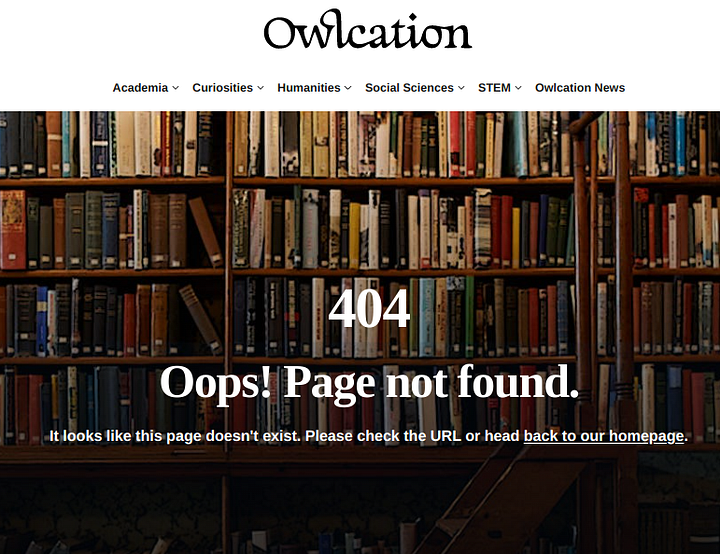
On closer examination, the URL on that 404 error page reads: https://owlcation.com/social-sciences/24-Struggles-All-INTJs-Can-Understand. This means when I first wrote the article's title, I intended to list 24 points. Using The Wayback Machine, the first version of the article captured by the Internet Archive was a list of 30 points.
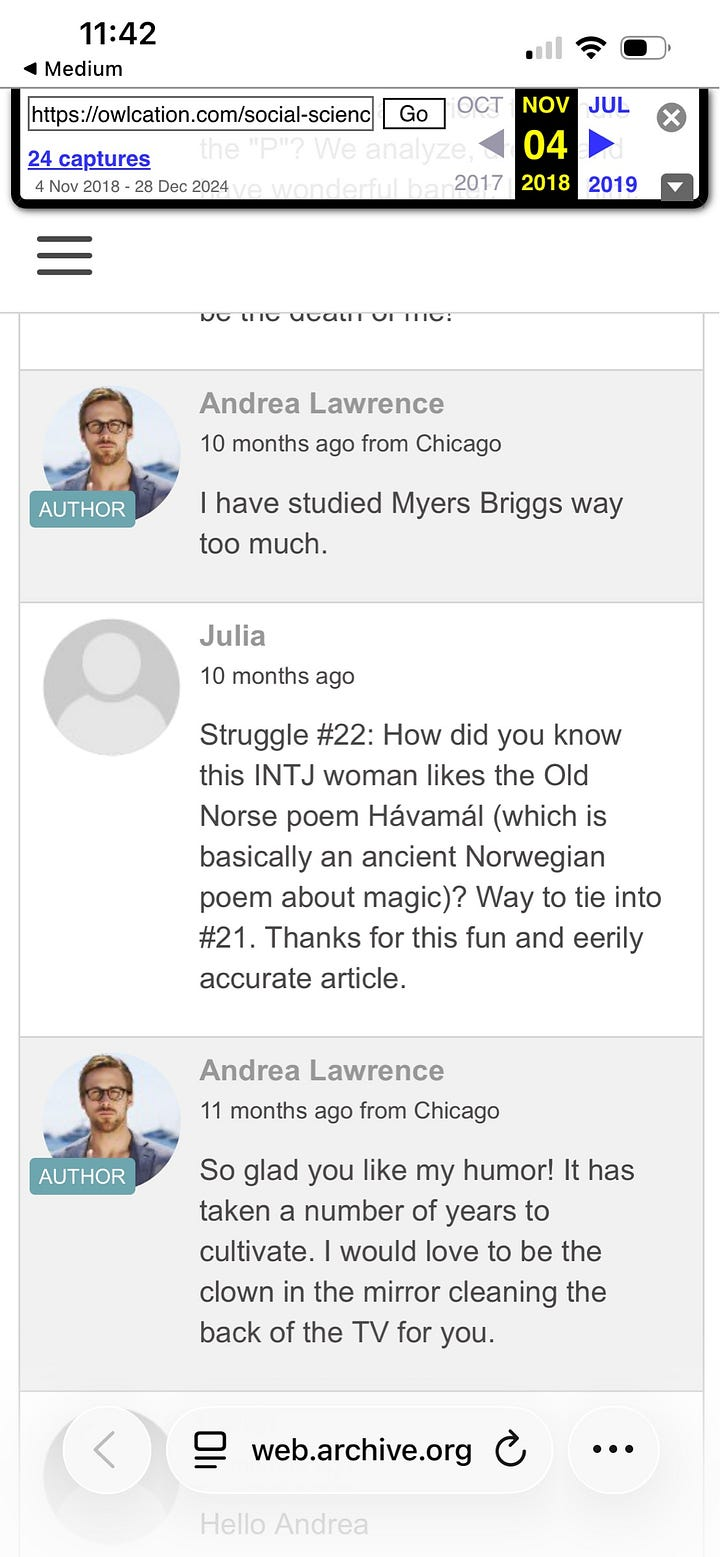
There are a lot of embarrassing things I did for the original version. The Wayback Machine has data on it as far back as October 13, 2016. So what's embarrassing about it? You'll notice my profile picture is of award-winning actor Ryan Gosling. I did this in part because the HubPages staff was aggressive about what profile pictures should be displayed, and I was gutsy and irrevent at that point in my online writing hobby. Before Ryan Gosling, I believe I used a picture of Nicholas Cage. The first picture appearing in the article is a meme of Severus Snape, and the images don't get any more sophisticated from there.
The original is so old that comments were still a feature on HubPages. If you scroll down to read them using the Wayback link, you'll see I was fairly active at responding to them. (In the screenshot, my responses are above people's comments.)
Let's jump forward to the most recent version of the article on The Wayback Machine. It recorded the January 9, 2024, update on December 28, 2024. This version closely matches the Reddit thread because you can see the same image in the thread and the article. It also lists 35 points.
Why Companies Replacing Articles With Different Articles Is Questionable
For years, revision was a key part of HubPages. In order to survive Google's algorithm updates, staff regularly adjusted articles in hopes that they could continue to have SEO success. The question is, when does revision become replacement? It seems revision was abandoned, and replacement became the present strategy.
My article and the new Owlcation article published on June 11, 2026, are strikingly related; however, they are not carbon copies. There is a strong case that it is structural plagiarism. They've rearranged points, kept to the same framework, and didn't bother to cite me in their works cited section.
Before getting too deep into this, I want to point out that structural plagiarism generally isn't a legal offense or criminal offense. It's more in the realm of an academic or ethical violation. In extreme cases, it can warrant a lawsuit. I do not have the wherewithal to determine if this is extreme, so I'd rather shade this post as an exploration of business ethics.
Personally, I would argue the new Owlcation story is drier than my work, and it relies heavily on generalizations. It's not necessarily done by an MBTI expert or enthusiast, but by someone checking a box to mimic successful content (that's my two cents).
The overlap in topic and number, 35, jumps out to me. Both articles cover:
- A need for solitude
- Having high standards
- Perfectionism
- Feeling misunderstood
- Having a strong preference for structure
- Loathing inefficiency
- Difficulty expressing emotions
- Overthinking
- A natural inclination toward independence
These are all traits pretty widely discussed in regard to INTJs elsewhere online; however, in this case, the way the ideas are similarly structured and expressed makes the core and aim of both articles the same.
There is a reason my original INTJ article worked so well on HubPages. It had to do with my delivery. I was conversational and quirky. I pumped many of my articles with humor and originality. This one is full of idiosyncratic examples: living alone on an island, odd cleaning habits, and other tidbits based on real people I know. It comes from a place that's observational, full of heart and whimsy, and occasionally offers a hint of sarcasm. That's how I propelled myself into getting millions of views: I offered takes that went above and beyond, plus added three spoonfuls of weirdness. I elevated a straightforward, easy take on MBTI.
But let's be honest. This isn't my best article. It's a list! But it was a list that someone thought was worth something along the lines of duplicating/counterfeiting/mining/ripping off/copy cating/scraping/devaluing through derivative imitation/questionably revising/having it up on their monitor and deliberately using it as a guide as they reinvented it.
What exactly makes me think those things?
Since I had a hunch about the deceptive nature of the new article, I spent time plugging the two articles into several different plagiarism trackers and AI bots to compare the stories. Finally, one of them dug its heels deeper, and it showed me what I suspected. Here is what Google's AI wrote when I asked it to compare the two URLs:
An analysis reveals that the 2026 Owlcation article exhibits severe structural duplication and potential patch-writing plagiarism of the 2021 Medium article by Andrea Lawrence. While the wording differs, both pieces align on the exact same 35-point thematic structure, indicating uncredited content spinning rather than independent creation. You can review the original content on Medium.
The comparison reveals near-identical thematic, sequencing, and psychological pain points used, constituting uncredited derivative work.
I was shocked that the analysis was so scathing. I simply asked it to compare the two URLs. It had no reluctance to flag the new article as wrongful.
What does the new Owlcation article do that's different? It's clean, it is stripped of my eccentric flair, and it focuses more on the most doldrum example imaginable… the workplace. It reads more like a take on productivity. It's almost like this article was forced to work on the Severance floor while mine lives in the real world (which, if you're familiar with the show, they're the same person). The new article describes issues such as feeling mentally burnt out, troubles with delegating tasks, and being expected to be "the brain" in every situation.
The two articles are worded differently, the numbered points don't correspond evenly, but the themes are similar. To me, it's clear mine was used as a jumping-off point and then scrambled, which makes it slippery to discern its level of misdeed.
In the next section, I've spliced together the first 12 points made in each article. My writing is the first take for every example. The Owlcation article is second. You'll see that there is a lot that's the same, but not all hitting at the exact same numbered bullets.
I don't want to do this for all 35 points, as that would be incredibly lengthy. Feel free to skim and get back to the rest of the article if you get bored with reading all these points.
*I do not agree with all the points made about INTJs in the points below. This counts for me as well as the Owlcation writer. If I wrote another version of INTJ struggles, it would have some similarities but a lot of new ideas.
Side By Side Comparison
1. INTJs love their alone time. They would be happy to live a solitary life on an island where they could think all day, study all they want, not have to worry about interruptions, and focus on whatever catches their fancy. The problem: real life generally doesn't operate this way. It's hard to avoid all the social demands from school, work, family, and the like.
1. Constantly seeing inefficiencies. INTJs quickly spot flaws in systems, processes and arguments, which is great for improvement but exhausting when the world seems perpetually "badly configured."
***
2. By the way, that island would always be tidy and neatly organized, and the INTJ would go to bed at a reasonable hour every night. INTJs love structure. Too much randomness is anxiety-inducing. They need structural integrity!
2. Feeling misunderstood. Their mix of intensity, independence and low-key delivery often leads others to misread them as cold, arrogant or disinterested when they're actually deeply invested.
***
3. Idle chit-chat drives them nuts. An INTJ could possibly live happily on an island populated with all the other Myers-Briggs personalities… as long as interaction was minimal!
3. Explaining ideas that are 10 steps ahead. INTJs often think in long causal chains, so they'll jump straight to the conclusion while everyone else is still on step two, leading to confused looks and tedious backtracking.
***
4. An INTJ doesn't understand why other people can't immediately see the most logical solution to the problem at hand. They don't realize that sometimes context isn't immediate for those around them.
4. Overanalyzing simple social interactions. A brief comment or odd look can send them into a spiral of pattern analysis, trying to decode motives and implications long after everyone else has moved on.
***
5. INTJs can come off too critical. They'll try to communicate their logical prowess, but those explanations can be a bit blunt if they're not careful. They can make people feel stupid.
5. Being expected to "just go with the flow". They like having a plan, clear purpose and logical structure; being told to wing it "for fun" can feel like asking them to walk blindfolded across a minefield.
***
6. INTJs verbally share the wealth of their logical brains… but only complain and experience their emotions inside their heads. They bottle everything up and then explode and then feel the burnout of that explosion.
6. Struggling with small talk. Surface-level chatter feels inefficient and mentally dull, so casual networking or "getting to know you" events can feel like a performance rather than a natural interaction.
***
7. They struggle to be romantically forward. They have trouble getting into serious relationships. They often wait until they're older. Many choose an independent and hermetic life.
7. Having a high bar for competence. INTJs naturally expect themselves and others to be competent and prepared, so sloppy thinking, laziness or repeated mistakes can trigger deep frustration.
***
8. These folks love to date other INTJs, but since they're both loners it can be challenging for them to spark a romance. . . or even find each other.
8. Taking a long time to trust people. They tend to vet people carefully and quietly over time; until someone passes their internal tests, they may seem distant or aloof, even if they like the person.
***
9. An absurd amount of laser focus can be destructive. An INTJ will become obsessive about details, like getting stuck on numbers, buttons, rows and columns, particular sounds, or repeating patterns. Observing an INTJ getting stuck on the small details can be like watching a car revving in neutral.
9. Being accused of being "too serious". They're often focused on long-term goals and big-picture ideas, so their default mode can look intense - even when they're actually relaxed and content.
***
10. INTJs often hold their tongues, making them secretive. They're worried they'll put their foot in their mouth. Don't get me wrong, they know how to be a protector of people. . . but they also know how to bite into a person's ego, stupidities, and deepest fears.
10. Struggling to show emotions in the moment. INTJs feel deeply but may process emotions internally and privately, which can lead others to think they don't care or are emotionally unavailable.
***
11. INTJs get tired of trying to tolerate everything. They have long lists of things that annoy them.
11. Getting stuck in perfectionism. Their need for efficiency and improvement can morph into endless tweaking and revising, making it hard to declare something "good enough" and move on.
***
12. They have devised many unique internal systems for themselves linguistically, mathematically, and scientifically. Their made-up systems are often too colloquial or specific for others.
12. Feeling bored in many group settings. Meetings without agendas, classes that move too slowly, or conversations that loop in circles can feel like an intellectual slow death.
My interpretation is that the newer Owlcation article is an editorial reach aimed at appealing to a wide audience. I am under the impression that the original was scraped or mined for profit. I think it's hard to make the argument that this was innocent, and I've just fallen prey to bad optics.
The new article is dipping its toes in murkiness, but it is not a full-blown copy-and-paste effort, and that's for a good reason. It's likely because it's been adjusted to mask where the writer, editor, or staff came up with the framework.
I believe putting the points side by side reveals the manipulative nature of what the Owlcation writer(s) or editor(s) did. It appears they've shuffled points and swapped in synonyms or even whole phrases as synonyms, likely to evade plagiarism checkers. Many of their points seem like explanations of mine.
The Owlcation text takes my precise, highly specific, and personal observations of INTJ behavior and squeezes out the personality, streamlining it and presenting it as an original work. Here is how the similarities line up under inspection:
Laser Focus vs. Perfectionism:
- My article (Point 9): It describes an INTJ with obsessive preoccupations: ("numbers, buttons, rows, columns… revving in neutral").
- Owlcation's article (Point 11): Copies the exact mental trap described in mine and repackages it as "endless tweaking and revising," where the person gets stuck in perfectionism.
Hidden Emotions/Explosion vs. Internal Processing:
- My article (Point 6): It highlights how INTJs "complain and experience their emotions inside their heads… bottling everything up."
- Owlcation's article (Point 10): Covers the exact same idea, rewording it to claim INTJs "process emotions internally and privately, which can lead others to think they don't care."
Blunt vs. Biting Criticism
- My article (Points 5 & 10): I mention they are "too critical," can be "blunt," make people "feel stupid," and can "bite into a person's ego."
- Owlcation's article (Point 2): It uses more gentle language but conveys the same premise: INTJs delivery leads others to misread them as "cold, arrogant, or disinterested."
After comparing the two articles extensively, I do not think the Owlcation one would exist without my work. I did not give anyone permission to replicate it. Personally, I think I should be compensated for something like this. To me, they sanitized my distinct voice and swapped in formal headings.
A Closer Look Under the Hood At Owlcation's Strategies
The mundane byline, Owlcation Editors, gives TAG power. The staff won't have to consult with an author to make changes. They can keep a consistent, if not bland, voice across articles. This is why these derivative articles keep appearing: it's a streamlined production to lobotomize articles into gray generality. This is being done on old, legacy articles that proved their concept had traffic-pulling power.
Google could help if it didn't chew up and indulge in princely perfect prose that's generic and easy for it to assimilate into its algorithm. I don't want Google feasting on my work for my personality and verve, but this means more average C- work gets spread because companies think it's more digestible and shareable for a wider audience.
And the strategy is all wrong. Owlcation's numbers haven't improved according to SEMrush. The site is receiving around 283,000 views a month. It received millions when HubPages writers were crafting content.
Lest we not forget to check TAG's stock numbers. I haven't forgotten it claimed it had a successful, proven strategy for publications, and that's why they were taking HubPages' niches and turning them into standalone endeavors. Today it ended at $1.05. It is an at-risk stock. And of course it is! Look at the derivative strategies the company and its third parties employ in the outlets it owns.
Deleting Content Off a Platform Doesn't Protect It From Theft or Mining
I know content about MBTI is a dime a dozen. I also know people like to write about the struggles of each Myers Briggs personality, and I know there are readers interested in these articles (that's why I wrote them). What irks me is that both articles have the same number, 35, to discuss the struggles INTJs face.
The big revelation out of this mess is that Owlcation will upload articles based on the frameworks of deleted HubPages writers' content. They removed the articles after we requested their removal, but no one wanted to keep them there if they weren't going to get paid. Just because we wanted them removed doesn't mean TAG's staff and affiliates should upload obviously similar content to take their place.
These articles may differ in the way they're written, but I find this whole process worthy of scrutiny. Corporate rewrites to this degree raise ethical questions even if they don't infringe on copyright law.
I'm not a copyright lawyer, but I think this tiptoes into a legal area. Has TAG or its third parties crossed a legal line, or have they simply skirted around one? That's not for me to decide. I'm here to send alarm bells: writers beware of what TAG-owned publications will do. Your work isn't safe with them.
The writers or editors of Owlcation wouldn't have recreated my article if it had been unsuccessful. This means they're using data to figure out what was successful on Owlcation that was written by legacy writers who were forced out of the system. This type of strategy could be used on other niche sites previously under the HubPages banner that are now solely TAG properties.
There is no telling whether the shuttered niches could one day return. AxleAddict closed initially, but for some reason, TAG decided to bring it back. This means other niches with data on what were successful articles could make a comeback: Exemplore, PairedLife, ReelRundown, Holidappy, and Spinditty. As well, other TAG-owned sites could use HP's data to craft content.
How This Complicates Matters For Writers
It appears that TAG decided not to pay legacy writers for their content so as to earn more for themselves. We earned a percentage from the ad share revenue model; now TAG and its third parties receive 100% of the earnings on Discover.HubPages articles that remain there.
This should concern anyone who has written content on HubPages because it means staff will dig up deleted material and repurpose old, successful stories, whether by rewriting them with scraping software, AI, or employing desperate writers who don't see the problem with all of this.
My friends and I have spotted hundreds of these questionable works; this is just the second case I've discovered of my own content. The problem is not limited to Owlcation. I've seen this on WanderWisdom and HobbyLark.
If TAG or its third parties are willing to take a listicle about INTJs and not have the mind to change the number of points and barely the title, then there really isn't any limit to what TAG and/or Owlcation will do. As well, drafts left in the data could emerge on one of these sites.
Bottom line: If your work was on HubPages, it isn't safe from getting repurposed. This will make it more difficult for you to publish your content somewhere else, because it will compete against the counterfeit for SEO and AISEO. You could also get flagged for duplicate work or even deindexed on Google.
To wrap things up, let's compare my article and the new article one last time. Theirs occupies the same genre as mine, it uses the same "35" framework, and it comes off as a washed-out rendition. Mine has a stronger voice to it, and that's partly because I'm not a staff byline with the personality of the Greendale mascot. (Community sitcom reference; it's insular but on target.)
Learning Resources
Works Cited
- Davis, Haley. Upcoming Changes to HubPages Sites, HubPages Forums, Mar. 2025.
- HubPages Staff Announcement: Reminder: Upcoming Changes to HubPages Earnings and Publishing, HubPages Forums, Jan. 2026.
- Lawrence, Andrea. 30 Struggles All INTJs Can Understand, Wayback Machine, 4 Nov. 2018.
- Lawrence, Andrea. 35 Problems and Struggles All INTJs Face, Wayback Machine, 28 Dec. 2024.
- Owlcation Editors. 35 Real Problems and Struggles Only INTJs Will Understand, reviewed by Nicole Urso Reed, 11 June 2026.
- Reddit. 35 Problems and Struggles All INTJs Face, 2021.
- Winter, Lisa. We're Moving Content To Discover HubPages, HubPages Forums, July 2024.
Notice: This article was crafted by a human. The only part of AI involved has to do with a section where I used Google's AI to compare two URLs with its plagiarism tracking feature. This is made clear in the text and is a single blockquote. Other plagiarism checkers that could do this required me to either sign up or pay for a subscription, which isn't something I wanted to do. I felt the analysis by Google was important to the story.
This article was first published on Medium by Andrea Lawerence.
About the Creator
Andrea Lawrence
Freelance writer. Undergrad in Digital Film and Mass Media. Master's in English Creative Writing. Spent six years working as a journalist. Happily living with my husband, toddler, two cats, and corgi-labrador mix.
Enjoyed the story? Support the Creator.
Subscribe for free to receive all their stories in your feed.
Comments
There are no comments for this story
Be the first to respond and start the conversation.