
I Cut Google Ads Cost Per Conversion by 44% While Growing Conversions 9x — Here's Exactly What Changed
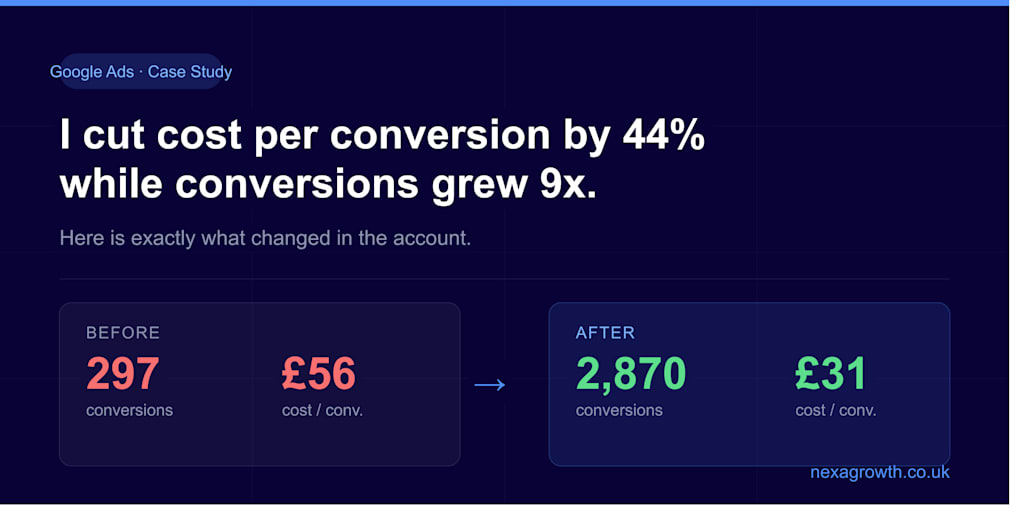
A real account rebuild — from 297 conversions at £56 each to 2,870 conversions at £31 each. No platform switch. No budget gimmicks. Just fixing what was broken.

Note: This article was written with AI assistance based on real campaign data and results from Nexa Growth Marketing Ltd. All numbers, screenshots, and outcomes are genuine.
We went from 297 conversions at £56 each to 2,870 conversions at £31 each.
Same platform. Same business. Completely different structure.
That is not a small tweak. That is a fundamentally different way of running paid search. And the most important change had nothing to do with the budget.
The Situation
A service business came to us with a Google Ads account that had been running for several months. On the surface it looked reasonable: ads were live, clicks were coming in, and conversions were being recorded.
The problem was the unit economics. At £56 per conversion, the account was not generating the volume the business needed to grow. They were spending £16,700 per month and walking away with 297 conversions. The instinct from management was to increase the budget.
We told them to wait.
What the Audit Actually Showed
Before touching a single bid or adding a penny of budget, we spent two weeks inside the account. What we found was a familiar pattern.
The campaigns were running broad match keywords almost exclusively. That meant ads were appearing for searches that had almost nothing to do with what the business actually sold. We pulled the search terms report and found queries like "free [service]", "[service] jobs near me", and "how to do [service] yourself" all triggering paid ads and consuming real budget.
There was also significant campaign overlap. Multiple campaigns were targeting the same audiences with slightly different ad copy, effectively competing against each other and inflating cost per click internally. Smart Bidding was receiving contradictory signals and could not optimise effectively as a result.
The landing pages were doing the account no favours either. Forms were buried below the fold. There were no trust signals near the conversion point. The headline on the landing page did not match the ad that sent the visitor there.
Put simply: the account was spending money to attract the wrong people, and then failing to convert the right ones when they did show up.
The Strategy, Step by Step
Keyword targeting
We stripped out almost all broad match. The new keyword structure was built on phrase and exact match terms only, each mapped to clear commercial intent. If a keyword did not reflect someone actively looking to purchase or enquire, it did not make the cut.
This reduced impressions significantly. That was intentional. We were not there to win eyeballs. We were there to generate enquiries from people who were actually ready to act.
Negative keyword filtering
We built an extensive negative keyword list covering every non-commercial modifier we could identify. Terms like "free", "DIY", "course", "jobs", "salary", "template", and "how to" were added across every campaign. This single change had a dramatic effect on traffic quality almost immediately.
Campaign consolidation
We merged overlapping campaigns into a tighter, cleaner structure. Where five campaigns had been competing against each other for the same search terms, we consolidated into two with clear audience and intent separation. Google's Smart Bidding works better with consolidated, consistent conversion data, and within a few weeks the algorithm had noticeably better signal to optimise against.
Budget reallocation
Rather than increasing overall budget, we shifted spend toward the campaigns and ad groups that were already converting efficiently. Some segments that had consumed meaningful budget with zero conversions over 90 days were paused entirely. That freed up resource to scale what was actually working.
Landing page improvements
We worked with the client to make four specific changes to the landing pages: move the form above the fold, add two trust signals adjacent to the form, rewrite the headline to match the ad creative directly, and simplify the form to three fields only.
None of these were design overhauls. They were targeted conversion improvements based on where sessions were dropping off.
The Results
The before and after data covers two comparable periods.
Before:
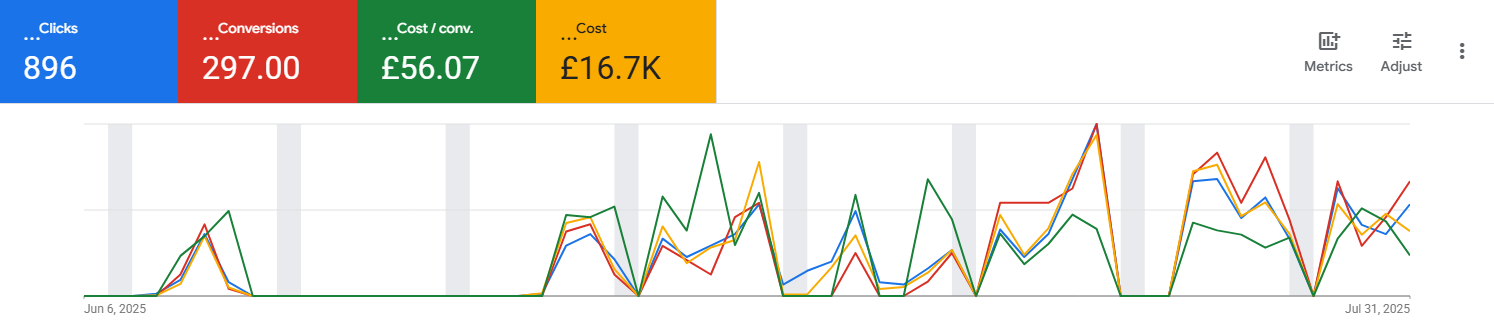
- Clicks: 896
- Conversions: 297
- Cost per conversion: £56.07
- Total spend: £16,700
After:
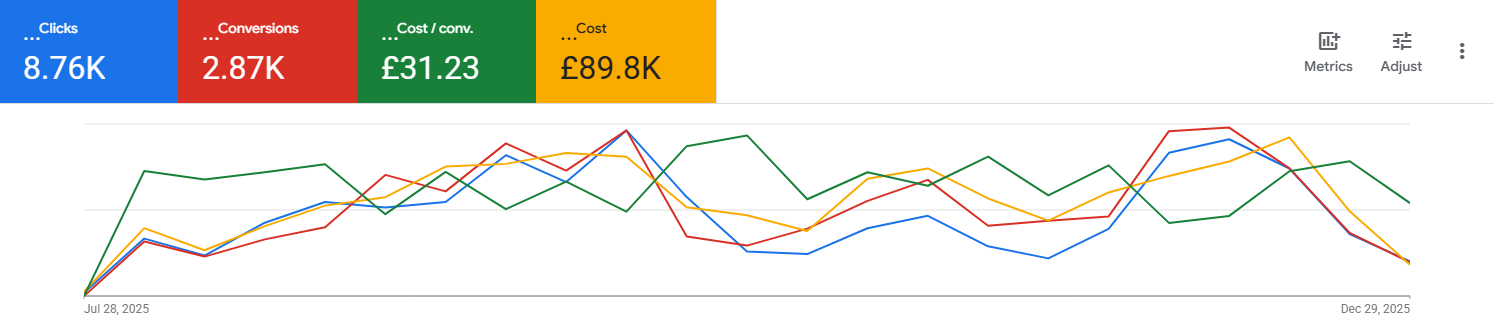
- Clicks: 8,760
- Conversions: 2,870
- Cost per conversion: £31.23
- Total spend: £89,800
A 44% reduction in cost per conversion alongside a 9x increase in conversion volume. The conversion rate held consistent throughout, which means the structural changes did not compromise quality. They simply removed the waste and made the budget work harder.
The Trade-Off Worth Knowing About
Tightening keyword targeting always reduces raw traffic volume initially. If you had looked at the account mid-transition, before the budget was scaled back up, you would have seen lower impressions and lower clicks.
Someone not paying close attention might have called that a step backward.
It was not. It was the account being prepared to grow properly. Once the structure was sound, scaling the budget produced consistent, predictable results instead of inconsistent volume with unpredictable quality.
Key Takeaways
- Broad match without rigorous negative keywords is a budget leak, not a reach strategy
- Campaign overlap is an invisible cost that most accounts carry for months without noticing
- Landing page friction matters as much as ad quality, often more
- Smart Bidding needs clean, consolidated conversion data to optimise effectively
- Cutting traffic volume intentionally is quality control, not regression
- The instinct to raise budget before fixing structure almost always delays real results
The Broader Lesson
Google Ads is not difficult to spend money on. It is very difficult to spend money on efficiently. Most accounts that are underperforming are not there because of the platform. They are there because of decisions made early in the setup that were never revisited.
The question worth asking before increasing any budget is not "how do we get more volume?" It is "do we actually understand why the current volume is not converting?"
In this case, we did not increase the budget until we could answer that confidently. When we did scale, the economics justified every pound of it.
If your Google Ads account is generating clicks but not enquiries, the structure is almost always the problem — not the budget.
- Nexa Growth Marketing Ltd
- nexagrowth.co.uk
- [email protected]
About the Creator
Shakeel
Shakeel Ahmed | CEO at Nexa Growth Marketing Ltd, Helping businesses grow with SEO, PPC, and data-driven marketing.
Enjoyed the story? Support the Creator.
Subscribe for free to receive all their stories in your feed.
Comments
There are no comments for this story
Be the first to respond and start the conversation.