
How Video Annotation Transforms Media Streaming and Content Recommendations
From Behavior to Context: How Video Annotation Enhances Media Streaming Recommendations

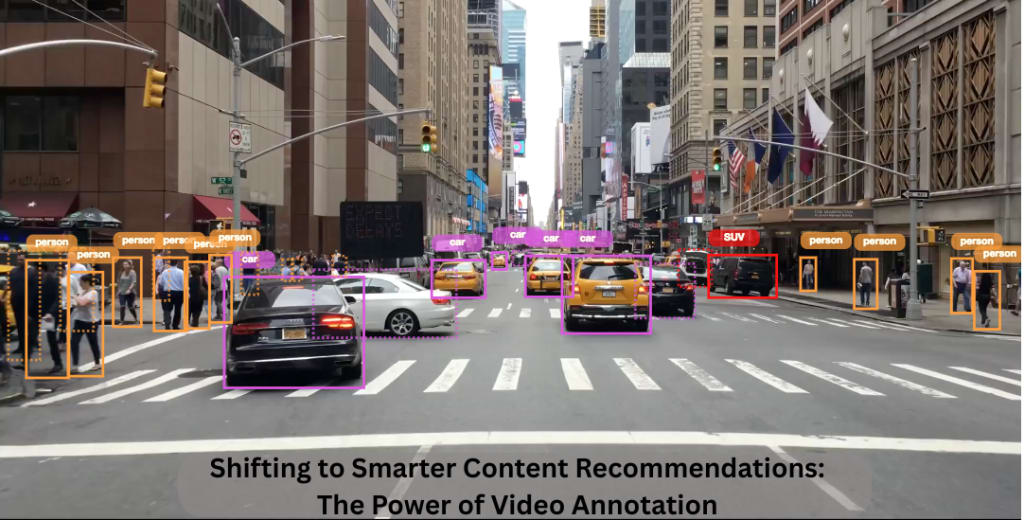
The shift from behavior-based to more sophisticated content-aware recommendations has transformed how businesses capture and retain customer attention today.
The introduction of AI and ML enabled businesses to analyze past user interactions, viewing history, content metadata (like genre, cast, and title), and identifying patterns. This analysis of user behavior allowed them to identify user preferences and predict what viewers would likely watch next. At that time, this was enough to recommend content as formats were more straightforward, and users' choices were easier to predict. But that is no longer the case.
Today, this approach offers only a partial picture as it fails to account for the diversification of content formats and the emergence of new genres. As content evolves, users may explore outside their usual preferences, making past behavior less predictive.
Additionally, it overlooks the deeper reasons behind user choices, such as the context in which content is selected or the emotional responses it evokes. This gap often results in repetitive, less engaging recommendations. That’s where video annotation helps with personalised recommendations that consider factors beyond consumption history.
This write-up will explore this shift toward content-aware media recommendations and video annotation as a key driver behind it.
Shifting from Behavior-Based to Content-Aware Media Recommendations
Traditional media recommendation systems rely exclusively on user behavior, which limits their ability to recommend personalized content. Here are a few key limitations of this approach.
Limitations of Behavior-Based Recommendation Systems
Cold Start Problems: The behavior-based approach relies on historical data from previous interactions. In case a new user or content is added, there won’t be enough interaction data to analyze and generate accurate recommendations.
Context-Blindness: Recommendations based on user behavior show what was watched and predict what might be chosen next. They do not explain why a user made that choice. These systems miss the emotional and visual cues, such as a captivating scene, mood, or theme, that draw users in.
Content Fatigue Due to Over-Personalization: These models often recommend content very similar to what a user has already watched. They suggest the same genres, themes, and storylines, limiting the discovery of fresh content. As a result, users may experience content fatigue.
Why Content-Level Understanding Matters?
To truly personalize media recommendations, you must understand why someone prefers certain content. Knowing the reasons behind a user’s media choices helps businesses offer content that resonates on a personal level, not merely what past behavior indicates will be clicked. For example:
Consider the popular series, Stranger Things. One viewer may be drawn to its sci-fi suspense while another might love the nostalgic '80s setting. At the behavior level, their preferences might look identical as they both decided to watch it, but their motivations are vastly different.
Behavior-level data often misses these nuances. This is why businesses need a content-level understanding of their users’ preferences to fill these gaps.
How Does Video Annotation Facilitate Personalized Media and Content Recommendations?
Video annotation is a process that provides granular insights into video content. It systematically labels elements on a frame-by-frame basis, rendering visual data comprehensible to AI and computer vision models. Additionally, it can classify specific scenes to capture context and nuance. Integrating these insights with traditional behavioral data enables organizations to go beyond the basic statistical recommendations.
Here is how video annotation helps businesses gain a content-level understanding, facilitating better media and content recommendations.
- Going Beyond Static Metadata
Behavior-based recommendations rely on the patterns and insights gained from analyzing static metadata of previously consumed content, such as:
Genre: Thriller
Cast: Brad Pitt and Jennifer Aniston
Duration: 2 hr 10 mins
The above only tells you that the user watched a 2-hour thriller starring Brad Pitt and Jennifer Aniston.
On the other hand, video annotation can add more context and visual detail by tagging elements within the movie, such as themes (e.g., “high-paced car chase”), moods (e.g., “angry,” “sad”), and scene types (e.g., “action sequence”).
When this contextual insight is combined with past behavior data, it creates a more accurate picture of highly specific user preferences. As a result, businesses can map media content more effectively, leading to more personalized and relevant future recommendations.
- Bridging Viewer Preference Gaps with Scene-Level Attributes
Recommendations based on past behavior are generated by treating each piece of media or content as a single unit viewed or preferred previously. For instance, if someone watched the movie Inception, behavioral data would merely note it as "watched Inception," without knowing which specific scenes or elements, such as the plot twists, action sequences, or visual effects, captured the viewer's interest.
On the other hand, video annotation can break the entire movie down into multiple scenes and tag specific attributes, like “dream sequence,” “intense confrontation,” or “sacrifice,” for each frame. When these insights from video scene detection are combined with previously appreciated themes, businesses can identify commonalities. Rather than recommending whole films or series, they can suggest scenes or elements that match the viewer’s interests.
- Overcoming the Cold Start Problem
When new content lacks user interaction data, AI-driven video annotation can add relevant attributes like mood, setting, or activity. This provides a starting point for users to understand the content. The system can then recommend it to users with similar interests based on past behavior.
- Improving Search and Discovery
Annotation for video streaming enhances content searchability by tagging key elements like scenes, actions, or quotes at the frame or dialogue level. This allows users to search for specific moments and jump directly to them without having to watch the entire video to find what they’re looking for. For example:
Searching for “humor based on my pain” will take the user directly to the episode where that dialogue is tagged.
- Providing Intelligent Ad Insertion Suggestions
Implementing video annotation for content recommendations can assist businesses in optimizing ad placement. Using a combination of video scene detection and emotional intensity analysis, including facial recognition, audio sentiment analysis, and scene pacing, video annotation can help determine where ads will be most effective. Ads are more likely to be well-received during natural breaks in content or scenes with low emotional intensity.
- Filtering Age-Appropriate & Sensitive Content
Video annotation also plays a crucial role in filtering age-appropriate and sensitive content. By tagging specific elements such as violence, substance use, or explicit language, the recommendation system can identify content meant for adult audiences. This ensures viewers are presented with only age-appropriate recommendations, enhancing safety and improving content relevance for all viewers.
Additionally, annotations are not just limited to video scene detection; they can also add context. For instance, a scene showing a gun in a character’s hand could be tagged as “violence,” but the context of the scene, whether it’s for a thriller or a cartoon, helps further refine the categorization and determine the severity."
Human vs. AI: Enhancing Content Recommendations through Video Annotation
There are two main approaches to video annotation for streaming and content recommendations: manual (human-involved) and AI-driven.
Manual Video Annotation
This involves humans using certain annotation tools to label elements within a video. Here's how humans typically annotate videos:
- Frame-by-Frame Analysis: Annotators watch the video and tag specific elements, like objects, actions, and emotions, within each frame. This can involve marking moving objects, labeling emotions, or identifying faces and their expressions.
- Scene-Level Analysis: Instead of tagging individual elements, annotators identify entire scenes and assign attributes like "action," "romantic," or "dramatic" based on visual context and audio cues.
The manual approach requires close attention to detail, as annotators must carefully analyze each frame or scene. It is also time-consuming and resource-intensive, especially when working with large volumes of video data. Human involvement increases the risk of errors as annotators may overlook important details. Moreover, subjectivity in interpretation can further affect the accuracy and consistency of scene detection.
This is why many businesses opt to outsource video annotation to professional service providers. These providers offer access to dedicated human annotators who utilize video annotation tools for labeling and then review all annotations without being subjective.
Consequently, businesses get the desired insights without dedicating internal resources or time.
Automated, AI-Powered Video Annotation for Content Recommendations: In many cases, especially when the volume of videos to be annotated is high, AI-driven video annotation solutions are increasingly used to automatically detect and label objects, actions, or scenes within videos. This can involve:
- Object Detection: Pre-trained ML models (e.g., YOLO or Faster R-CNN) are used to identify and label objects like people, cars, animals, etc.
- Event/Emotion Classification and Tracking: AI/ML models can be trained to identify specific activities or actions in videos (like walking, jumping, or running) and compare them to previously learned patterns for accurate labeling. This can also be extended to identifying certain moods and emotions at the scene level.
- Speech-to-Text Video Annotation: When audio descriptions are available, AI tools transcribe spoken words into text, automatically tagging relevant scenes and elements within a video, thus creating a searchable transcript.
AI-driven video annotation is highly effective, especially for repetitive tasks or when large volumes of data need to be processed quickly. It can quickly identify and label common objects like cars, people, or animals across thousands of frames. However, in complex scenarios, AI systems still struggle to identify and label subtle nuances that require a deeper understanding of context or emotions. For instance, AI might fail to recognize a new emotion expressed in a character’s face if it has not been previously trained on such data.
A Balanced Approach
The humans-in-the-loop approach, which combines the efficiency of AI with the expertise of human annotators, has proved to be the most effective for video annotation. While AI can process large amounts of data quickly, human involvement ensures annotations are not just accurate but also nuanced.
AI handles the initial processing by automatically detecting and tagging objects, actions, and scenes within the video. This allows for quick, large-scale video analysis, especially for repetitive or straightforward tasks. Once the AI completes the initial tagging, expert annotators review the results, refining the tags by adding contextual details or correcting errors where necessary. This hybrid approach accelerates the annotation process while maintaining high quality and precision, which is critical when working with large volumes of video content.
The ultimate goal is to gain a deeper understanding of video content and user preferences, utilizing this knowledge to deliver better, more personalized media and content recommendations moving forward.
About the Creator
Alvaro Dee
Alvaro Dee is a Data Analyst at SunTec Data- a global outsourcing company that specializes in data management and support services.
Enjoyed the story? Support the Creator.
Subscribe for free to receive all their stories in your feed.
Comments
There are no comments for this story
Be the first to respond and start the conversation.