
How VAT Works in UAE: Registration, Verification, and Deregistration
Simple Guide to UAE VAT Rules, TRN Checks, and Staying Compliant for Businesses and Startups

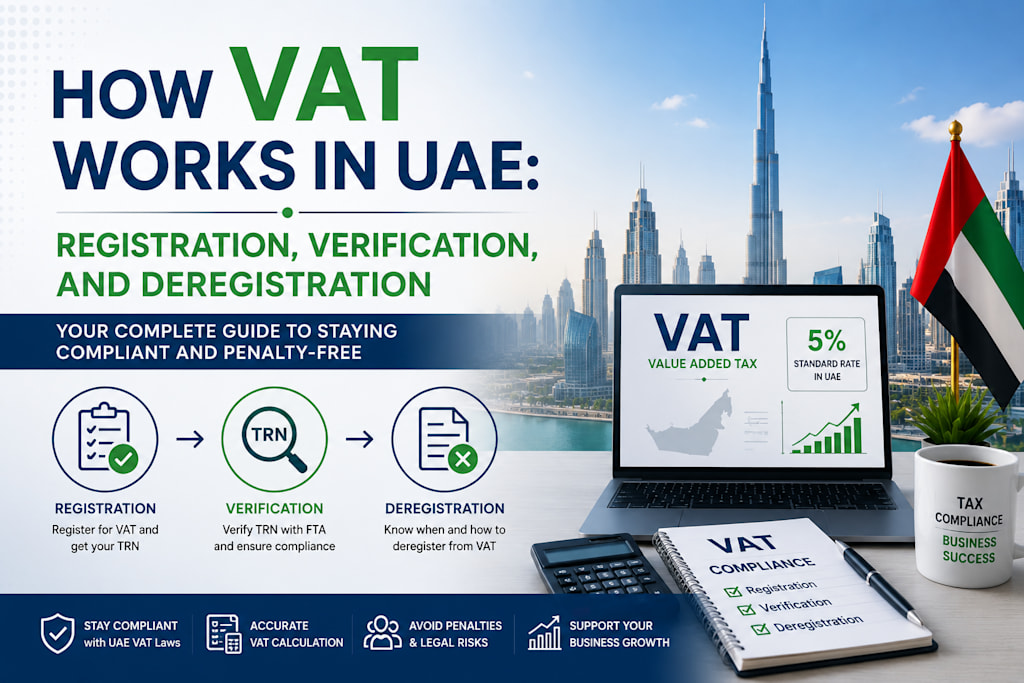
If you’re planning to start or grow a business in the UAE, understanding VAT is essential. From VAT registration and TRN verification to VAT deregistration and calculating taxes correctly, businesses across Dubai and the UAE must stay compliant with Federal Tax Authority (FTA) regulations.
This guide explains everything in simple terms for startups, freelancers, SMEs, and business owners operating in the UAE.
What Is VAT in UAE?
VAT (Value Added Tax) is an indirect tax applied to most goods and services in the UAE. The UAE introduced VAT on January 1, 2018, at a standard rate of 5%.
Businesses collect VAT from customers and submit it to the Federal Tax Authority (FTA).
For example:
• If a product costs AED 100
• VAT at 5% becomes AED 5
• Total customer payment becomes AED 105
VAT applies to many industries including retail, healthcare, hospitality, e-commerce, consulting, and manufacturing.
Who Needs VAT Registration in UAE?
Businesses in the UAE must register for VAT if their taxable supplies exceed the mandatory registration threshold.
Mandatory VAT Registration
A business must register for VAT if annual taxable revenue exceeds AED 375,000.
Voluntary VAT Registration
Businesses earning above AED 187,500 may voluntarily register.
This is especially useful for startups and small businesses wanting to claim VAT input credits.
Understanding TRN in UAE
After VAT registration, businesses receive a Tax Registration Number (TRN).
The TRN is used for:
• VAT invoices
• Tax returns
• Business transactions
• Verification purposes
Customers and suppliers often verify TRNs before conducting business.
What Is FTA TRN Verification?
FTA TRN verification allows businesses and customers to confirm whether a company is officially VAT registered in the UAE.
This helps:
• Prevent fraud
• Verify supplier legitimacy
• Ensure compliant invoicing
• Build trust between businesses
Businesses can perform VAT verification directly through the FTA portal.
Why VAT Compliance Matters
Failing to comply with UAE VAT regulations can lead to:
• Financial penalties
• Business disruptions
• Tax audits
• Reputation damage
Maintaining proper invoices, records, and timely filings helps businesses avoid unnecessary complications.
VAT Calculator UAE: How Businesses Use It
A VAT calculator helps businesses quickly calculate VAT-inclusive and VAT-exclusive prices.
Example 1: Adding VAT
Product Price: AED 1,000
VAT (5%): AED 50
Final Price: AED 1,050
Example 2: Removing VAT
Total Amount: AED 1,050
VAT Amount: AED 50
Original Price: AED 1,000
VAT calculators are especially useful for:
• Retail businesses
• Freelancers
• E-commerce sellers
• Accounting firms
• Service providers
VAT Deregistration UAE Explained
VAT deregistration means canceling VAT registration with the Federal Tax Authority.
Businesses may apply for VAT deregistration if:
• Business operations stop permanently
• Revenue falls below the deregistration threshold
• The company closes or restructures
De-Registration of VAT: Important Things to Know
Businesses should not ignore VAT deregistration requirements.
If a company no longer qualifies for VAT registration but fails to deregister on time, penalties may apply.
Before deregistering, businesses should:
• File pending VAT returns
• Clear outstanding liabilities
• Maintain financial records
• Ensure compliance with FTA requirements
Dubai Business License Cost and VAT
Many entrepreneurs ask about the Dubai business license cost when starting a company.
Business setup costs vary depending on:
• Mainland or free zone setup
• Business activity
• Number of visas
• Office requirements
• Government approvals
In addition to license costs, businesses should also consider:
• VAT registration requirements
• Accounting expenses
• Tax compliance costs
• Audit requirements
Proper financial planning helps businesses avoid unexpected expenses later.
Common VAT Mistakes Businesses Make
Incorrect Invoicing
Missing TRN numbers or incorrect VAT calculations can create compliance issues.
Late VAT Filing
Delayed VAT return submissions may result in penalties.
Poor Record Keeping
Businesses must maintain invoices and accounting records properly.
Ignoring Deregistration Rules
Businesses closing operations sometimes forget to apply for VAT deregistration.
Tips for Staying VAT Compliant in UAE
• Keep accurate accounting records
• Use reliable invoicing software
• Verify supplier TRNs regularly
• File VAT returns on time
• Work with professional accountants or VAT consultants
• Stay updated on FTA regulations
Final Thoughts
VAT compliance has become an important part of running a business in the UAE. Whether you are registering for VAT, verifying a TRN, calculating VAT, or applying for VAT deregistration, understanding the process helps businesses stay compliant and financially organized.
For startups, SMEs, and growing companies, working with experienced accounting professionals can simplify VAT management and reduce the risk of penalties.
About the Creator
NR Doshi and Partners
NR Doshi & Partners is a leading audit, tax, and business advisory firm in the UAE with more than four decades of professional excellence.
Enjoyed the story? Support the Creator.
Subscribe for free to receive all their stories in your feed.
Comments
There are no comments for this story
Be the first to respond and start the conversation.