
How Value Engineering Powers Consistent Store Rollouts
Why Scalable Retail Growth Starts with Better Engineering

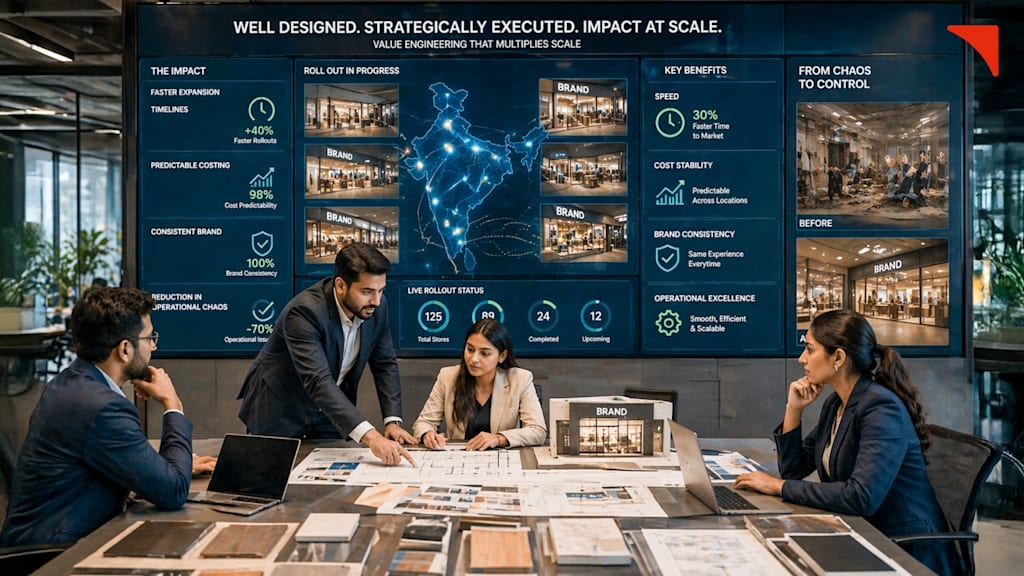
We’ve sat through far too many rollout meetings where as soon as someone utters the words ‘value engineering’, the room divides into half the attendees who heard 'cheaper materials' and the other half who start mentally preparing for a fight. Their responses underscore how deeply the term is misunderstood. For years, value engineering has been positioned as a solution to when budgets are bleeding out and timelines are starting to slip. In almost all those cases, it was ultimately positioned as a more polite way to ask everyone to 'cut corners' without actually using those words. While not entirely incorrect (some degree of cost reduction often occurs), that's a very dangerous oversimplification of what value engineering can do when you’re trying to expand your brand across hundreds of locations simultaneously.
Just below that statement is a more productive question. Today, a lot of retail leaders are focused on one single metric: 'how do we reduce per-store cost'. But the better question, the one that distinguishes those brands that scale smoothly from those that lurch forward store-opening-to-store-opening, is the following: 'How do you build more stores faster, at the same capital, without diluting the brand experience your customer expects.' It's only when you set this objective that value engineering morphs from a simple cost-saving lever into an intelligent system for rolling out stores.
The Shift: From Cost Reduction to Rollout Intelligence
This isn't a minor tweak. It changes how people and decisions are involved and where actual savings lie. When a conversation is centered around cost reduction, it becomes a back-and-forth over procurement pricing and lists of materials to swap out. When a conversation revolves around rollout intelligence, it extends up the supply chain to encompass the very design, manufacturing logic, logistics and capital structure behind every store build. The results are not marginal: a brand that can engineer away friction at every step of building a store will be able to multiply its expansion capacity long before anyone suggests cheaper laminate.
Where do Value Engineering Savings Actually Manifest Themselves?
These savings exist at a handful of interconnected levels, though they rarely operate independently. Despite this, most discussions around rollout efficiency fail to integrate them.
Material intelligence is the first level, and it's less about sourcing a cheaper board than about integrating fixtures with standard material dimensions. How many times have you seen a shopfitting drawing that ignores the realities of raw material sheets, resulting in cutting plans with unacceptable waste percentages? When you integrate material intelligence into the initial design phase, you design around those standard sheet sizes to drastically reduce waste, ensuring manufacturers can provide accurate quotes even when dealing with high-volume orders. Without it, there’s really no way to cost accurately for 100 stores.
Manufacturing acceleration is a natural consequence. By shifting from bespoke, labour-intensive fabrication to standardized, computer-controlled machinery and pre-engineered component systems, you convert craft into manufacturing. We’ve seen projects where identical fixture sets produced by different regional suppliers couldn’t be distinguished because of ambiguities left in original specifications. Precision engineered fabrication, however, eliminates that guesswork and allows multi-vendor execution without constant design supervision.
The layer most people skip is functional simplification. Layers of materials and redundant processes often accumulate on store elements over time. A simple shelving unit might have a substrate, a laminate layer, a decorative trim, and a protective coating when a single directly-printed panel would accomplish the same thing visually and durably with a fraction of the components and fabrication steps. When you eliminate those layers, you don't necessarily degrade the brand aesthetic-you achieve the same sensory result more efficiently. Fewer components mean fewer things to order, fewer chances for errors and less to coordinate when the store is built. No store manager has ever complained about having fewer components to manage under a tight deadline.
Logistics and deployment efficiency is a layer that many people find most stinging because of how visible it often is. Over-sized, fully-assembled fixtures that are cumbersome to ship take up significantly more space in transit, are expensive and difficult to maneuver into constrained urban sites and often turn what would be a straightforward delivery into a logistical nightmare. When designing for movement is integrated, fixtures are engineered to flat-pack, easily assemble on-site with minimal tools and skills. This step alone can make a huge difference to rollout speed and cost; it’s usually a decision that’s obvious once the problems are defined.
It’s only when value engineering incorporates a lifecycle view of capital that the entire system becomes truly efficient. It’s a misuse of capital to deploy durable, expensive materials on display units that will only ever be used for six months. Permanent perimeter fixtures need those durable materials. Seasonal displays require much less of them. Making those decisions at the design phase ensures you’re spending money where it strengthens the brand for the long term, rather than burning it on elements that have minimal life.
Why Does Value Engineering Become Critical at Scale?
Small errors at the individual store level rarely cause any concern; perhaps a few feet of plywood extra here, an hour of rework there, a rush job to ship the fixtures across town at a higher cost. When you scale those issues to a hundred locations, you're now losing the money it would cost to build a couple of extra stores. Time to market follows a similar trend: a few extra weeks per store can translate into thousands of dollars in lost market share. Value engineering, when it’s properly executed, starts addressing those efficiencies before they accumulate to become overwhelming.
More Than Cost Cutting, Value Engineering as a System
It is the move from cost-saving as a goal to systems-building as the mission that separates the one-off results from the sustained success. By weaving these different levels of value engineering into the design, procurement, manufacturing, logistics, and deployment processes, you convert disparate parts into a cohesive whole. This is what enables companies to move beyond treating each store as a separate, individual project that needs to be managed from scratch. By viewing rollout as a product, many retailers can streamline their expansion process. Each dollar saved is then a step toward being able to build more stores, faster, and with more confidence.
The D'Art Approach: Value Engineering to Rollout Intelligence
It is important to note that "embedding value engineering into a broader rollout operating system" is not just theoretical. We’ve seen the concept work at companies like D'Art where the value engineering work never ends at sign-off with the cost team. Instead value engineering is built into the framework which ties the modular design systems with standard fixture and signage platforms along with deep on-the-ground vendor integration. Essentially, that means that a store prototype created for a high-street catchment can then be recreated as a mall or kiosk without going back to the drawing board because the engineering has been considered. Elements like the Power Stock Strategy, where standardized components are placed on the ground, and modular archetype-based design are key to changing retail turnkeys from custom pain points into repeatable models. Brands achieve faster retail rollouts not by rushing the installation crew but by reducing the common points of resistance which slow everyone down from location to location.
The Competitive Reality
Today the most competitive retail expansions are won not on the drawing board, but in the system that allows design to connect with procurement to manufacturing with logistics and with installation as a single system. Brands that can not systemize their rollout processes end up overspending, inconsistent installation, and losing valuable time in their store rollout while other brands that embrace engineered rollout systems are expanding faster and becoming more predictable as well as strengthening their store network. The gap between leaders and laggards has ceased to be one of creativity; rather, it has become one of reproduction across an entire portfolio.
Conclusion
When misunderstood value engineering is merely a euphemism for cost cutting; in fact, correctly implemented, it becomes an accelerant for growth. It's not about doing less; it's about doing more with the same resources and then scaling those resources further at every store opening. As physical retail continues to demand both velocity and consistency for expanding brands, the ability to engineer efficiency in every rollout will ultimately distinguish market leaders from their counterparts still struggling to achieve scale.
About the Creator
D'Art Design
D’Art Design is a leading global retail design agency. We integrate tactic to provide outstanding experiences, through brand communication and activation, brand design, promotion, and interior design.
Enjoyed the story? Support the Creator.
Subscribe for free to receive all their stories in your feed.
Comments
There are no comments for this story
Be the first to respond and start the conversation.