
How to Source Trifluoroacetic Acid (TFA): Purity, Packaging, Application Fit and Supplier Checklist
Why TFA Sourcing Requires More Than Price and Assay

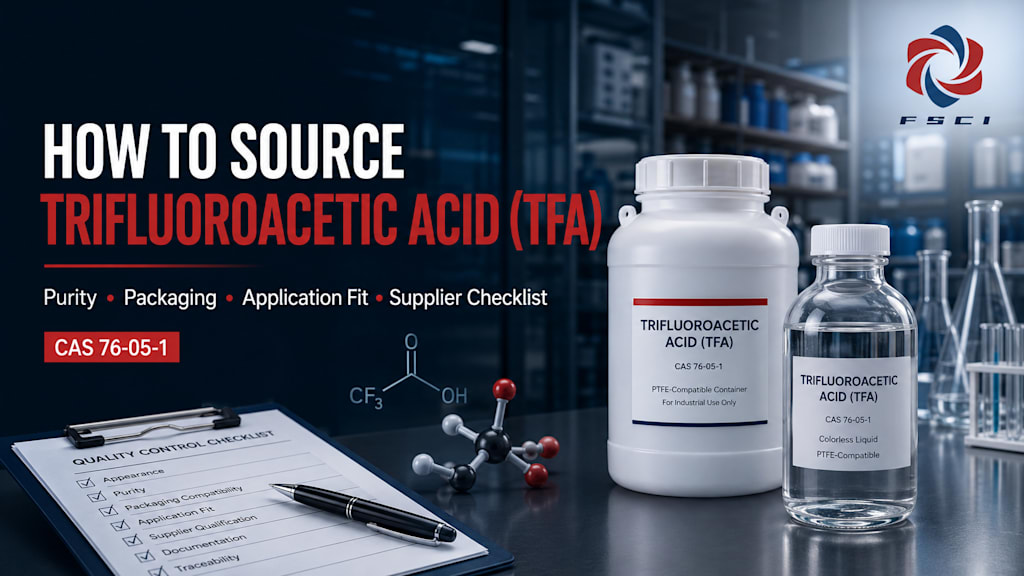
Trifluoroacetic acid, commonly abbreviated as TFA, is used in industrial organic synthesis, agrochemical intermediate production, biochemical work, and certain analytical systems. Its usefulness across these fields does not mean that one grade or specification is suitable for every process.
A purchasing decision based only on price and assay can overlook moisture, color, residual impurities, packaging compatibility, and documentation requirements. These factors may influence process consistency, analytical reliability, storage planning, and receiving inspection.
TFA is also a corrosive chemical that requires appropriate packaging, labeling, storage, and transportation controls. Buyers should evaluate the product and the supply chain together. A suitable source must be able to provide consistent batches, accurate documents, compatible containers, and dependable delivery information.
Define the Intended Application First
Before requesting a quotation, buyers should define how the material will be used. This helps the supplier identify an appropriate grade and prevents comparisons between products designed for different purposes.
Industrial organic synthesis buyers may focus on assay, moisture, process-relevant impurities, batch consistency, and commercial-volume availability. Their primary concern is often whether the material can be introduced into an established production system without creating avoidable variability.
Agrochemical intermediate manufacturers may place additional emphasis on residual impurities that could carry forward into later production stages. They may also require traceability and documentation that aligns with internal quality programs and customer requirements.
Biochemical users may need tighter control of contaminants that could interfere with sensitive materials or downstream evaluation. The term “biochemical reagent” alone is not enough to establish suitability. The required grade and acceptance criteria must be defined by the user.
Analytical laboratories may prioritize consistency, moisture control, and impurities that could affect background response or measurement quality. Suitability depends on the analytical method, instrument, sensitivity, and validation requirements.
A complete request for quotation should therefore include the intended application, required grade, expected purchasing volume, quality limits, packaging preference, destination, and required documentation.
Compare the Relevant Purchasing Specifications
Assay describes the measured amount or concentration of the target chemical in the product. A higher number is not automatically the correct choice for every buyer. The required assay should be based on the intended use, internal quality standards, and the effect of other components on the process.
When checking available specifications, packaging formats, and sourcing documentation for Trifluoroacetic acid (TFA) CAS 76-05-1, buyers should compare the published information with their own acceptance criteria and verify the proposed batch through its Certificate of Analysis.
Moisture deserves separate attention because TFA is hygroscopic, meaning it can absorb moisture from its surroundings. The acceptable moisture level depends on how sensitive the buyer’s process is to water. Procurement teams should confirm the test method, specification limit, and actual batch result rather than relying on a general description of purity.
Color and appearance provide practical incoming-quality checks. Buyers should request the supplier’s current standard and establish what the receiving team should inspect. Unexpected discoloration, visible contamination, container damage, or an inconsistent appearance should be investigated before the material is released for use.
Residual impurities should be evaluated according to the application. A compound that matters in an analytical system may be less relevant in an industrial synthesis, while a low-level impurity that carries through multiple manufacturing stages may be important to an agrochemical producer. Buyers should identify application-relevant concerns instead of asking only for “high purity.”
Batch consistency is equally important. The specification defines acceptable limits, while a batch-specific COA reports the results for a particular lot. Buyers should review both documents because a generic specification sheet cannot replace actual lot data.
Match the TFA Grade to Application Requirements
Industrial synthesis users generally need a grade that supports predictable processing at the required production scale. They may prioritize assay, moisture, impurity control, consistent supply, and packaging that fits the facility’s transfer and storage capabilities.
Agrochemical manufacturers may need additional review of impurities, traceability, and documentation because the material can become part of a longer intermediate-production chain. Supplier notification procedures for specification or manufacturing changes may also be relevant.
Biochemical and analytical users should evaluate suitability against their own methods and validation requirements. A product described for general laboratory use should not automatically be assumed suitable for every biochemical assay, chromatography method, or sensitive analytical application.
Before buyers commit to a commercial order, their technical and quality teams should confirm that the offered grade meets the actual process requirements. Supplier literature can support this review, but it does not replace internal evaluation.
Evaluate Packaging Size and Delivery Format
Packaging selection should reflect order volume, consumption rate, storage capacity, handling equipment, and inventory planning. Options such as 25 kg and 250 kg containers may be available, but buyers should confirm the current formats for each quotation.
A smaller package may be practical for lower consumption, trial purchasing, or facilities that want to limit the time a container remains open. Larger packaging may reduce the number of containers needed for production, but it requires suitable storage, movement, and handling capabilities.
Customized packaging or delivery arrangements may also be possible. Buyers should describe any special requirements early, including net weight, pallet configuration, label language, delivery schedule, and documentation needs. Custom requests may affect lead time, minimum order quantity, and transportation planning.
Review Packaging Compatibility and Storage Controls
Because TFA is corrosive, container compatibility cannot be assumed. Procurement teams should ask the supplier to confirm that the proposed container, closure, seal, and outer packaging are appropriate for the supplied product and intended transportation conditions.
The buyer’s safety team should independently review the package against facility requirements and applicable regulations. Recommendations for container materials should come from verified compatibility information, the current SDS, the supplier, and qualified safety personnel.
Container integrity is an important receiving criterion. Packaging should arrive sealed, correctly labeled, and free from visible damage or leakage. Lot numbers and product identification should be legible and consistent with the COA, packing list, and shipping documents.
Storage instructions should be established before delivery. Requirements for ventilation, temperature, segregation, secondary containment, and emergency planning must be determined from the current SDS, local regulations, facility procedures, and professional safety review. Improvised handling practices are not an acceptable substitute.
Transportation conditions should also be confirmed in advance. The applicable classification, packaging rules, labels, and documents may vary by shipment quantity, destination, and transportation method.
Audit Supplier Documentation
Documentation review is a central part of chemical supplier qualification. Before approving an order, procurement and quality teams should request the following:
A current product specification sheet
A batch-specific Certificate of Analysis
A current Safety Data Sheet
Container and hazard-label information
Packing-list and lot-number details
Applicable dangerous-goods and transportation documents
Required export and customs documentation
Traceability records connecting the shipped lot to its quality documents
The product name, CAS number, batch number, quantity, and packaging description should remain consistent across the relevant documents. Discrepancies should be resolved before dispatch whenever possible.
Regulatory and transportation requirements vary by destination, order quantity, carrier, and shipping method. Buyers should confirm current requirements with the supplier, logistics provider, customs professionals, and qualified regulatory personnel rather than relying on documents from a previous shipment.
Validate the Supplier Through a Sample or Small Order
A sample or small commercial batch allows buyers to evaluate more than chemical specifications. It also provides an opportunity to review packaging condition, labeling accuracy, document quality, communication speed, and delivery performance.
Samples should be identified by lot and accompanied by relevant analytical information. The buyer can then evaluate the material using approved internal methods and compare the results with the supplier’s documentation.
A small initial order may reveal practical issues that do not appear during quotation, such as document delays, unclear lot marking, packaging damage, or slow responses to technical questions. Resolving these issues before increasing order volume can reduce procurement uncertainty.
Buyers should also confirm whether the approved sample is representative of future commercial supply and how lot-to-lot changes will be communicated.
TFA Supplier Qualification Checklist
Use this checklist when reviewing a prospective trifluoroacetic acid supplier:
Intended application and required grade are clearly defined.
Assay or concentration requirements are confirmed.
Moisture limits and test methods are reviewed.
Color, appearance, and relevant impurity criteria are documented.
A representative sample or trial quantity is available.
A batch-specific COA can be provided.
A current SDS is available in the required language.
Packaging material, size, closure, and sealing method are confirmed.
Container labels meet shipment and destination requirements.
Storage and transportation conditions are documented.
Export and customs documents can be prepared.
Production and delivery lead times are realistic.
Lot numbers support traceability through delivery.
Technical, quality, and after-sales contacts respond promptly.
A process exists for reporting damaged packaging or quality deviations.
Questions to Ask Before Buying TFA
Procurement teams can send these questions to a TFA chemical supplier before placing an order:
Which grade do you recommend for the application described in our request, and what specification supports that recommendation?
What assay, moisture, color, appearance, and impurity criteria apply to the offered product?
Can you provide a batch-specific COA for the sample and proposed commercial lot?
What packaging sizes are currently available, and can 25 kg, 250 kg, or customized formats be confirmed for this order?
How has the compatibility of the container, closure, and seal with the supplied TFA been verified?
Which SDS, labels, transportation records, and export documents will accompany the shipment?
What are the production lead time, document-preparation time, and estimated delivery schedule?
How are lot traceability, specification changes, packaging problems, and quality complaints handled?
Written answers make supplier comparisons more consistent and give purchasing, quality, logistics, and safety teams a shared record for review.
Conclusion
Reliable TFA procurement begins with a clear definition of the intended application. Industrial synthesis, agrochemical production, biochemical work, and analytical testing can require different grades, impurity controls, packaging formats, and validation standards.
By reviewing specifications, confirming compatible packaging, auditing documentation, and validating performance through a sample or small order, buyers can make more informed sourcing decisions. These steps support better traceability, more consistent deliveries, and stronger coordination between procurement, quality, safety, and production teams.
About the Creator
Enjoyed the story? Support the Creator.
Subscribe for free to receive all their stories in your feed.
Comments
There are no comments for this story
Be the first to respond and start the conversation.