
How to Build a Prototype Brief That Answers the Right Engineering Questions
A prototype can be beautifully made and still answer the wrong question.

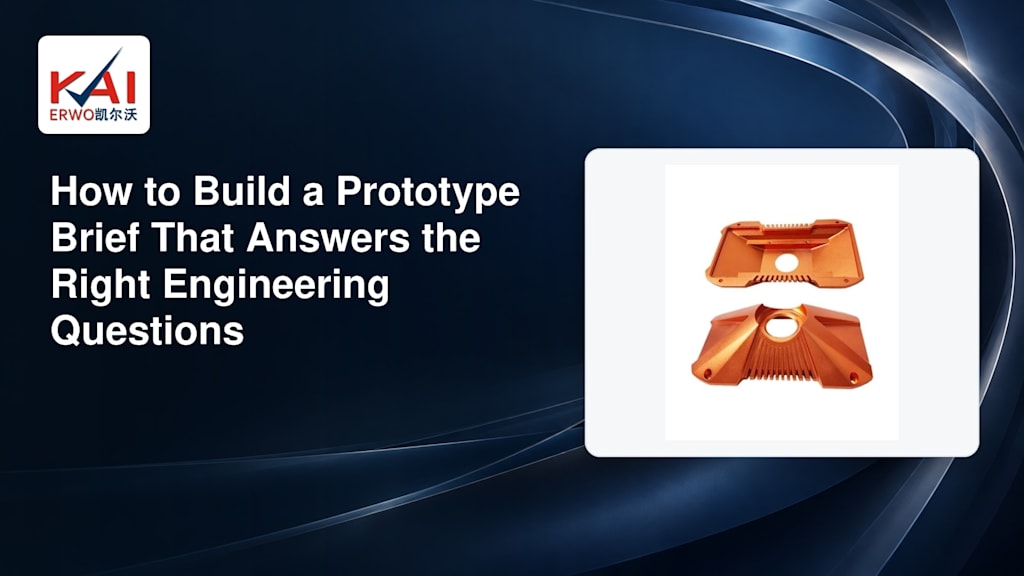
The team may receive a presentation model when it needs assembly evidence, or a functional-looking part without the material information required for the intended review. The issue often begins before manufacturing, in a brief that describes the object but not its purpose.
A useful prototype brief links the requested part to a decision. It explains what the team wants to learn, how the part will be reviewed, and what conclusions remain outside the scope. That gives suppliers a clearer basis for proposing a route.
Write the Decision Before the Part Description
Begin with a practical question. Can the team access the fasteners after assembly? Does the enclosure accommodate the identified components? Which of two layouts is more useful for a handling review? The question should be specific enough to guide the prototype requirements.
Then describe the part and the conditions of the review. Identify related components, relevant revisions, and any deliberate simplifications. A supplier can propose more relevant options when it understands why the geometry matters.
NASA's Systems Engineering Handbook describes validation in relation to intended use and its environment. For a prototype brief, the useful lesson is to state the context of the evaluation rather than rely on a general claim that the design will be validated.
Select Evidence That Can Answer the Question
Define what reviewers will observe or measure. Use criteria that match the question and identify the person responsible for interpreting the findings. If a result requires a comparison, specify the reference or mating component.
Separate evidence from inference. A prototype may establish clearance under the checked conditions while leaving material behavior unresolved. The brief should make that limitation visible before the team interprets the result too broadly.
NASA's technology readiness framework associates maturity with demonstrated evidence. A finished sample is therefore better treated as an input to a defined review than as an automatic declaration that the product is ready for its next stage.
Keep the Brief Short Enough to Use
A focused record can preserve the important context without becoming a lengthy specification for every iteration.
Brief Field
Question the Field Should Answer
Development decision
What will the team decide after the review
Part definition
Which geometry, revision, and related components apply
Required observations
What reviewers must measure or inspect
Review conditions
How and where the prototype will be assessed
Known limitations
Which conclusions the prototype cannot support
Decision owner
Who interprets the evidence and approves the next step
When approaching a rapid prototyping and manufacturing company, share this brief before requesting a final proposal. It allows the supplier to discuss suitable manufacturing routes and identify gaps that could make the eventual prototype less useful.
Avoid adding features simply because they are possible to manufacture. Every requirement should support the review or another clearly identified need. Where the team has multiple incompatible objectives, separate the evaluations instead of hiding the conflict in one broad brief.
Test the Brief With Another Reviewer
Ask a colleague to explain the intended decision using the brief alone. Any missing context is worth resolving before release.
• State one primary decision for the prototype iteration.
• Identify the controlled part and related component revisions.
• Define the observations that would support the decision.
• Record the conditions and limits of the review.
• Assign an owner to interpret the findings.
The broader services described by Kaierwo can be reviewed if different prototype routes are under consideration. Assess each route against the brief instead of allowing the available process to define the question retrospectively.
Frequently Asked Questions
Can one prototype answer several questions?
Yes, when the requirements are compatible and the review plan is clear. Separate questions that need different materials, conditions, or evidence.
Should the brief specify the manufacturing process immediately?
Only when there is a justified constraint. Otherwise, explain the intended evidence and ask the supplier to propose suitable options.
What if the review produces an unexpected finding?
Record it separately from the original acceptance decision. Decide whether it needs a new evaluation before changing the design or project plan.
Rewrite one current prototype request around its intended decision. Remove requirements that do not support that decision and add the evidence that reviewers will actually need.
About the Creator
Enjoyed the story? Support the Creator.
Subscribe for free to receive all their stories in your feed.
Comments
There are no comments for this story
Be the first to respond and start the conversation.