
How Robotics Is Powering the Next Generation of Automotive Manufacturing
From collaborative robots to AI-driven quality inspection, the industry is entering a new age of automation.

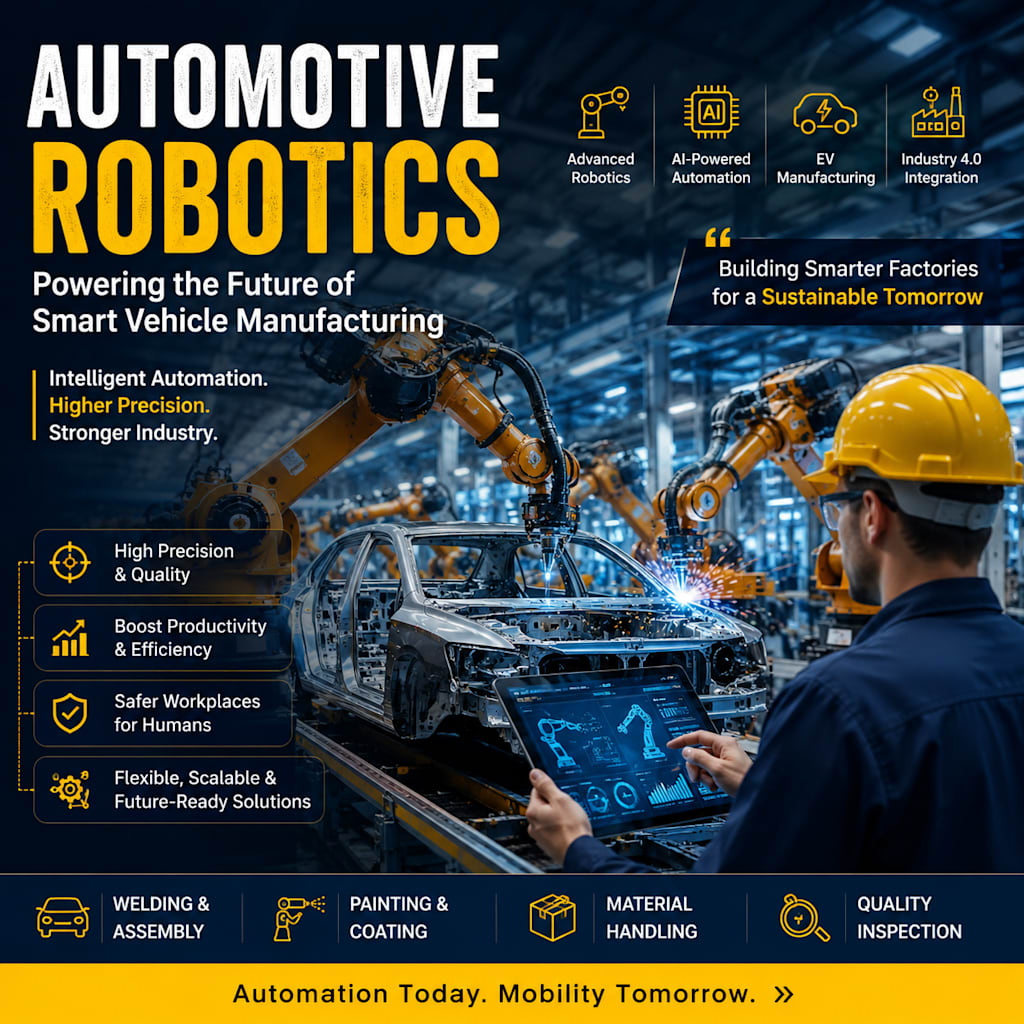
Automotive robotics is spearheading one of the greatest manufacturing transformations in its history.
Factories that were once reliant on manual labor are becoming sophisticated, automated production systems powered by robotics, artificial intelligence, machine vision and real-time connectivity. From welding vehicle frames to assembling EV batteries, robots are leading the transformation of automotive production.
A New Era for Automation in the Market
The global market for automotive robots reached approximately $13.24 billion in 2025, and the market is anticipated to grow to almost $29.85 billion by 2034. This reflects a robust compound annual growth rate (CAGR) of 9.17% over 2026-2034, and highlights the critical role of automation in the future of vehicle manufacturing.
Growing EV adoption, the increasing complexity of vehicle production, labor shortages, and the adoption of Industry 4.0 technologies are all fueling the change.
Automotive manufacturers are no longer adopting robotics simply to reduce their costs; it is now essential to producing high-quality and versatile vehicles while remaining competitive.
Why Are Car Makers Investing Massively in Robotics?
Automobiles are more complex now than they were a decade ago.
The assembly process for electric vehicles differs significantly from that of conventional internal combustion engine automobiles. Integrated battery pack assembly, lightweight component handling, installation of high-voltage components and precision welding all demand precise robotic systems.
Simultaneously, the world's leading car manufacturers are expected to ramp up production output while maintaining a high standard of quality.
Robotics offers a solution to many production-related problems such as:
* Reducing errors
* Accelerating production speed
* Decreasing operational costs in the long-term
* Enhancing worker safety
* Maintaining around-the-clock production cycles
The efficiency and precision offered by robotics are what makes them a cornerstone of next-generation automotive manufacturing.
The Role of EVs in Driving Increased Adoption of Automation
One of the primary driving forces behind the automotive robotics market is the rapid expansion of electric vehicles.
As countries introduce regulations aimed at curbing emissions, and the overall adoption of EVs increases, manufacturers are beginning to produce new, dedicated electric vehicle production lines.
The manufacturing of an electric vehicle is completely different to that of a conventional vehicle. The production processes for EV battery packs alone incorporate robotic elements such as:
* High-accuracy laser welding
* Assembly from cells to module
* Application of adhesive
* Integration of cooling mechanisms
* Verification of high-voltage systems
These processes have generated a surge in the demand for robotic systems that can manage delicate components with superior precision. As gigafactories for EV production expand across the globe, so too will robotics integration within these factories for the remainder of the decade.
Industry 4.0 and the Changing Face of Automotive Production
Robotics in automotive manufacturing no longer merely encompasses the machinery itself. Today's factories are becoming connected and intelligent through Industry 4.0, where robots, sensors, software and analysis platforms come together to create integrated manufacturing systems.
Key technologies that are central to the adoption of these smart factories are:
* AI
* IoT Connectivity
* Remote monitoring solutions via the cloud
* Systems to enable predictive maintenance
* Analytics for production data
Through smart factories, robots can now communicate with other production equipment, detect inefficiencies in the production process and even provide prior warning of impending equipment malfunctions. The shift to connected manufacturing is enabling automotive companies to improve output while also minimizing production downtime.
Articulated Robots Dominate the Landscape
Among the different types of robots, articulated robots remain the most widely utilized in the automotive sector. These accounted for over half of the market share in 2025, and their popularity stems from their adaptability and their ability to automate diverse tasks across automotive production lines.
With their multi-axis maneuverability, they can handle various assembly tasks such as:
* Welding
* Spray painting
* Moving materials
* Component assembly
* Application of sealants and adhesive
Given the ever-increasing complexity of automobile designs, articulated robots are more relevant than ever as they are readily adaptable to varied production environments.
Collaborative Robots Revolutionize Human-Machine Interfaces
A particularly notable development is the increased use of collaborative robots, or 'cobots'. Traditional industrial robots require enclosed work areas but cobots are designed for safe collaboration with human workers.
Cobots are widely being implemented for:
* Precision assembly tasks
* Quality inspections
* Transporting materials
* Repetitive ergonomic tasks
Manufacturers find these systems to be particularly attractive, as they can reduce the required factory space and are less expensive to implement than conventional robots. Collaborative robots will become an increasingly dominant section of the market as production lines are required to be more flexible and produce more varied products.
AI Enhances Robot Capabilities
Artificial intelligence is making it possible for industrial robots to evolve from pre-programmed machines into intelligent and self-learning systems.
Machine vision capabilities powered by AI enable real-time inspection of vehicle components to identify micro defects at a faster rate than any alternative method. This leads to improved:
* Consistency in products
* Precision of manufacturing
* Product quality
* Manufacturing output
AI also empowers robots to identify optimal motion paths, decrease power usage and adapt to new production targets without the need for direct programming. As the field of machine learning matures, automotive robots will only become more capable of acting autonomously.
Asia-Pacific Leads the Global Market
The Asia-Pacific region currently dominates the automotive robotics market and is experiencing significant growth. China continues to hold the top position in terms of automobile manufacturing output, and is making substantial investments to support its electric vehicle sector through automation. Japan is a strong market performer, due to its significant robotics manufacturing capability and presence of leading robotics firms.
Key Players Driving Innovation
Among the world's largest and most influential robotics and automation firms, the competition is intense. Industry leaders are investing heavily in AI-powered robotics platforms, automation of EV production lines, advanced sensor technologies, digital twin solutions and intuitive robot programming software.
Leading companies such as ABB, FANUC, Yaskawa, DENSO, Kawasaki Heavy Industries, and Omron, among others, are constantly introducing new products and solutions to meet the demands of automotive manufacturers, while strategic partnerships between robotics firms and automotive producers further boost industry innovation.
Challenges Persist
Despite the strong positive market trends, the automotive robotics sector is not without its hurdles.
Initial investment costs can represent one of the main challenges in implementing robotics, as smaller manufacturers may find it difficult to bear the expenses of setup, training and maintenance.
The issue of cybersecurity is also becoming more prominent, as increased connectivity between factories and cloud systems via the IoT network brings with it an increased threat of cyber-attacks or disruptions.
Workforce impact, especially in relation to automation and traditional jobs in manufacturing, poses another challenge. This underlines the need for reskilling and training programs for the workforce.
The Future of Automotive Robotics
The next decade promises increased integration between robotics, AI, and the development of smart manufacturing systems. Future automotive production facilities might include:
* Fully automated production lines
* Humanoid robots to work with human operators
* AI-powered quality control systems
* Self-optimizing production environments
* Remote management of robot fleets
As vehicle production lines transition towards more software-defined and electric architectures, robotics will increasingly become the foundational technology of automotive manufacturing.
Conclusion
Automotive robotics is no longer solely about replacing manual labor. It represents a significant shift toward smart and interconnected production systems that will support the mobility industry of the future. From the production of EVs to the establishment of AI-driven factories, robotics is a critical driver shaping the modern automotive sector.
About the Creator
Robert
Senior Market Researcher at IMARC Group, specializing in global market analysis, industry trends, and data-driven insights across diverse sectors.
Enjoyed the story? Support the Creator.
Subscribe for free to receive all their stories in your feed.
Comments
There are no comments for this story
Be the first to respond and start the conversation.