
How Enterprises Modernize Legacy Systems Without Rebuilding From Scratch
Discover how enterprises reduce modernization costs and risks by evolving existing systems instead of starting over.
Imagine that: you’re expanding, the competition is getting ahead, and your developers are wasting 70 percent of their time fixing antiquated software rather than writing new code. The very heart of your company, the application responsible for the billing, the customer database, or the order management process was coded 15 years ago. It does work. More or less. However, integrating that piece of technology with any sort of modern API, mobile application, or cloud platform is akin to conducting brain surgery on a live person.
That’s the legacy system quandary, and it’s more pervasive than you might think.
As a matter of fact, according to a McKinsey report, legacy technology ranks among the top three barriers to digital transformation of major corporations. But replacing the whole system by building a new one from scratch isn’t usually a viable option. Rebuilds, as we already know, often end up being prohibitively costly and risky, with countless failures littering the landscape.
Fortunately, there’s an alternative. Application Migration & Modernization provides companies with a more controlled strategy of transforming their applications without taking a gamble on a wholesale rebuild. And here is how they do it.
What Is Application Migration & Modernization?
Application migration & modernisation can be defined as an effort aimed at enhancing an application’s efficiency by improving, restructuring, and relocating it without necessarily upgrading its core components.
It is where strategy meets architecture and spans a wide range of efforts such as:
- Migration of workload to the cloud from the server’s premises
- Disintegration of applications to microservices
- Application platform upgrade
- Adding modern APIs to legacy applications
- Gradual replacement of modules through the Strangler Fig approach
This is not a nostalgic endeavor. It is about being pragmatic and maintaining only those aspects of your applications that add value while building the base for future innovations.
Why Enterprises Can't Afford to Ignore This
The consequences may not be as obvious as they should be. Take for instance the following facts:
- 77 percent of Fortune 500 organizations still use mainframes based on the COBOL programming language (IBM, 2022).
- A global expenditure of $2.08 trillion is forecasted to be spent on maintaining IT infrastructure yearly, largely in the upkeep of legacy systems (Gartner).
- An average company owns up to 900 applications in its portfolio, out of which a substantial number are tagged under the term "technical debt."
- Organizations utilizing legacy systems experience 30 to 40 percent more time-to-market delays when compared to their cloud-native counterparts.
Lastly, we can't overlook the regulatory and security threats associated with legacy systems. These systems are less secure and are harder to maintain compliance with changing regulations such as the GDPR or DPDP in India.
The 6 Most Effective Modernization Strategies
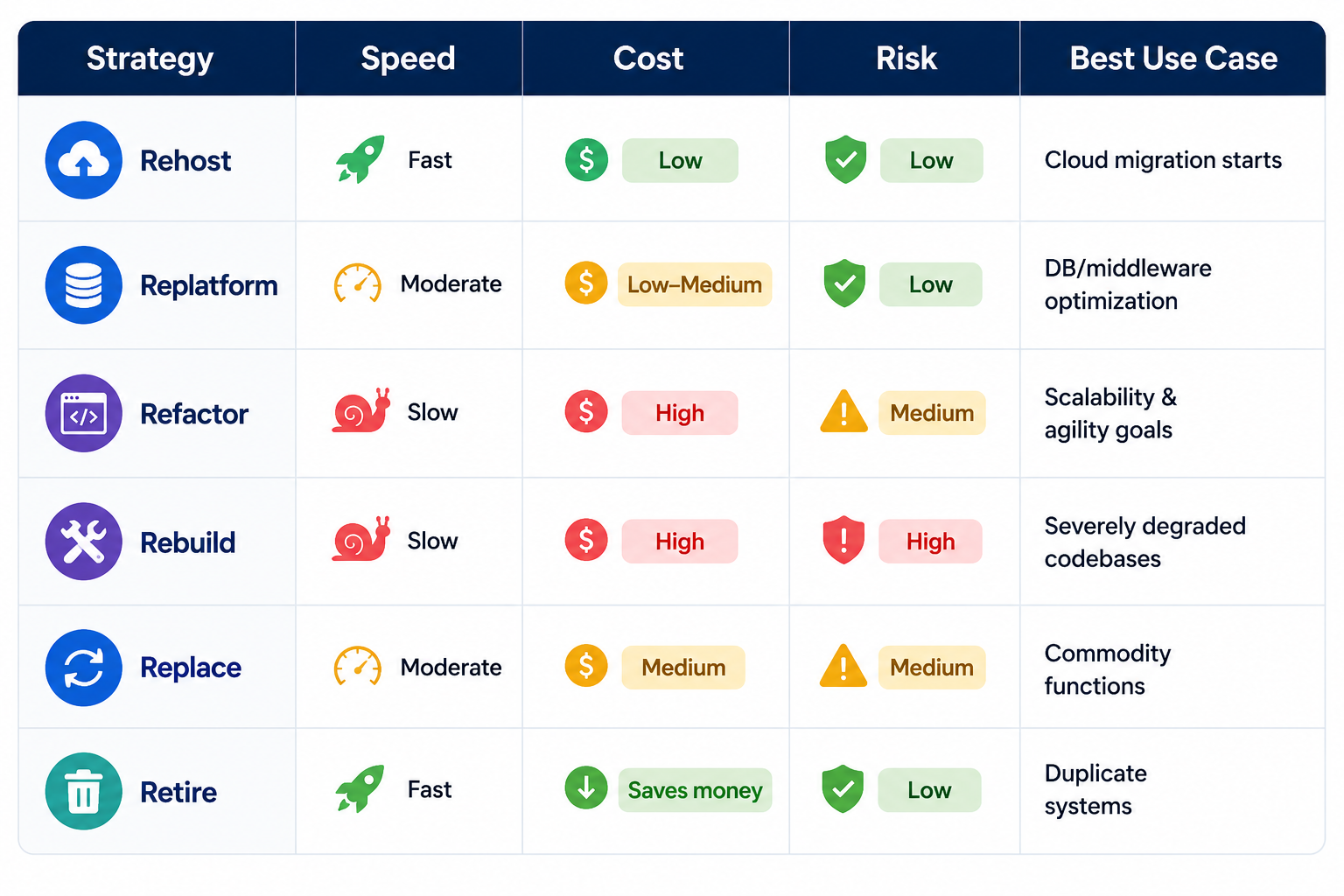
When planning application migration & modernization, most enterprises choose from a range of approaches, often called the "6 Rs." Understanding each is essential to building the right roadmap.
1. Rehost
Transfer the application as is to another environment, usually the cloud. With no code modifications needed, this approach is quick, safe, and ideal for businesses that are starting out in the cloud.
Best for: Applications that are working fine but using expensive on-premise resources.
2. Replatform
Do simple optimization tweaks while migrating, such as moving from an internally managed database to a cloud-based managed service, but do not alter the core infrastructure.
Best for: Groups looking for fast cloud successes with minimal improvements in performance.
3. Refactor / Re-architect
Profoundly refactor the software so as to make full use of its native cloud features. Usually entails decomposing the system into microservices or using containers (Docker/Kubernetes).
Best for:Applications requiring rapid scalability or modern DevOps practices.
4. Rebuild
Rewrite the application from scratch using modern technology, but preserve the same functional scope and business logic.
Best for: Systems where the codebase is so degraded that incremental fixes cost more than a clean rebuild of specific modules.
5. Replace (Repurchase)
Retire the legacy system and adopt a modern SaaS alternative (e.g., moving from a custom CRM to Salesforce).
Best for: Non-differentiating functions where a market-ready solution exists.
6. Retire
Decommission systems that are redundant or no longer needed.
Best for: Portfolio rationalisation and cost reduction initiatives.
Comparison: Modernization Approaches at a Glance
The Strangler Fig Pattern: Nature's Blueprint for Legacy Modernization
Perhaps the most beautiful and widely implemented solution for application migration/modernization is the Strangler Fig Pattern, where the application gradually strangles the existing one without shutting it down.
Here's how it works in enterprise software:
- Pick a small subset of features or modules from the legacy system
- Implement those same features/modules on the new architecture
- Shift some traffic from the legacy application to the new one
- Iterate until you completely replace the legacy system
This technique is particularly useful since the company continues earning money throughout the process, and the development team gains confidence with every step taken.
Example: In a case study, a large UK retail bank successfully modernized its core banking system, which was 30 years old. Instead of replacing the entire platform, the organization gradually moved services such as accounts, notifications, and payments one by one, with each service becoming a cloud-native microservice. As a consequence, infrastructure costs were reduced by 60%, and deployment frequency tripled.
Also Read: Why Legacy Systems are Slowing You Down and How to Modernize Them?
Key Benefits of Modernizing Without Rebuilding
Reduced Risk: Incremental changes mean smaller blast radius if something goes wrong
Business Continuity: Operations continue uninterrupted throughout the modernization process
Faster ROI: Value is delivered in phases rather than waiting years for a full rewrite
Lower Cost: Targeted modernization costs significantly less than full replacement
Talent Retention: Developers prefer working on modern stacks modernization helps attract and keep engineering talent
Regulatory Compliance: Modern systems are easier to update for new compliance requirements
Common Challenges (and How to Overcome Them)
Lack of Documentation: Legacy systems are often poorly documented. Solution: Invest in discovery workshops and automated code analysis tools (e.g., CAST, SonarQube) to map dependencies before touching anything.
Organizational Resistance: Teams are often attached to "the way we've always done it." Solution: Involve business stakeholders early, communicate the ROI clearly, and celebrate small wins publicly.
Data Migration Complexity: Moving data from legacy databases to modern stores is rarely straightforward. Solution: Use a dedicated data migration layer and run parallel systems during transition to validate data integrity continuously.
Hidden Dependencies: You only discover what's connected when you try to move something. Solution: Use dependency mapping tools and plan for a "discovery sprint" before committing to a migration timeline.
Best Practices for a Successful Modernization Program
- Begin with portfolio assessment, not everything is created equal. Assess based on business importance and technical difficulty.
- Establish an architectural "north star" before doing anything else, know your destination before embarking on the journey.
- Use a product mind-set, modernization is never done, it's something you continuously evolve.
- Design and build for observability right from the start, logging, monitoring, instrumentation are essential.
- Maintain parallel environments during crucial migration phases to avoid loss of data and downtime.
- Have a dedicated modernization capability, don't attempt modernization while trying to go faster on new features. Protect team bandwidth.
- Be metrics-driven, measure deployment frequency, MTTR, uptime, developer happiness, etc.
Conclusion
Legacy systems have not come to be an issue in a day’s time, and it will also take time before they can get migrated or modernized. However, with proper planning, gradual application migration and modernization can make it possible for companies to develop in their technology landscape in a manner that is fiscally prudent, operationally safe and strategic.
The winners of the race today are not those who went back to square one but those who were able to make well-informed decisions regarding what to do with certain technology. It is now clear that there is enough technology to help firms migrate or modernize; it’s just a question of taking the lead and following through.
Frequently Asked Questions (FAQs)
Q1: How long does a typical enterprise legacy modernization take?
It depends largely on the extent and methodology employed. Migration via re-host can be done in a matter of weeks; refactoring of a complex monolithic application can take 18-36 months. Within the span of 6-12 months of modernization, most organizations will begin to see positive effects.
Q2: Is it always better to modernize than replace a legacy system?
Not necessarily. The process will typically be quicker and less expensive for commodity services (such as payroll processing or email). Modernization makes sense only when the existing system includes unique business logic which would be difficult or expensive to replicate.
Q3: What's the difference between application migration and application modernization?
The term migration usually implies the transfer of applications to another platform without modifying their basic architecture. Modernization encompasses the alteration or engineering of applications. Most applications require both processes at once.
Q4: How do we handle data during legacy modernization?
The data migration process can be the most complicated one. Some best practices that need to be followed include using parallel systems, automating the process of data validation, and involving a separate team for handling data engineering tasks.
Q5: What is the Strangler Fig pattern and when should we use it?
The Strangler Fig technique entails replacing functionality in an older system by introducing new services bit-by-bit, without stopping the existing system. The Strangler Fig technique is most useful for companies that cannot afford to have their systems down during modernisation.
About the Creator
Enjoyed the story? Support the Creator.
Subscribe for free to receive all their stories in your feed.
Comments
There are no comments for this story
Be the first to respond and start the conversation.