
How Do You Know When Your Song Is Good Enough?
Letting Go of the Perfect Version of a Song

Recently, someone asked me a question that stayed with me longer than expected: “How do you know if your song is good enough?”
At first, it sounds simple. You either like it or you don’t. But the more I thought about it, the more I realized how complicated the answer actually is. In songwriting, at least in my experience, there’s no clear finish line where something suddenly becomes “good enough.” There’s only the process: vision, trial and error, emotion, and the persistence to keep shaping something until it feels honest.
The best way I can explain it is through one of my songs, “May I Have This Dance” by Thorne Empire.
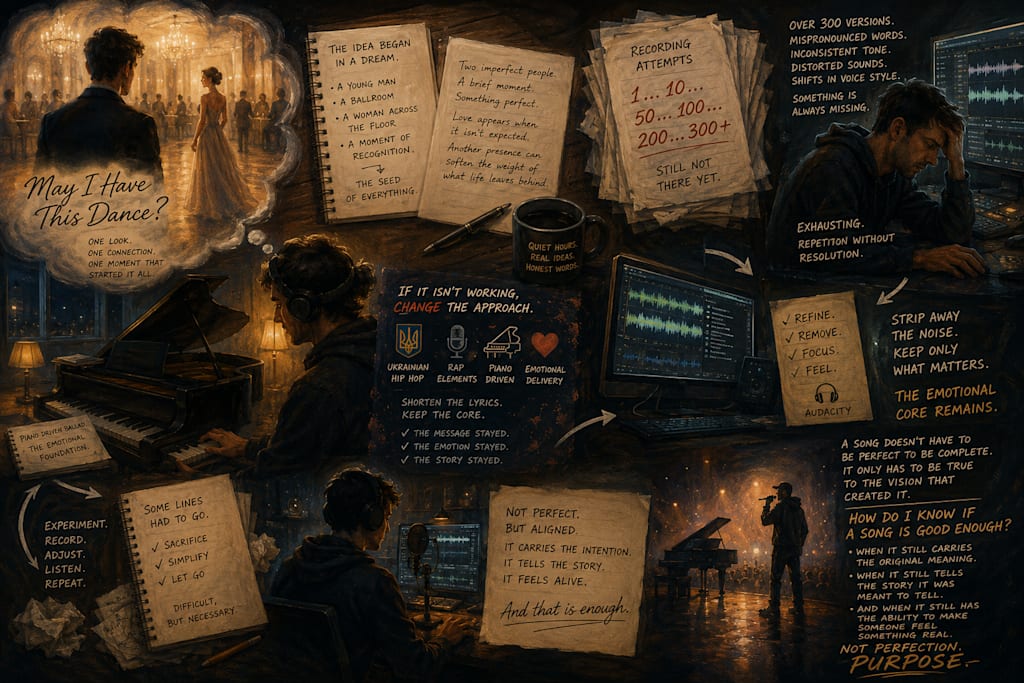
The idea began in a dream.
I still don’t know whether it came from something I had seen, something I had felt before, or something my mind simply constructed on its own. But it was vivid enough that it stayed with me. In that dream, a young man entered a ballroom and saw a woman standing across the floor. Nothing dramatic happened; no dialogue, no movement, just a moment of recognition. One look. One connection. That single image became the seed of everything.
From it came the line: “May I Have This Dance?”
Like many of my ideas, the writing didn’t happen in a clean, structured way. It came in the quiet hours of the night, when everything was still and there was nothing competing for attention. In that space, the idea expanded. I started imagining two imperfect people sharing a brief moment of something perfect. I thought about how love often appears when it isn’t expected, and how the presence of another person can sometimes soften the weight of everything life leaves behind.
The song became more than lyrics at that point. It turned into a story first, and a song second.
Once the writing was done, I used AI tools to help refine the structure, check inconsistencies, and explore improvements. That led into the recording phase, where the real challenge began.
From the start, I knew the song needed to be a piano driven ballad. That felt like the emotional foundation. I began experimenting with different arrangements and recorded several early versions, adjusting small details each time. After the first ten attempts, I chose the version that felt closest to the vision.
But that was only the beginning.
When I listened back more critically, I realized something important: what works in writing doesn’t always survive in sound. Certain lines needed to change. Some had to be removed entirely. So I revised the lyrics again and continued recording.
And continued.
And continued.
In total, I recorded over 300 versions of the song.
Still, none of them fully captured what I had imagined.
The AI tools I used introduced their own problems; mispronounced words, inconsistent vocal tone, distorted sounds at the ends of phrases, and even unexpected shifts in voice style that broke the emotional consistency. Almost each new version required listening from beginning to end, only to feel that something essential was still missing.
It became exhausting. Not because of one failure, but because of repetition without resolution.
That’s when I had to make a shift.
If the current approach isn’t working, something has to change.
I already knew what the song was supposed to feel like, so I stopped trying to force the same structure. Instead, I reimagined it as a blend of Ukrainian hip hop, rap elements, piano driven composition, and emotional vocal delivery. I also made a difficult decision: I shortened the lyrics.
That might sound minor, but for a creator, it can feel like letting go of something personal. Some lines had to be sacrificed. Some ideas had to be simplified. But I refused to change the core meaning.
The message stayed.
The emotion stayed.
The story stayed.
I went back into recording again. Even after the changes, the process wasn’t smooth. AI still made mistakes. But after nearly 200 more versions, something finally clicked. One version came close enough to what I had been trying to reach.
Not perfect, but aligned.
From there, I used Audacity to refine what automation couldn’t. I removed distracting layers, stripped away unnecessary instrumentation, and focused the sound until only the emotional core remained.
The result still wasn’t identical to what I originally heard in my head. It never could be at this moment in time. But it carried the intention. It told the story. It felt alive.
And that’s when I understood something important.
A song doesn’t have to be perfect to be complete. It only has to be true to the vision that created it. There will always be ways to improve a piece of art, always another version that could be better. But waiting for perfection can mean never finishing at all.
Maybe one day someone will reinterpret “May I Have This Dance” and make something even better. I think I would be okay with that. That’s how art evolves.
So how do I know if a song is good enough?
Not when every detail is flawless.
Not when every version is exhausted.
But when it still carries the original meaning.
When it still tells the story it was meant to tell.
And when it still has the ability to make someone feel something real.
For me, that’s the standard.
Not perfection.
Purpose.
About the Creator
Thorne Empire
I write the lyrics and let the AI carry the tune. Sometimes it’s magic, sometimes it misses the mark; but every word is a piece of me. Whether it hits or not, the fact that you listened, and felt anything at all; that means everything.
Enjoyed the story? Support the Creator.
Subscribe for free to receive all their stories in your feed.
Comments