
How Cable Reel E-RTGs Are Redefining Workshop Handling Efficiency
Smart Electric Mobility for Workshop Handling
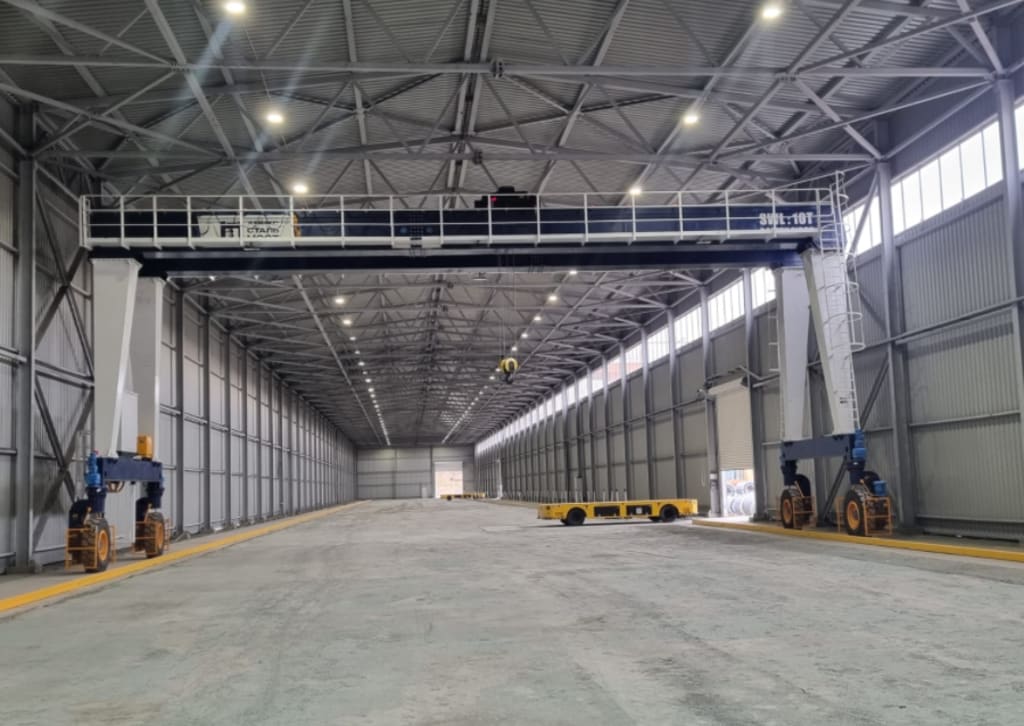
As industrial production becomes more complex and space within workshops grows increasingly valuable, manufacturers are under pressure to improve material handling efficiency while reducing energy consumption and operational costs. In this context, Cable Reel E-RTG (Electric Rubber Tyred Gantry) cranes are emerging as a transformative solution.
Unlike traditional diesel-powered RTGs or fixed overhead cranes, cable reel E-RTGs combine electric power supply with high mobility, enabling flexible, continuous, and highly efficient material handling inside large workshops, precast yards, steel fabrication facilities, and heavy industrial assembly plants.
This evolution is not just about electrification—it is about redefining how workshop logistics are structured, how materials flow, and how production space is utilized.
What Is a Cable Reel E-RTG?
A Cable Reel E-RTG is an electric RTG crane powered through a cable reel system that continuously supplies electricity from an external source. As the crane moves along its working lane, the cable is automatically wound and unwound through a controlled reel mechanism.
Unlike diesel RTGs that carry onboard generators, cable reel systems eliminate fuel dependency entirely, providing:
- Stable grid-based power supply
- Continuous operational capability
- Lower emissions
- Reduced mechanical complexity
This makes cable reel E-RTGs especially suitable for enclosed or semi-enclosed workshop environments where emissions, noise, and space utilization are critical concerns.
Why Workshops Are Moving Toward Cable Reel E-RTGs
Traditional workshop handling systems often rely on:
- Overhead bridge cranes (fixed coverage only)
- Forklifts (limited lifting capacity and precision)
- Diesel yard cranes (high emissions and maintenance costs)
However, modern workshops are changing. They are larger, more modular, and require flexible handling across multiple production zones.
Cable reel E-RTGs solve several long-standing challenges:
- They eliminate rail dependency
- They cover wide working areas
- They allow flexible repositioning of heavy components
- They support continuous high-duty cycles
- They reduce congestion caused by fixed crane paths
This combination makes them especially valuable in dynamic production environments.
Cable Reel Power System: The Core of Efficiency
At the heart of the system is the cable reel power supply mechanism.
How It Works
The system consists of:
- A ground-mounted power source
- A high-voltage flexible cable
- A motor-driven reel on the crane
- Automatic tension control
As the crane travels along its path:
- The cable reel releases power cable smoothly
- The crane maintains continuous electrical connection
- When reversing direction, the reel automatically retracts cable
- Tension sensors ensure controlled winding and prevent cable damage
This allows uninterrupted operation without manual intervention.
Why It Matters in Workshops
In workshop environments, uninterrupted workflow is critical. Cable reel systems provide:
- Stable energy for continuous lifting cycles
- No downtime for refueling
- Reduced energy fluctuations compared to hybrid systems
- Safer indoor operation compared to diesel alternatives
How Cable Reel E-RTGs Improve Workshop Layout Efficiency
One of the most significant advantages of cable reel E-RTGs is their ability to reshape workshop layout planning.
1. Eliminating Fixed Crane Constraints
Unlike overhead cranes that are restricted to fixed bridge spans, E-RTGs can move freely along defined lanes. This allows:
- Dynamic material staging areas
- Flexible production line arrangement
- Reconfigurable assembly zones
2. Maximizing Floor Space Utilization
Workshops often suffer from wasted space caused by fixed workshop gantry crane infrastructure. Cable reel E-RTGs reduce this limitation by:
- Removing overhead beam dependency
- Allowing open-floor layouts
- Supporting high-density storage zones
3. Improving Inter-Zone Material Flow
In large industrial workshops, components must move between fabrication, assembly, inspection, and storage areas.
E-RTGs enable:
- Direct point-to-point transport
- Reduced intermediate handling
- Fewer forklift transfers
- Faster production cycles
Enhanced Lifting Capability for Heavy Components
Cable reel E-RTGs are not limited to light industrial loads. They are engineered for heavy-duty workshop applications.
Typical Applications Include:
- Steel beams and structural frames
- Wind turbine components
- Precast concrete elements
- Heavy machinery parts
- Large welded assemblies
Depending on configuration, lifting capacities can range from tens to several hundred tons.
Stability in Heavy Loads
- The gantry structure provides:
- Even load distribution across wheels
- High torsional rigidity
- Reduced deformation under uneven loads
This is essential for workshops handling oversized or irregular components.
Precision Handling in Confined Workshop Environments
Workshops often require millimeter-level accuracy when positioning components for welding, assembly, or machining.
Cable reel E-RTGs support precision through:
Advanced Steering Systems
Modern units include:
- Crab steering for lateral movement
- 90-degree steering for tight positioning
- Carousel steering for compact rotation
- Diagonal movement for obstacle navigation
Intelligent Control Systems
Operators benefit from:
- Variable speed control
- Anti-sway technology
- Load positioning assistance
- Digital display feedback systems
This ensures that heavy components can be placed exactly where required without repeated adjustments.
Energy Efficiency and Sustainability Benefits
Cable reel E-RTGs significantly improve energy efficiency compared to diesel-based systems.
Key Advantages
- No fuel consumption
- Lower carbon emissions
- Reduced heat output in workshop environments
- Higher energy conversion efficiency via electric motors
In addition, regenerative braking systems can recover energy during lowering operations, further improving efficiency.
Impact on Indoor Air Quality
Because workshops are often enclosed or semi-enclosed, eliminating diesel exhaust has a major impact:
- Cleaner working environment
- Improved operator safety
- Reduced ventilation requirements
- Lower long-term facility costs
Maintenance Advantages Over Traditional Systems
Maintenance is a major cost factor in industrial lifting equipment.
Cable reel E-RTGs offer several advantages:
Reduced Engine Maintenance
No diesel engine means:
- No oil changes
- No fuel system maintenance
- No exhaust system repairs
Simplified Electrical Systems
Electric systems are:
- Easier to diagnose
- Less prone to mechanical failure
- More predictable in service intervals
Cable Management Reliability
Modern cable reel systems are designed with:
- Reinforced cable insulation
- Automatic tension control
- Wear-resistant winding mechanisms
This reduces cable damage risks even under frequent movement cycles.
Safety Improvements in Workshop Handling
Safety is a critical concern in industrial environments, especially when handling heavy components indoors.
Cable reel E-RTGs enhance safety through:
Zero Emission Operation
No diesel exhaust means safer indoor operation without toxic gas accumulation.
Load Monitoring Systems
Real-time monitoring includes:
- Overload protection
- Wind load (for semi-outdoor workshops)
- Structural stress detection
Anti-Collision Systems
Modern units often integrate:
- Proximity sensors
- Travel limit controls
- Emergency stop systems
These features reduce the risk of workplace accidents.
Comparison with Traditional Workshop Handling Methods
Forklifts
- Limited lifting capacity
- High labor intensity
- Inefficient for large components
Overhead Cranes
- Fixed coverage area
- Expensive installation
- Limited flexibility for changing layouts
Diesel RTGs
- High emissions
- Noise pollution
- Higher operating costs
Cable Reel E-RTGs
- High mobility
- Clean energy operation
- Large coverage area
- High lifting capacity
- Flexible deployment
This makes them a balanced solution for modern workshops seeking both efficiency and adaptability.
Industry Applications Driving Adoption
Cable reel E-RTGs are increasingly used in:
Steel Fabrication Plants
For transporting beams, plates, and assembled frames across production zones.
Precast Concrete Workshops
For moving heavy molds, beams, and finished structural elements.
Wind Energy Manufacturing
For handling nacelles, tower sections, and blade components.
Heavy Machinery Workshops
For assembling large industrial machines and subassemblies.
Shipbuilding Workshops
For modular hull section movement and assembly operations.
Future Trends in Workshop E-RTG Technology
The next generation of cable reel E-RTGs is expected to include:
- Fully automated navigation systems
- AI-based load optimization
- Smart factory integration
- Remote operation capabilities
- Digital twin monitoring systems
- Energy-efficient predictive control algorithms
These advancements will further improve productivity and reduce operational complexity.
Conclusion
Cable reel E-RTG cranes are redefining how modern workshops approach heavy material handling. By combining electric power supply, flexible mobility, and advanced control systems, they offer a powerful alternative to traditional lifting methods.
Their ability to improve space utilization, reduce emissions, enhance safety, and streamline production flow makes them a key technology in the evolution of industrial workshop design.
As manufacturing becomes more automated and space efficiency becomes increasingly critical, cable reel E-RTGs will continue to play a central role in shaping the future of high-efficiency workshop operations.
About the Creator
Aicrane01
Welcome to the Aicrane Blog, your practical guide to lifting solutions. Discover articles covering overhead cranes, gantry cranes, winches, steel structures, boat lifts, and more.
Website: https://steelmillcranes.com/
Enjoyed the story? Support the Creator.
Subscribe for free to receive all their stories in your feed.
Comments
There are no comments for this story
Be the first to respond and start the conversation.