
How Businesses Are Using Custom AI Software to Solve Real Operational Problems
How companies are using tailored AI solutions to automate workflows, improve efficiency, reduce operational bottlenecks, and build smarter business systems across industries.

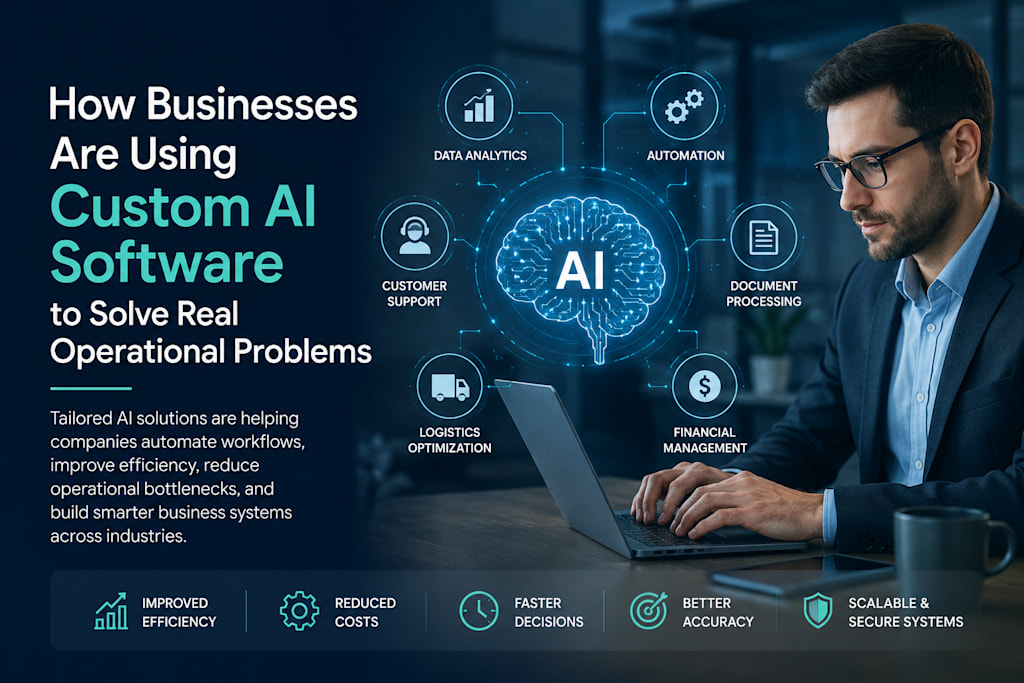
Artificial Intelligence is no longer just a conversation about the future. For many businesses, it has become a practical solution to operational challenges that have existed for years.
Across industries, companies are dealing with rising workloads, repetitive manual processes, disconnected systems, delayed reporting, and growing customer expectations. While most organizations already have access to large amounts of data, many still struggle to turn that information into efficient day-to-day operations.
That is where custom AI software is starting to create real impact.
Instead of relying entirely on generic AI tools, businesses are building tailored AI systems designed specifically around their workflows, operations, and decision-making processes. The goal is not simply automation. It is creating smarter operations that reduce inefficiencies and help teams work faster and more effectively.
Businesses Are Moving Beyond Generic AI Tools
Public AI platforms have made artificial intelligence more accessible than ever. Employees can now generate content, summarize information, or automate simple tasks in seconds.
However, operational business challenges are rarely simple.
A logistics company may need software that predicts delivery delays based on traffic patterns, weather conditions, and driver availability. A financial organization may require AI systems that analyze invoice risks and detect unusual payment behavior. A healthcare provider may need intelligent document processing systems capable of organizing patient records securely and accurately.
These are highly specific operational problems that generic tools are not always designed to solve.
Custom AI software allows businesses to build systems that fit directly into operations rather than forcing employees to adapt to limited software capabilities. This flexibility is one of the main reasons custom AI adoption is accelerating across industries.
AI Is Solving Everyday Operational Problems
One of the biggest misconceptions about AI is that it only exists for futuristic automation or content generation. In reality, businesses are using AI to improve very practical operational workflows.
Customer support is one of the clearest examples.
Support teams often deal with thousands of requests every week. AI-powered systems help businesses automatically classify tickets, identify urgent cases, analyze customer sentiment, and suggest responses to support agents. Instead of spending time on repetitive administrative work, teams can focus on solving more complex customer issues.
The logistics industry is also using AI to improve operational visibility.
Transportation and delivery businesses are adopting AI systems that optimize routes, predict delays, improve fuel efficiency, and monitor fleet activity in real time. These tools help reduce operational costs while improving delivery performance.
Financial operations are becoming increasingly automated through AI as well.
Businesses use AI software to process invoices, verify documents, identify anomalies, automate approvals, and improve forecasting accuracy. Tasks that previously required hours of manual work can now be completed much faster with fewer errors.
Healthcare organizations are also finding practical value in AI-driven workflows.
Medical providers manage massive amounts of documentation every day. AI tools help summarize patient records, organize healthcare data, automate scheduling, and reduce administrative pressure on staff members.
Human Resources teams are applying AI differently but with similar operational benefits.
AI systems assist with resume screening, candidate matching, onboarding workflows, interview scheduling, and employee engagement tracking. Rather than replacing HR professionals, these tools help reduce repetitive administrative tasks and improve hiring efficiency.
Retail and eCommerce companies use AI to improve forecasting and inventory planning.
Custom AI systems analyze buying patterns, seasonal demand shifts, customer behavior, and inventory movement to help businesses make smarter stocking decisions. This improves operational planning while reducing waste and overstocking.
In many situations, the purpose of AI is not replacing employees. It is helping employees operate more efficiently by removing repetitive operational bottlenecks.
Why Custom AI Software Performs Better for Many Businesses
Many organizations initially experiment with ready-made AI tools before realizing operational requirements are far more complex.
Custom AI software offers advantages that off-the-shelf platforms often cannot provide.
The first advantage is integration.
Businesses already rely on multiple systems such as CRMs, ERPs, accounting software, communication platforms, analytics dashboards, and operational databases. Custom AI systems connect directly with these tools and work within existing business infrastructure.
The second advantage is workflow customization.
Every business operates differently. Internal approval chains, reporting structures, compliance requirements, and operational processes vary significantly across industries. Custom AI allows companies to create systems designed around exact workflows instead of adapting operations to software limitations.
Security and compliance are also major factors.
Organizations handling sensitive customer, financial, or healthcare data often require stricter governance and data protection controls. Custom AI systems provide greater control over security policies, data management, and compliance requirements.
Scalability is another important reason companies choose custom solutions.
As businesses grow, operational complexity increases. Custom AI platforms evolve alongside organizational needs instead of becoming restrictive over time.
How Software Development Companies Are Supporting AI Adoption
Many organizations understand the potential of AI but struggle with implementation. Building operational AI systems often requires workflow analysis, software integration, cloud infrastructure planning, data engineering, and long-term scalability strategies.
This is where software development companies become important technology partners.
Companies like Bytexus help businesses build AI-powered systems designed around real operational requirements instead of generic automation use cases.
Bytexus focuses on custom software development, AI/ML solutions, cloud applications, workflow automation, enterprise integrations, and scalable business platforms. The company works across industries such as FinTech, logistics, healthcare, retail, and enterprise operations where businesses often manage large datasets, repetitive workflows, and operational inefficiencies.
Their approach focuses on:
AI-powered workflow automation
intelligent document processing
predictive analytics
enterprise AI integrations
cloud-native software architecture
scalable operational systems
As AI adoption continues to grow, businesses are realizing successful implementation depends less on trendy tools and more on building systems aligned with operational realities.
The Challenges Businesses Still Face With AI
Despite growing adoption, implementing AI successfully is not always straightforward.
Poor data quality remains one of the biggest challenges. AI systems depend heavily on accurate and organized data. If information is outdated, fragmented, or inconsistent across systems, performance suffers significantly.
Some businesses also begin AI projects without identifying a clear operational problem to solve. Companies that achieve the best results usually focus on specific inefficiencies rather than adopting AI simply because it is popular.
Employee adaptation can also become difficult.
Teams may hesitate to trust automation if they feel AI disrupts familiar workflows or threatens responsibilities. Businesses that implement AI successfully often position it as a support tool designed to improve employee productivity rather than replace people entirely.
Integration complexity is another common issue.
Older systems, disconnected databases, and legacy infrastructure can make deployment challenging. This is one reason many organizations partner with experienced software development teams when implementing operational AI solutions.
The Future of Operational AI
The next phase of AI adoption will likely focus on connected operational intelligence rather than isolated automation tools.
Businesses are increasingly investing in systems capable of monitoring workflows, predicting operational disruptions, recommending actions, and automating multi-step processes across departments.
AI copilots for employees are also becoming more common. Instead of manually searching through multiple systems, teams use AI assistants to access insights, generate reports, and identify operational patterns much faster.
Predictive decision-making will continue becoming more important as organizations seek systems that not only explain what happened, but also forecast what may happen next.
Over time, AI may become deeply embedded into business infrastructure in the same way cloud computing and digital platforms became standard operational tools.
Final Thoughts
The businesses seeing the greatest success with AI are not necessarily the ones chasing trends or experimenting with flashy tools.
They are the organizations identifying operational friction and building systems that solve real business problems.
Custom AI software helps companies reduce delays, improve visibility, automate repetitive workflows, and make faster operational decisions across industries. As operational demands continue growing, businesses will likely rely even more on intelligent systems designed specifically around processes and long-term goals.
AI adoption is no longer just about innovation. For many organizations, it is becoming an essential part of building more efficient and scalable operations for the future.
About the Creator
Vishwajeet Singh
A proven leader in digital transformation, Vishwajeet drives innovation, scalability, and business impact at Bytexus. His role focuses on strategic direction, enterprise-level execution, and building long-term value for global clients .
Enjoyed the story? Support the Creator.
Subscribe for free to receive all their stories in your feed.
Comments
There are no comments for this story
Be the first to respond and start the conversation.