
How Artificial Intelligence Is Transforming Due Diligence in M&A Transactions
The Evolution of M&A Due Diligence Through AI

Mergers and acquisitions (M&A) have long relied on extensive due diligence to assess financial, operational, legal, and reputational risk. Traditionally, this process has been manual, time-consuming, and resource-intensive. However, artificial intelligence (AI) is revolutionizing M&A due diligence by offering deeper insights, faster processing, and significantly enhanced risk detection capabilities.
The Strategic Role of AI in M&A Transactions
AI is no longer a futuristic concept—it's an essential tool in the modern dealmaker's toolkit. From identifying hidden liabilities to improving valuation accuracy, AI empowers acquirers with the intelligence to make smarter, faster decisions.
AI Supports Strategic Decision-Making by:
- Analyzing vast datasets in minutes rather than weeks
- Uncovering hidden risks in financials, contracts, and compliance documents
- Accelerating timeline-to-close through automated review
- Predicting post-deal synergies and integration risks
Key Use Cases of AI in M&A Due Diligence
1. Contract Analysis and Clause Extraction
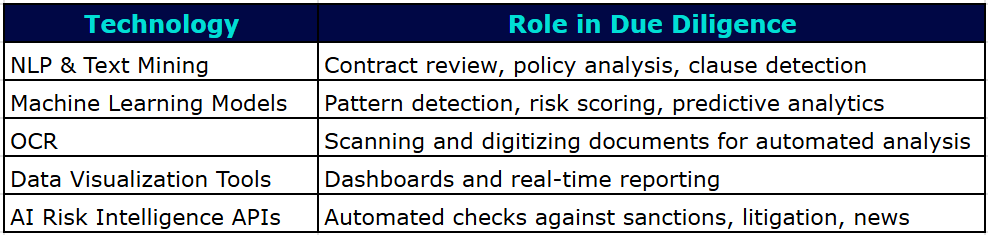
AI-enabled Natural Language Processing (NLP) rapidly scans and interprets thousands of legal documents. It pinpoints unusual clauses, change-of-control triggers, and liability risks across supply agreements, employment contracts, and more.
2. Financial Data Verification and Anomaly Detection
Machine Learning (ML) algorithms compare financial statements across periods and benchmarks. They automatically detect inconsistencies in revenue recognition, asset valuation, or expense categorization that may signal financial misrepresentation.
3. Cybersecurity and IT Due Diligence
AI tools evaluate target companies’ cybersecurity posture by reviewing system logs, threat detection histories, and policy documents. Red flags such as frequent breaches or outdated infrastructure are highlighted in real time.
4. ESG Risk Evaluation
AI scans news articles, regulatory filings, and social sentiment to assess the environmental, social, and governance (ESG) risks associated with a target company. It provides a reputational risk score that is increasingly important to investors.
5. People and Cultural Fit Assessment
AI can process internal communication data and employee feedback to analyze company culture, detect misalignment, and forecast potential integration friction post-acquisition.
Enhanced Speed and Efficiency
AI significantly reduces the time required for due diligence. Tasks that took teams of analysts several weeks can now be completed within days. This enables acquirers to:
- Move faster than competitors
- Respond quickly to deal opportunities
- Minimize disruption to business operations
Improved Risk Visibility and Compliance Assurance
AI ensures a comprehensive review that is both broader and deeper. Rather than sampling data, AI reviews all available data, ensuring:
- Full visibility into legal obligations
- Compliance with global regulations (e.g., GDPR, AML, FCPA)
- Real-time updates on changing compliance requirements
Integrating AI into the Deal Lifecycle
AI is most powerful when embedded throughout the M&A lifecycle—not just during due diligence. Leading firms are using AI for:
- Target screening and pre-deal intelligence
- Valuation benchmarking and modeling
- Post-deal integration planning
- Synergy realization tracking
Key Technologies Enabling AI-Driven Due Diligence
Challenges and Risk Mitigation
Despite its benefits, AI introduces new challenges:
- Bias in training data can skew risk assessments
- Overreliance on automation may overlook qualitative insights
- Cybersecurity vulnerabilities must be mitigated via robust controls
To address these, organizations must:
- Combine AI with expert human oversight
- Continuously validate AI outputs
- Apply ethical and transparent AI governance practices
- Self-updating models based on live data feeds
- Real-time acquisition alerts based on market activity
- Automated negotiation support driven by historical deal analysis
The Future: Autonomous Due Diligence
Looking ahead, AI will move toward greater autonomy:
AI is not replacing human judgment but augmenting it. The future M&A professional will be a strategist backed by intelligent systems, not just a data analyst.
Conclusion
AI is redefining due diligence in M&A. By enabling faster analysis, deeper insights, and real-time risk detection, it allows companies to move with agility and confidence. In a competitive M&A environment, adopting AI-powered due diligence is no longer optional—it's a strategic imperative. Organizations that embrace this transformation will lead the next era of smarter, data-driven dealmaking
About the Creator
Febi.AI
India’s first AI-powered bookkeeping – Automated tax compliances – Real time business insights with dedicated personal accountant. Features Including Transaction Management through AI, Automated File Management etc.
Website:- febi.ai
Enjoyed the story? Support the Creator.
Subscribe for free to receive all their stories in your feed.
Comments
There are no comments for this story
Be the first to respond and start the conversation.