
How AI Is Transforming Video Editing and Content Creation Workflows
AI Video Editing

Video production has changed considerably over the past few years. Creators once spent hours reviewing footage, arranging clips, adjusting timelines and preparing different versions of the same project. Today, artificial intelligence can assist with several of these tasks. However, the real improvement is not simply faster editing. It is the ability to connect planning, footage selection, editing and content adaptation into a more efficient production process. Tools supporting CapCut × Codex video creation demonstrate how natural-language instructions can help turn existing footage into an editable first cut. For creators and production teams, this introduces a more flexible way to approach everyday video work.
Why Traditional Video Production Needs a More Flexible Workflow
Traditional editing follows a sequence of manual decisions. Editors review source files, identify useful moments, arrange scenes, remove unnecessary footage and adjust the timeline. Each decision takes time, particularly when a project contains several hours of recordings.
The challenge becomes more noticeable when teams produce content for multiple platforms. A single campaign might require a full-length YouTube video, short vertical clips, promotional edits, and alternative versions for different audiences. Repeating the entire preparation process for every deliverable can consume valuable production time.
AI-assisted editing addresses some of this pressure. It can help organize footage, identify relevant sections, prepare captions and simplify repetitive editing tasks. Instead of treating every project as a completely manual exercise, creators can use automation to establish a workable starting point.
Nevertheless, automation should support the editor's decisions rather than dictate the final result. A faster workflow has little value if the finished video loses its message or visual consistency.
How Natural-Language Editing Is Changing the Process
One significant development is the growing use of natural-language instructions in creative software. Rather than relying exclusively on menus and timeline controls, creators can describe the outcome they want.
For example, an editor working with an interview recording might request a shorter sequence containing the strongest answers. Another creator might want several clips arranged chronologically, with unnecessary pauses removed.
This approach changes the initial editing process. The creator communicates the objective, while the connected AI workflow helps translate those instructions into editing actions.
CapCut × Codex follows this principle. Users can upload existing footage and describe the desired arrangement, pacing, format and target duration. The workflow can review the supplied clips, select useful moments, remove unwanted sections and prepare an editable rough cut in CapCut.
Importantly, the result remains editable. Creators can inspect the sequence, change clip positions, adjust timing and refine the creative direction before completing the project. <Cite refs={["turn412437search0"]}/>
This distinction matters. An editable first cut provides a foundation for further work without pretending that automated decisions will always match the editor's intentions.
Where AI Creates the Greatest Improvements in Video Editing
Not every editing task benefits equally from automation. The strongest applications are usually repetitive activities with clear objectives.
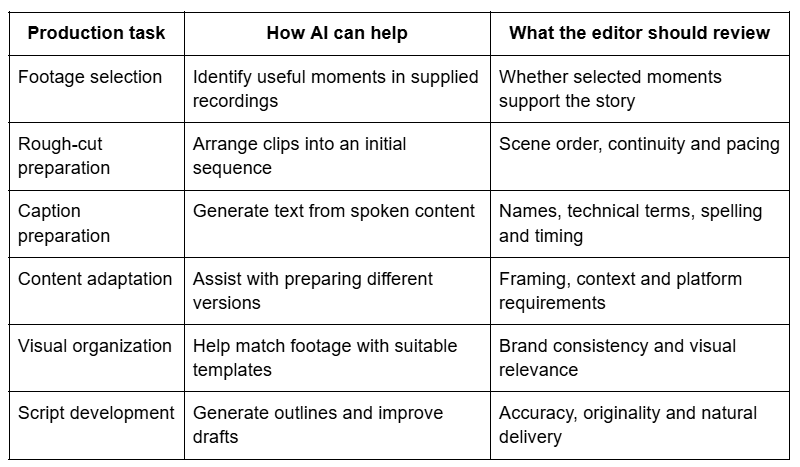
These applications can reduce repetitive preparation. However, each requires a different level of human supervision.
Caption generation, for instance, may work well with clear speech. Yet interviews containing technical terminology, unfamiliar names, or overlapping speakers need careful correction. Similarly, an automated rough cut may identify interesting moments without understanding their importance to the overall story.
The editor's role therefore shifts toward evaluation and refinement rather than disappearing altogether.
CapCut × Codex: Connecting AI Instructions With Practical Editing
CapCut × Codex offers an interesting example of how AI assistance can connect with an established editing environment.
The workflow starts with existing video material. Users provide their clips and explain the intended edit through natural-language instructions. The connected process can review the footage, identify useful sections, remove unnecessary parts and arrange selected clips into an editable rough cut.
Another useful aspect is template matching. Based on the supplied footage and editing direction, the workflow can help identify suitable options from CapCut's template library. Creators can then continue customizing the timeline instead of accepting an automatically selected style without review.
Consider a marketing team recording several product demonstrations. The team might have separate clips showing product features, customer interactions and close-up details. Rather than reviewing every recording manually before building the first sequence, the team can provide an editing brief describing the required structure.
The resulting draft gives the editor something concrete to evaluate. They can replace weak shots, improve transitions, adjust timing and ensure the finished video communicates the intended message.
CapCut × Codex is therefore best understood as an AI-assisted preparation and editing workflow, not a complete replacement for professional editing software. <Cite refs={["turn412437search0","turn412437search1"]}/>
The Advantages and Limitations of AI-Assisted Video Creation
AI editing offers practical benefits, but its effectiveness depends on the project, source material and quality of instructions.
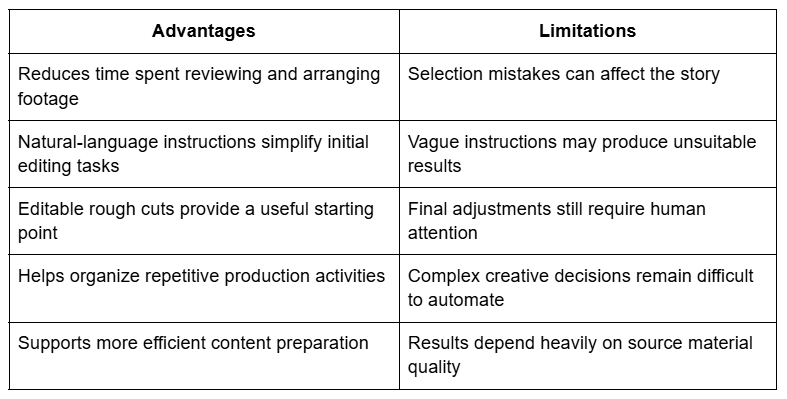
The most important advantage is not eliminating the editor's workload. It is reducing the time spent on repetitive preparation so professionals can concentrate on storytelling, accuracy and presentation.
The limitations also deserve attention. A tool may identify a visually interesting clip without recognizing its emotional significance. It may shorten a sequence while removing context that viewers need. These problems are not necessarily technical failures; they often reflect the difference between recognizing patterns and understanding creative intent.
Why the Quality of Instructions Matters
AI-assisted editing depends heavily on the information provided at the beginning. A vague request such as "make this video engaging" leaves too much room for interpretation.
A professional editing brief should communicate the purpose of the video, its intended audience, the desired duration and the relationship between individual scenes.
For example, an instruction for a product demonstration might specify:
Open with the product in use rather than a company introduction.
Prioritize clips demonstrating the main features.
Remove repeated explanations and unnecessary pauses.
Keep the sequence suitable for a two-minute promotional video.
Preserve footage that explains important product details.
This level of direction creates a clearer starting point. It also makes reviewing the first cut easier because the editor has defined criteria for evaluating the result.
For larger teams, maintaining reusable briefing templates can improve consistency. Different editors can follow the same structural requirements while retaining flexibility over individual creative decisions.
How AI Is Changing Content Production for Different Teams
The benefits of AI-assisted workflows extend beyond individual video creators.
Marketing departments can use them to organize campaign footage and prepare initial promotional edits. Educational teams can structure recorded lessons into shorter learning segments. Agencies can reduce repetitive preparation when handling multiple client projects.
Independent creators may benefit in a different way. They often manage research, scripting, recording, editing and publishing themselves. Reducing the time required for initial footage organization can leave more room for improving the actual content.
However, each application has different requirements. An educational video needs accuracy and clear explanations. A product advertisement needs brand consistency and persuasive presentation. Social media content often requires tighter pacing and platform-specific framing.
The technology may support all these workflows, but the creative brief must reflect the intended outcome.
What Professionals Should Consider Before Adopting AI Editing Tools
Choosing an AI editing workflow should involve more than comparing feature lists. Production teams should consider how the technology fits into their existing process.
First, examine the source material. Tools that work with supplied footage cannot compensate for missing recordings or poor-quality source files. Organizing assets before starting a project makes the process more manageable.
Second, evaluate editing control. A useful workflow should allow creators to inspect and modify the result. Locked outputs can create additional work when a client requests changes.
Third, consider privacy and usage rights. Teams should only upload footage they are authorized to process. Client recordings, confidential interviews and licensed media may have restrictions that affect how they can be used.
Finally, assess the complete production process rather than one isolated feature. Saving time during clip selection is helpful, but the real benefit should be measured across the entire project, including revisions and final delivery.
A More Practical Future for Video Creation
AI is changing video production by making certain stages more accessible and reducing repetitive manual work. Natural-language instructions, footage analysis, editable rough cuts and automated assistance are creating new possibilities for individual creators and professional teams.
CapCut × Codex represents this shift by connecting conversational editing instructions with CapCut's editing environment. It gives creators a way to move from existing footage toward an editable first cut while retaining control over the final result.
The strongest production workflows will not rely on automation alone. They will combine efficient technology with accurate research, thoughtful direction and experienced editorial judgment. That balance is what turns a collection of clips into a well-structured video that people actually want to watch.
About the Creator
Mohammad Akhtar
Mohammad Akhtar is an SEO and SEM Expert with over 10 years of experience in digital marketing and search engine optimization. A 2013 graduate of The Islamia University of Bahawalpur, he has worked with various IT companies.
Enjoyed the story? Support the Creator.
Subscribe for free to receive all their stories in your feed. You could also become a paid subscriber, letting them know you appreciate their work.
Comments
There are no comments for this story
Be the first to respond and start the conversation.