
How Agricultural Robots Are Transforming Modern Farming Practices
Agricultural Robots Trends
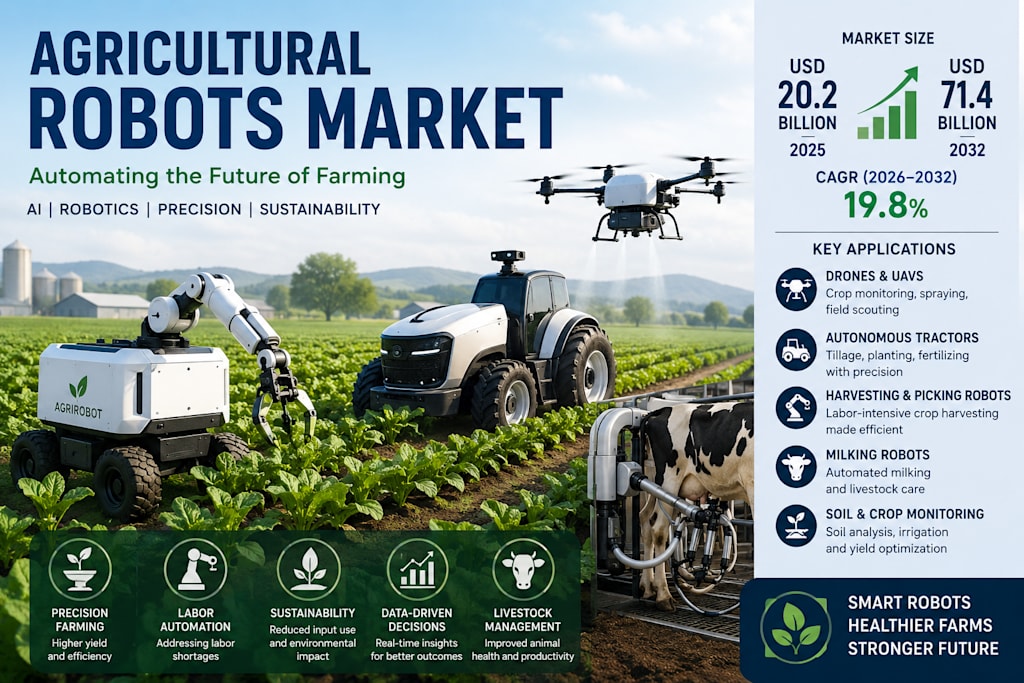
The agricultural robots market is undergoing a structural transformation as farming systems increasingly adopt automation, artificial intelligence, and precision-driven technologies to improve efficiency and reduce operational dependence on manual labor. Valued at USD 20.2 billion in 2025, the market is projected to reach USD 71.4 billion by 2032, advancing at a CAGR of 19.8% during 2026–2032. This expansion reflects the growing role of robotics in addressing labor shortages, improving crop productivity, and enabling data-led agricultural decision-making.
Agricultural robotics has moved beyond experimental deployment and is becoming a functional part of modern farm operations. From autonomous tractors and UAVs to robotic harvesting systems and precision spraying tools, these technologies are helping farms optimize resource use, improve yields, and reduce inefficiencies. With global food demand increasing and climate-related production pressures intensifying, automation is becoming an essential component of long-term agricultural sustainability.
Industry Transformation and Market Overview
Agriculture is shifting from labor-intensive operations toward digitally managed, technology-enabled ecosystems. AI integration, machine learning, IoT-connected sensors, and computer vision are redefining how crops are monitored, harvested, irrigated, and protected.
Modern robotic systems can identify diseased plants, estimate crop maturity, detect weeds, and optimize spraying accuracy. This transition is particularly important for large-scale farming environments where productivity and cost control are closely tied to precision agriculture. At the same time, robotic solutions are becoming increasingly relevant for livestock management, indoor farming, dairy automation, and soil analysis.
As farm labor costs continue to rise and productivity expectations increase, robotic adoption is becoming an operational investment rather than a discretionary upgrade.
Key Market Insights
• UAVs/Drones accounted for the largest market share of 40% in 2025, supported by widespread use in crop monitoring, soil mapping, precision spraying, and field surveillance.
• Harvesting and picking robots are projected to record the highest CAGR of 19.9%, driven by automation demand in specialty crop farming.
• Crop farming held the largest application share of 40%, supported by robotic deployment in tillage, planting, and AI-powered weeding systems.
• Hardware represented the dominant component category with 55% share, due to strong investment in robotic arms, sensors, drones, and autonomous machinery.
• North America led the global market with 40% share, supported by mature precision farming infrastructure and strong automation investments.
• Asia-Pacific is expected to witness the fastest expansion, driven by mechanization programs, digital agriculture adoption, and food production requirements.
Core Growth Drivers
AI Integration and Computer Vision Expanding Functional Capabilities
Artificial intelligence and computer vision are significantly improving the effectiveness of agricultural robots. Smart systems can now analyze crop health, detect nutrient deficiencies, identify weed species, and enable targeted intervention at plant level.
Precision spraying supported by AI reduces excessive pesticide usage while maintaining yield quality. These systems also improve field-level decision-making by integrating multispectral imaging, satellite data, and machine-learning models.
Agricultural Labor Shortages and Rising Wage Costs
Labor availability remains a major challenge for agricultural economies worldwide. Commercial farms, especially fruit and vegetable producers, rely heavily on seasonal workers and manual operations.
Robotic systems help reduce dependency on fluctuating labor availability while improving consistency in repetitive tasks such as harvesting, milking, and field monitoring. Rising wage costs are further strengthening the economic case for automation.
Food Security Pressures and Productivity Demands
Global food production requirements continue to rise. Population growth, climate uncertainty, and land-use constraints are forcing agricultural systems to improve productivity per acre.
Robotics helps farmers reduce waste, improve planting precision, monitor irrigation, and maximize operational efficiency—supporting long-term food security strategies.
Expansion of Digital Farming in Emerging Economies
Emerging economies such as India, China, Brazil, and parts of Southeast Asia are increasingly integrating digital agriculture practices. Government-backed financing programs, farm modernization initiatives, and lower-cost precision solutions are improving access to robotic systems.
Compact robotic platforms designed for fragmented farms are creating new opportunities beyond large commercial operations.
Market Challenges
High Capital Investment Requirements
Agricultural robots often involve substantial upfront costs. Autonomous tractors, robotic harvesting systems, and dairy automation platforms require significant capital expenditure, limiting adoption among small and medium-sized farms.
Rural Connectivity and Infrastructure Gaps
Cloud-connected farming systems depend on broadband coverage, GPS reliability, and digital infrastructure. In many rural regions, inconsistent connectivity reduces the effectiveness of AI-led automation tools.
Interoperability and System Integration Issues
Many farms use mixed-vendor equipment. Integration challenges between software platforms, sensors, and robotic fleets create operational complexity and may reduce overall efficiency.
Technical Skill Gaps
Robotic agriculture requires data interpretation, equipment maintenance, and digital workflow management. A shortage of technically trained agricultural workers may slow adoption in several developing markets.
Segmentation Analysis
By Type
The UAVs/drones segment dominates the market, supported by lower deployment cost, faster scalability, and broad application across monitoring, imaging, spraying, and mapping.
Meanwhile, harvesting and picking robots are emerging as the fastest-growing category, especially in fruit, vegetable, and vineyard applications where delicate crop handling is required.
Other key segments include:
• Driverless/Autonomous Tractors
• Milking Robots
• Harvesting & Picking Robots
• UAVs/Drones
• Others
By Application
Crop farming remains the largest application area, supported by automation in planting, tillage, spraying, and weed management.
The crop monitoring segment is expected to grow fastest, driven by multispectral imaging, remote sensing, and AI-based disease detection tools.
Other applications include:
• Dairy & Livestock Management
• Soil & Irrigation Management
• Crop Monitoring
• Crop Farming
• Others
By Component
The hardware segment holds the largest share, including robotic arms, LiDAR sensors, GPS systems, batteries, propulsion units, and autonomous equipment.
The software segment is expected to witness stronger expansion, as recurring revenue models such as farm intelligence platforms, AI subscriptions, and robotic fleet management gain traction.
By Farm Type
Outdoor farming dominates due to the large installed base of tractors, drones, and field robotics.
Indoor farming is expected to gain momentum with growth in controlled-environment agriculture, hydroponics, and vertical farming.
Regional Analysis
North America
North America leads the market because of large-scale commercial farms, mature mechanization infrastructure, and strong adoption of autonomous systems. The U.S. remains the primary revenue contributor.
Europe
Europe is expanding steadily with emphasis on sustainability, smart farming practices, and labor efficiency. Regulatory support for precision agriculture supports adoption.
Asia-Pacific
Asia-Pacific is projected to register the fastest growth. Urbanization, aging farm populations, and food demand pressures are increasing investment in automation across China, India, Japan, and Australia.
Latin America
Brazil and Mexico are witnessing stronger adoption in crop-focused automation, particularly in large agricultural production zones.
Middle East & Africa
The region is gradually integrating robotics in greenhouse farming, irrigation optimization, and climate-sensitive agricultural operations.
Competitive Landscape
The agricultural robots market remains fragmented and highly competitive, driven by diverse product categories and specialized applications. No single manufacturer dominates across all segments.
Competition is shaped by:
• AI-enabled automation platforms
• Precision farming software ecosystems
• Product innovation in harvesting and spraying systems
• Strategic partnerships
• Geographic expansion
• Integration of robotics with farm intelligence tools
Manufacturers are focusing on platform differentiation, efficiency, and cost optimization.
Key Players
Major companies shaping the agricultural robots industry include Deere & Company, AGCO Corporation, CNH Industrial N.V., DJI Technology Co., Ltd., GEA Group Aktiengesellschaft, Lely B.V., DeLaval Inc., Kubota Corporation, Trimble Inc., and CLAAS KGaA mbH.
These players compete through automation capabilities, digital farming ecosystems, regional distribution strength, AI integration, and specialized equipment innovation.
Recent Developments
Recent industry developments indicate stronger alignment between robotics and precision agriculture:
• AI-powered spraying systems are improving selective input application.
• Autonomous tractors are being optimized for driverless field operations.
• Smart dairy systems are improving livestock monitoring and productivity.
• Drone manufacturers are expanding payload capacity and precision imaging functions.
• Farm intelligence platforms are increasingly integrated with robotic ecosystems.
These developments are improving efficiency while broadening the practical use of robotics across commercial agriculture.
About the Creator
Enjoyed the story? Support the Creator.
Subscribe for free to receive all their stories in your feed.
Comments
There are no comments for this story
Be the first to respond and start the conversation.