
How a Simple System Became McDonald’s Real Advantage
In 1948, two brothers closed a successful drive-in and rebuilt the work behind the counter.
By Human Business Works
Behind their home in San Bernardino, California, Richard and Maurice McDonald marked out a restaurant kitchen on a tennis court with red chalk.
They were trying to see the work before rebuilding it.
The brothers drew the positions of grills, counters and workers, then moved through the imaginary kitchen as if orders were coming in. They changed the arrangement when people crossed paths or took unnecessary steps. According to Smithsonian, a rare rainstorm washed away their markings, so they returned and drew the layout again.
The exercise was unusual partly because the brothers already had a business that worked.
McDonald’s Bar-B-Q had opened in San Bernardino in 1940 as a conventional drive-in with a large menu and carhop service. Customers remained in their cars while employees carried orders out to them. By the late 1940s, the brothers were not trying to rescue an obviously failed restaurant. They were reconsidering a successful one. The Library of Congress describes the 1948 operation as successful when they decided to revamp it to become more competitive.
That decision meant giving up familiar parts of the business.
The brothers studied what customers were buying and reduced the menu. Smithsonian reports that they removed expensive, labor-intensive barbecue items and concentrated on the products that sold most often. They also removed the carhops. Customers would come to a window instead.
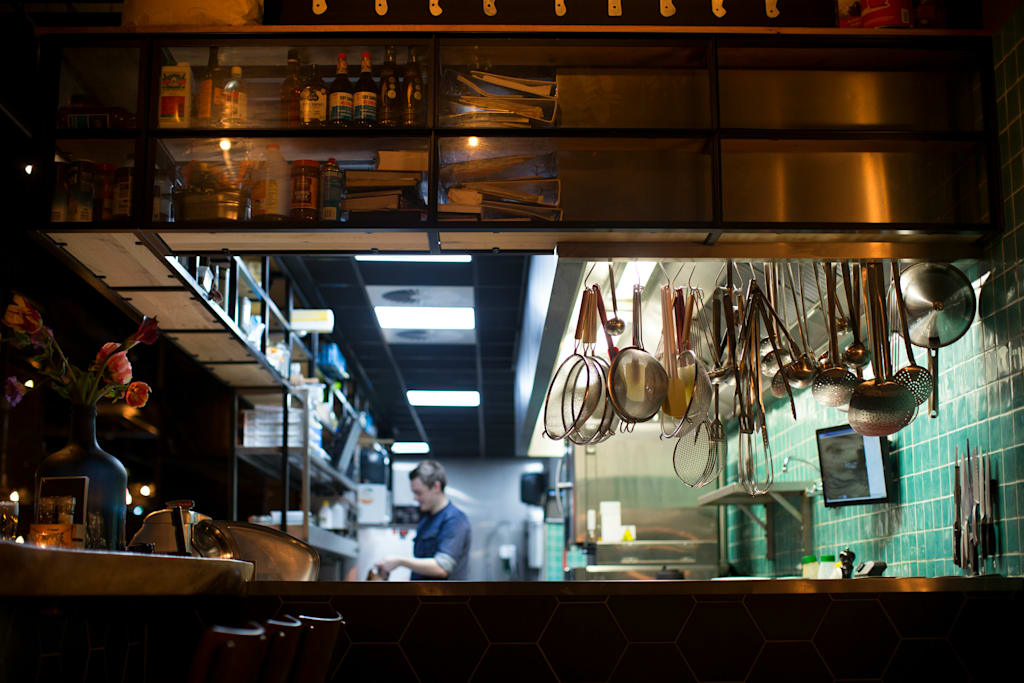
Inside, the kitchen was reorganized around a sequence of specific tasks intended to move food through quickly and consistently.
In 1948, McDonald’s shut down for three months while the restaurant was altered. When it reopened in December, the menu had been cut to nine items, with a 15-cent hamburger at its center. McDonald’s called the new approach the Speedee Service System.
The name emphasized speed, but the deeper change was order.
The restaurant no longer depended on every employee figuring out the best way to handle the next meal. Much of that thinking had already been done. The brothers had decided where the work should happen, which products would be sold, how customers would order and how the kitchen would move.
That simplicity came with a risk. Customers were accustomed to drive-in service, and the new restaurant asked them to behave differently.
Smithsonian recounts that some customers initially pulled into the parking lot and waited for carhops who never arrived. Some left. Others objected to the reduced choices. The brothers even had employees park their cars outside so the restaurant would not look empty.
The system that later seemed well suited to American fast food did not immediately look like progress from the parking lot.
Eventually, customers began to accept the trade.
The service was quick. The menu was easy to understand. The kitchen could concentrate on producing a small number of items repeatedly instead of supporting the broader operation of the old drive-in.
What had been removed from the restaurant created space for something else: predictability.
That became important six years later, when Ray Kroc arrived.
Kroc was selling Multimixer milkshake machines. In 1954, he visited the McDonald brothers’ restaurant after becoming interested in an operation that used several of the machines. McDonald’s corporate history says Kroc was fascinated by what he saw. He also learned that the brothers were looking for someone to help franchise the concept nationally.
The attraction was larger than one crowded counter in San Bernardino.
A good restaurant can be difficult to reproduce. A cook develops instincts. An owner notices problems before anyone else. Employees become accustomed to one another. Small decisions accumulate until much of the business lives inside the experience of the people running it.
The Speedee system had moved some of that knowledge out of people’s heads and into the design of the operation.
The menu could be repeated. The kitchen arrangement could be repeated. The sequence of work could be repeated. Standards could be explained to another operator in another restaurant.
That did not mean expansion was effortless. Early McDonald’s locations did not always operate with complete uniformity. As the organization grew, standardization became increasingly important.
The Historic American Buildings Survey, preserved by the Library of Congress, identifies McDonald’s standardization across its restaurants as a key factor in the company’s rapid success. The significance was consistency: customers could encounter the same basic product and operating approach at different locations rather than treating every restaurant as an independent experiment.
Training became part of protecting that consistency. McDonald’s official timeline records the opening of Hamburger University in 1961, where operators could be taught the company’s methods. Fred Turner, who had joined McDonald’s as a counter worker in 1956 and later became chairman, helped define operating standards around quality, service and cleanliness.
What started on the tennis court had changed form.
The brothers had originally been solving a local problem: how to make one restaurant move with less friction. But a process built for repetition had another property. It could travel.
The visible parts of a growing company tend to receive most of the attention. A new location can be photographed. A new product can be advertised. A logo can become familiar. The ordinary sequence of tasks inside the business receives less notice.
Yet the early McDonald’s turning point happened inside that sequence.
The brothers looked at a functioning operation and asked which movements, menu items and service conventions were actually necessary. They were willing to close the restaurant, redraw the kitchen and disappoint some customers before they knew whether the simpler model would be accepted.
They did not simplify because simplicity sounded elegant. They were trying to make the work function differently.
Years later, the system could support a much larger organization because another person did not have to invent McDonald’s again each time a restaurant opened. The Library of Congress notes that the model of standardization was subsequently emulated by franchises of many kinds.
That may be the quieter turning point in McDonald’s history.
The famous symbols came later. The scale came later. What came first was a restaurant floor drawn in chalk, erased by rain, and drawn again.
The lines themselves disappeared. The idea behind them proved much harder to wash away.
About the Creator
Enjoyed the story? Support the Creator.
Subscribe for free to receive all their stories in your feed.
Comments
There are no comments for this story
Be the first to respond and start the conversation.