
Hidden Costs of Full Stack AI Application: Where Your Budget Quietly Doubles
Explore the 7 layers of hidden costs full stack AI application with real figures and examples.
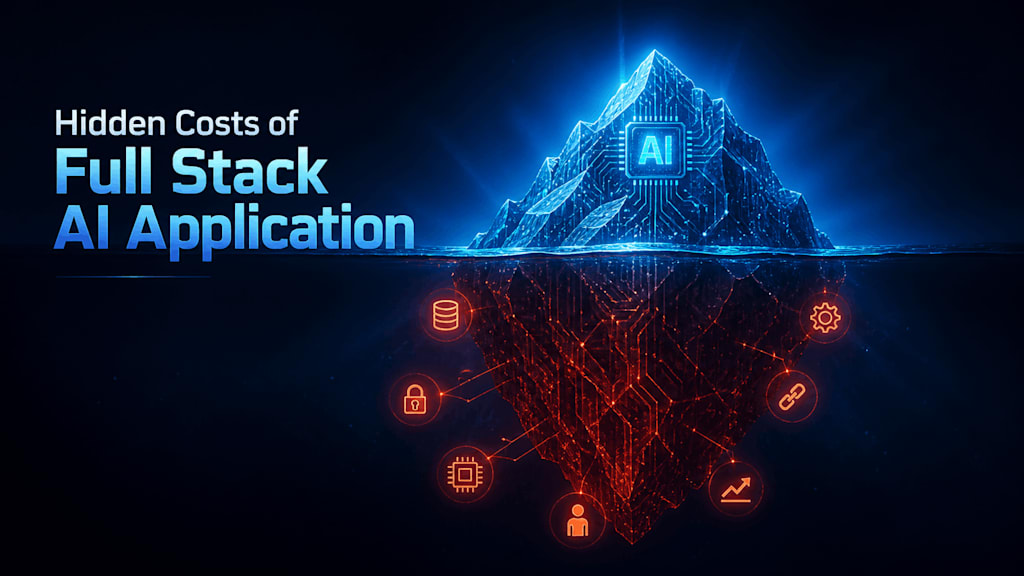
A recent MIT NANDA report found that 95% of enterprise generative AI pilots deliver zero measurable return on investment, despite collective enterprise spending of $30 to $40 billion in a single year. That stat is not an AI bubble warning. It is a budgeting story.
Here is the part most leadership decks miss. The model itself is rarely what blows up the budget. The hidden costs of full stack AI application work sit inside the layers nobody quotes upfront, things like data preparation, inference scaling, drift monitoring, integration overhead, compliance, and the ugly gap between a working pilot and a production system real customers can use. Recent industry analysis shows these layers add 30 to 60% on top of the original estimate, and another 30 to 60% in regulated sectors.
This piece breaks down the hidden costs of full stack AI application work, with 2025 and 2026 figures from MIT, Gartner, and CloudZero. By the end, you will have a 7-layer cost framework you can run any full stack AI proposal against before signing it off.
Why Full Stack AI Application Costs Don't Behave Like Software Budgets
Traditional software budgets are deceptively simple. You estimate engineering hours, factor in cloud and licensing, add a 20% buffer, and the number usually holds. Full stack AI doesn't follow the same physics.
A full stack AI application combines a model layer, a data pipeline, a vector or feature store, an orchestration engine, a user-facing UI, an MLOps and observability stack, and a governance layer for compliance. Each layer has its own cost curve, and most of them scale with usage rather than with code.
The 2025 report of AI Costs found that average monthly enterprise AI spending hit $85,521, a 36% jump from 2024, and the share of organizations spending over $100,000 per month more than doubled, jumping from 20% to 45% in a single year. The hidden costs of full stack AI application work are baked into how AI systems behave at scale, not into how vendors price them on day one.
The 7 Hidden Costs of Full Stack AI Application Work: Layer by Layer
These are the seven cost categories that show up in real production full stack AI builds and rarely make it into the original quote.
Layer 1: Data Preparation Take 30 to 60% of the Budget
Clean, structured, labeled training data is the rarest resource in any AI project. Industry research suggests roughly 96% of businesses begin AI projects without sufficient training data, requiring an unplanned investment of $10,000 to $90,000 just to make the data usable. On larger enterprise builds, data preparation can consume 30 to 60% of the total project budget, more than the model itself.
Layer 2: Inference Cost Scaling Behaves Non-Linearly
Inference is where AI economics diverges sharpest from traditional software. A feature costing $500 per month at 10,000 monthly requests can hit $50,000 per month at 1,000,000 requests using premium APIs. The hidden costs of full stack AI application growth often surface here first. A successful product feature drives traffic, traffic drives token consumption, and the AI vendor bill outpaces revenue for two quarters before the team rearchitects around fine-tuned open-source models.
Layer 3: MLOps, Drift Monitoring, and Retraining Cycles
Annual maintenance for an AI system runs 15 to 25% of the original build cost, and that figure climbs toward 50% in heavily regulated sectors. Drift monitoring, evaluation suites, retraining pipelines, and rollback infrastructure aren't optional add-ons. They are part of the stack that determines whether your model still works in month 14. Most early proposals quote zero MLOps cost. The hidden costs of full stack AI application maintenance are recurring, not one-time.
Layer 4: The Integration With Existing Systems
AI rarely lives alone. It connects to a CRM, an ERP, a data warehouse, a customer-facing app, an internal admin tool, and at least two legacy systems nobody wants to touch. The smartest companies plan for this upfront. They hire full stack developer who can own the AI model integration alongside the legacy systems it has to talk to, instead of bolting on contractors after the architecture is already locked.
Layer 5: Compliance and Governance Overhead
Healthcare, finance, government, and education AI builds carry a different cost structure. Regulated industry implementations add 25 to 40% to baseline build costs, and another 30 to 60% in ongoing overhead for HIPAA, GDPR, SOC 2, or FedRAMP compliance. Companies in the BFSI and healthcare verticals that try to retrofit governance after launch spend three to five times more than those that bake it in during architecture design.
Layer 6: Human-in-the-Loop Review Pipelines
High-stakes AI outputs need humans in the loop. Legal contract analysis, medical imaging summaries, financial trade recommendations, and customer-facing automated decisions all require review workflows. That means review tooling, reviewer salaries, training, and SLA management.
A customer support chatbot handling 1,000 conversations daily costs $500 to $1,500 monthly in API fees, but the human review pipeline behind it can run 5 to 10 times that figure. Most early proposals omit this entirely. The hidden costs of full stack AI application review workflows surface within the first 90 days of production traffic, and they don't go down.
Layer 7: The Pilot to Production Multiplier
The single most predictable cost surprise in AI is the gap between a working pilot and a production-ready system. Gartner found that moving from 90% to 99% model accuracy alone can multiply implementation effort by 3 to 5 times, and pilots typically cost only 15 to 25% of production cost while skipping 70% of the hard problems. This single multiplier accounts for more of the hidden costs of full stack AI application overruns than any other line item.
The Pilot Trap: Why 95% of Enterprise AI Investments Stall
MIT's 2025 GenAI Divide research put hard numbers on the hidden costs of full stack AI application failures that many engineering leaders had been feeling for two years. 95% of enterprise generative AI pilots fail to reach measurable P&L impact. The interesting part is not the failure rate. It is the why. Internal builds succeed about 33% of the time, while partnerships with specialized vendors hit 67%, twice the success rate. Same models. Same APIs. The difference is who absorbs the hidden cost layers.
Internal teams tend to underestimate every line item we just covered. Vendors who have shipped AI before price them in by default. The hidden costs of full stack AI application development aren't theoretical. They show up as 18 months of wasted runway, an executive sponsor who quietly stops mentioning the project in board updates, and an engineering team that learned a lot of expensive MLOps lessons the company won't get to apply.
How to Plan for the Hidden Costs of Full Stack AI Application Before Signing
Five disciplines separate businesses that absorb the hidden costs of full stack AI application work in advance from businesses that discover them too late. Each one is cheap to apply at the proposal stage and expensive to retrofit after launch.
- Apply a 30 to 50% buffer to every initial estimate.
- Treat data readiness as paid Phase 0.
- Model 3-year TCO, not just build cost.
- Run inference cost simulations against projected usage.
- Pick a partner that quotes for the system, not just the model.
Budget for the Stack, Not Just the Model
The hidden costs of full stack AI application development don't show up because they are tricky to find. They show up because most proposals don't ask the questions that surface them. Data preparation, inference scaling, MLOps, integration, compliance, human review, and the pilot to production gap, together they push real-world AI builds 30 to 60% past the headline estimate, and 60 to 100% past it in regulated sectors.
Companies that succeed in 2026 aren't the ones with the biggest AI budgets. They are the ones that audit AI proposals against the 7-layer framework before signing, and partner with full stack development services that quote for the system, not just the model. Run your next AI proposal against these seven layers. If even three are missing, the hidden costs of full stack AI application work will close the gap for you, on a timeline you don't get to choose.
About the Creator
Dhruvil Joshi
I'm a dynamic digital marketing executive with experience in the IT industry, I've developed a deep understanding of the unique challenges and opportunities that come with technologies.
Enjoyed the story? Support the Creator.
Subscribe for free to receive all their stories in your feed.
Comments
There are no comments for this story
Be the first to respond and start the conversation.